Early in the American Revolution, the Continental Congress exempted printers’ apprentices from military service and ordered those who’d enlisted to return to their presses. The founders “recognized that the press was no less valuable as a weapon of war than troops armed with muskets,” Alex Wright writes in Empire of Ink, his lively history of the ink-stained wretches who published American newspapers in the eighteenth and nineteenth centuries.
In contrast to the British, who’d radicalized the colonial press by trying to tax it through the Stamp Act, the budding American government subsidized newspapers through very low postal rates. Thanks to the printers’ practice of copying articles from other papers without permission, the American press grew into “a kind of proto-internet,” Wright argues.
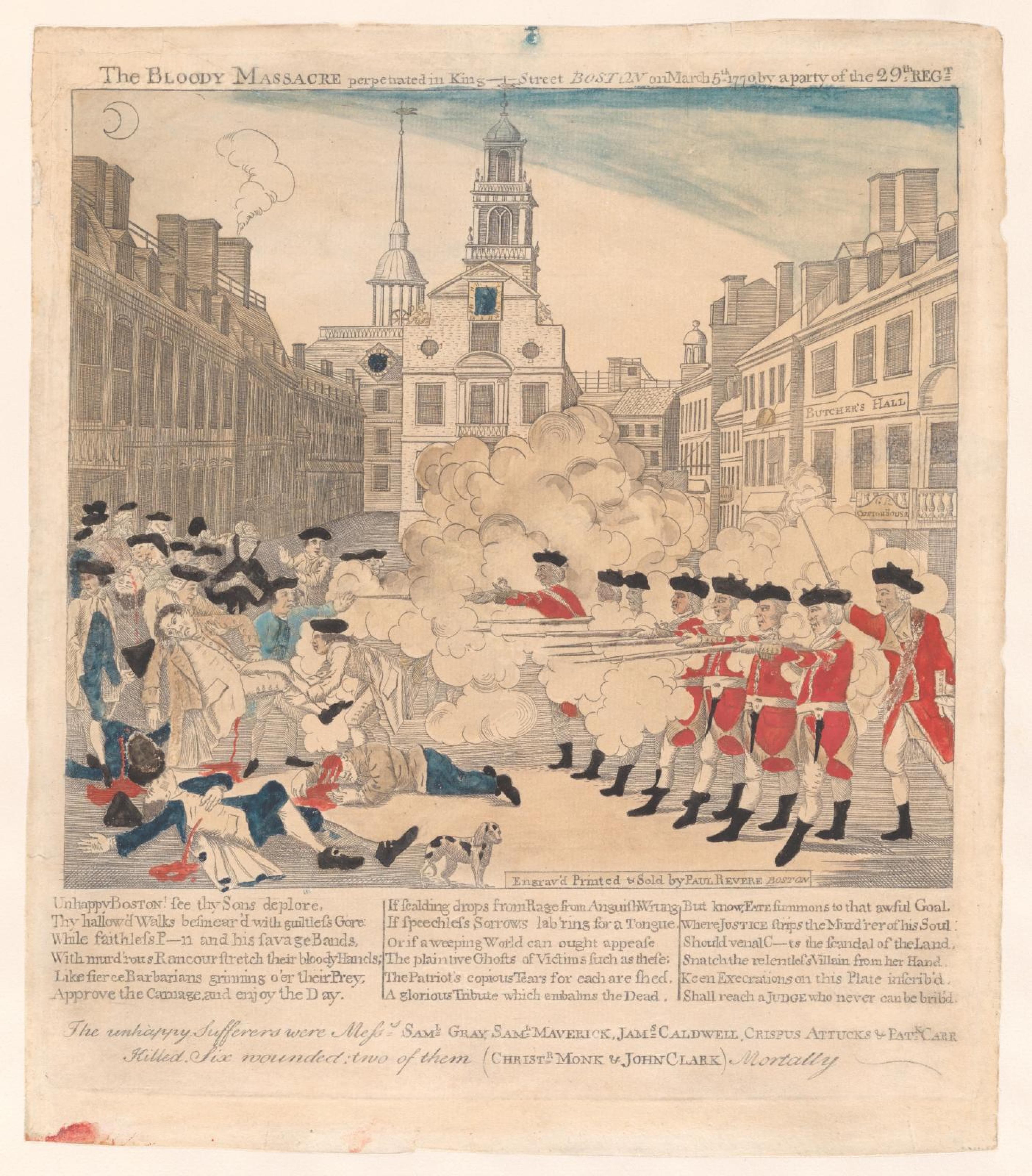
Publishers John Gill and Benjamin Edes provide an early example with their report in The Boston Gazette on the 1770 Boston Massacre, in which British troops fired into a crowd and killed five people, “a melancholy Demonstration of the destructive Consequences of quartering Troops among Citizens in a Time of Peace.” Their account of British butchery quickly appeared in twenty-seven other colonial newspapers.
All that cutting and pasting helped to unite the United States (and lower the publishers’ costs as well). America’s press flourished by the early nineteenth century, developing a freewheeling culture—the “rogues and radicals” of the book’s subtitle—that veered away from the European model in which government or booksellers sustained the newspapers. Wright’s account is a timely reminder of how a free press helped make America great.
Though there are many histories of the American press, Wright sees the need for a new one because the history of American journalism “is ripe for reinterpretation in the digital age.” He focuses on two areas that are somewhat overlooked: how changes in printing technology shaped the industry and the importance of “under-appreciated” small-town newspapers. He contends that historians have given their decentralized and rather chaotic media ecosystem too little attention while favoring big-city papers in New York, Chicago, and San Francisco.
The print-shop-based newspapers serving rural areas—where the vast majority of Americans lived at the time—drove political agendas in much the way today’s internet-based media do, Wright argues, asserting that today’s chaotic media scene echoes the nineteenth century’s press culture. He finds many parallels. In the nation’s early years, the federal government helped create an information network by subsidizing an expansive, low-cost postal system. In our own era, government developed the information highway we call the internet. The “tramp printers” of the nineteenth century, who traveled the country setting type and raising hell, are “the original gig workers.” Mark Twain, the most famous of tramp printers, became “the original influencer,” using multiple media platforms (newspapers, magazines, books, public speaking, and, late in life, audio) to achieve fame. The invention of portable presses spawned small-scale, amateur “citizen publishers” whose work presages “the bottom-up, user generated content coursing through social media channels.” The free, advertising-supported feature pages that became popular in rural newspapers were a precursor to websites that provide news for free to bring in advertising revenue.
Wright relates the stories of those small-town editors and printers with great charm. His book is rich with entertaining profiles and well-told anecdotes about topics that don’t get much attention outside academic studies. He tells of the Cherokee editor who used his newspaper in a valiant attempt to save his people from being marched out of Georgia. The camp newspapers that soldiers printed during the Civil War started the nation’s military press; troops under the command of General Ulysses S. Grant created Stars and Stripes in 1861. Another paper called The Black Warrior, published by an all-Black Union regiment, chronicled the Black soldiers’ interactions with white Southerners. Then there is a bloody story from Vicksburg, Mississippi: “Between 1837 and 1860, The Vicksburg Sentinel cycled through no fewer than eight editors—five of whom met with violent ends.” It was shockingly common for editors to collide with mob violence, duels, and beatings, especially in the South.
Wright doesn’t romanticize the violence, but overall, he leaves a sense of nostalgia for country editors. “If we can recover the spirit of the old able editors—with their scissors, paste pots, and clipping files—perhaps we can build something even more resilient and adaptable,” he writes.
This was more or less where he lost me. Those country editors of the nineteenth century are fun to read about, but they shouldn’t be regarded as a foundation for solving today’s crisis in local news coverage. They were highly partisan and did little original reporting. Most of what they published was taken verbatim from other papers, often those located in big cities.
Wright imagines a future in which “the modern AI-enabled newsroom may come to resemble a digital pastepot,” under the guidance of the “hybrid editor: part human, part machine, assembling and shaping the public sphere from the infinite scroll of digital content.” Wright knows whereof he speaks. He’s done high-level design work for Google News, which included developing AI tools for local news publishers, and for the New York Times Co., Instagram, and Etsy.
But if there is to be this “infinite scroll” of “content,” someone has to venture forth to find out what is actually happening—that’s called reporting. On-the-scene reporting costs a lot of money, and the business problem is that local news doesn’t generate as many online clicks as national news because it’s, by definition, aimed at a limited geographic area. That’s why The New York Times and The Washington Post have slashed their local coverage; national news can get more clicks, and thus more advertising revenue.
Our journalistic ancestors also had methods of building circulation. The Nevada newspaper where former printer’s apprentice Sam Clemens honed his writing skills—and developed his pen name Mark Twain—thrived on bogus stories. The editor of the Territorial Enterprise of Virginia City, Joe Goodman, hired Clemens in 1862. Thanks to the discovery of the Comstock Lode, the town was booming with silver miners and the, let’s say, hospitality industry that served them.
It sounds like a place with plenty of real news to report, but Twain made his mark by writing hoax stories that readers took as real. His popular but fictitious pieces on a purported massacre, a landslide, and the discovery of a petrified man were reprinted widely. “Twain justified taking these editorial liberties because ‘the public needed matters of thrilling interest for breakfast’—in other words, they were the 1860s equivalent of present-day clickbait,” Wright writes.
Empire of Ink is a fun and informative read, but it doesn’t offer a future to go back to. Rather, it suggests a need for further efforts—through such methods as nonprofit funding or tax incentives—to build news organizations that are large and sophisticated enough to do serious reporting rooted in the tradition of public-service journalism.
Empire of Ink
The Printers, Rogues, and Radicals Who Invented the American Newspaper
Alex Wright
Basic Books
$34 | 384 pp.
We welcome your comments about this article. Please send your response to [email protected].