Interested in discussing this article in your classroom, parish, reading group, or Commonweal Local Community? Click here for a free discussion guide.
On April 20, the right-wing commentator and early MAGA champion Tucker Carlson made a shocking admission on his podcast: he confessed he felt “tormented” for “misleading people” into supporting Donald Trump. His disenchantment with Trump began with the president’s decision to join Israel in attacking Iran.
Carlson’s disavowal was the latest in a string of high-profile Christian thought leaders—many of them Catholic—who once played key roles in legitimating MAGA but are now backpedaling from their alliance with Trumpism. Among the more prominent Catholics are the journalists Sohrab Ahmari and Matthew Walther, who both signed a 2019 Trumpist manifesto in First Things promising not only to support the new nationalism but to “jealously” guard the right’s future under the sign of Trump. In the runup to the 2024 election, Ahmari doubled down in a piece coauthored with Matthew Schmitz titled “He’s Still the One.” Their endorsement recounted Trump’s miraculous political feats, from defying “the deep state” to reversing the “disastrous foreign policy championed by the conservative movement.”
Less than four years later, the disillusionment of Ahmari—who helped popularize the Catholic postliberal movement with professors Adrian Vermeule and Patrick Deneen—is nearly total. In a piece titled “Against the Mad King” he recants his former enthusiasm for Trump, now alleging that the president has lost his sanity and concocted incoherent policies out of “absurdity” and “bullshit.” In the wake of Trump’s verbal attack on the pope, Matthew Walther ran even further away, posing the question: “Is Donald Trump antichrist?”
Like many of Trump’s newfound critics, Ahmari and Walther have spent more time accusing the president of derangement or possession than reflecting on why they and millions of Catholics felt so drawn to the New Right in the first place. To his credit, unlike his peers—though perhaps with some performative pathos—Carlson at least spent a few moments in self-reflection. “You and I and everyone else who supported him,” he explained to his audience, “we’re implicated…. It’s not enough to say, ‘Well, I changed my mind’—or like ‘Oh, this is bad—I’m out.’”
The question is not whether tying Catholic postliberalism to Trump’s authoritarianism was wise. It has been an absolute disaster morally and politically. Instead, a more profound reflection is in order. Why did some Catholics clearly perceive the dangers of Trumpism from the beginning, while many others did not? And why have many who no doubt hesitated at various moments of violence, crudity, and cruelty never find the courage to speak out? What are the deeper sources of the spell that MAGA has cast—and continues to hold—over so many American Catholics, including many Catholic intellectuals? Why does it take war, madness, or the eschaton for them to begin turning away?
No one embraces Trumpism because they think it offers a particularly wise and coherent set of policies. Catholic bishops, institutes, journals, and influencers have learned to quietly accept the excesses of the MAGA movement because they detect in it a sympathetic tone, a recognizable and consoling mood and posture. Trump may attack democracy, harm the global poor, and steal from the Treasury, but at least he is antiwoke.
As MAGA’s alliances rise and fall, as its crises come and go, what endures unchanged is its underlying emotional tone: resentment. This is what gives it coherence and invests it with bewitching, magnetic force. That familiar affect is what allows so many Catholics to find in Trumpism a kindred spirit and to give it at least tacit support. And sadly, this is what so many Catholic students and new converts have started to confuse with Catholic fidelity itself. If the deeper emotional sources of Christian nationalism are not addressed, the same bad wine will find new casks in the future. Its leaders might change, its tactics might shift, but the underlying animus will persist.
What attracted Catholic intellectuals to a mass movement manifestly incompatible with the Gospel and Church teaching is, fundamentally, a politics of resentment. To move beyond Catholic Trumpism, we have to understand these deep affective roots. A hasty disavowal may be an appealing strategy for those who have backed a failing cause, but it sheds no light on the past and offers no hope for the future.
Ideology taps into the deepest recesses of the human psyche, shaping emotions, articulating half-felt desires, conjuring forth both dreams and nightmares. Trumpism as a new ideological mutation on the right is no different. But it has its own distinctive emotional palette. The sociologist Arlie Russell Hochschild has chronicled what she calls the “anger and mourning on the American Right,” generated by a sense of alienation and loss of one’s own country at the hands of liberal elites. On the eve of July 4, 2025, Trump said of members of the Democratic Party: “I hate them. I really do. I hate them.” To share in Christian nationalism means sharing the right passions and hating the right people—fearing and loathing the “enemy from within” who, according to Trump, are “more dangerous than China, Russia, and all those countries.”
Despite the chaos of his first term, Trump kept sending the same signal, and the Catholic right picked up the emotional frequency through the noise, feeling it at a level they could not fully explain. Many American Christians tuned in and left the dial set even as the cruelty, crudity, and waste piled up. Indeed, as that affective signal continued pulsing, blinking red for ten years, their collective emotions were only reinforced, strengthened, and ritualized. The political theorist Elisabeth Anker diagnoses how such melodramatic “orgies of feeling” are performed not merely in aesthetic genres of theater or film but also in the media of political events and rallies. Soon the siren song of resentment grew so loud that it drowned out the suffering of brown and Black Christians targeted by Trump’s own administration. Many white Christians simply could not hear their cries over the hum.
Vice President J. D. Vance, a Catholic convert, at first resisted the style of Trump, whom he described in 2016 as “America’s Hitler.” So did many other Catholic conservatives. But too many on the Catholic right proved unable to resist the allure of Trump’s “orgies of feeling.” Over time, what cast the spell was not a preference for policy or party but an instinctive emotional resonance, a hunger for condemnation that had built up among many Catholics over long years of political disappointment. Vance, too, finally succumbed to this hunger. Like so many millions, he learned to speak the glibly violent language of Trump, vilifying his opponents as “a bunch of childless cat ladies who are miserable at their own lives…so they want to make the rest of the country miserable, too.”
That furious appetite for some kind of restoration, even if it required moral compromise or political violence, was the product of a long series of very real losses. Since the 1980s, Catholic conservatives allied themselves with Evangelicals and Jewish conservatives, building an impressive electoral coalition. On the Catholic right, the 1993 World Youth Day in Denver is still remembered as an inflection point in the culture wars. A new generation of young Catholics hoped to see what one fellow traveler imagined as a new “springtime of the Church” with a “rising tide of orthodox, vigorous young Catholics, to sweep away whatever stagnant pools remained of the aging liberal heterodoxy.” Many conservative Catholics hoped that the stable “moral majority” rechristening American public life would be accompanied by a flowering of Catholicism that might even supplant a long-dominant Protestant culture.
But as the Reaganite moral-majority coalition began to wane in the 2000s, disappointment and anger set in. In the U.S. Catholic Church, this coincided with terrible revelations of clergy sexual abuse. The Church had not convinced the majority of its morals after all. After a few modest victories, greater defeats kept rolling in, larger and seemingly more permanent every year—on health-care regulations, on gay marriage and feminism, and in the pervasive sexualization of popular and commercial culture.
By the time of Trump’s first election, many on the right were ready to condemn the system that had failed to deliver their goals. The Straussian bureaucrat Michael Anton, publishing under the pseudonym Publius in the Claremont Review of Books, captured the right’s mood when he declared the 2016 election to be the “Flight 93 election.” Conservatives, he argued, must either “charge the cockpit or…die”—a reference to the 9/11 United Airlines flight hijacked by terrorists but forced to crash when passengers seized the controls. “The republic is dying,” Anton announced. Liberals across the West had become “a party, a society, a country, a people, a civilization that wants to die.”
In less than a generation, high hopes of a political spring had fallen into the darkest fears that the nation was bent on spiritual mass suicide. Before this could occur, better to rush the cockpit and seize the controls from the elites. It was time to suspend the conventional legal order and start plotting revenge.
American Catholics who are beginning to question Trumpism might ask themselves why resentment became the dominant emotional response to loss, and how on earth that affective tone became a proxy for a Christian faith devoted to forgiveness and mercy, not to mention loving the enemy. Coming to terms with the affective capture of American Christianity, held hostage for more than a decade in a prison of resentment, will require some difficult emotional labor. Catholics who fell for Trumpism will have to learn to mourn the disappointments of long-lost dreams of cultural hegemony with patience, honesty, and prayer.
This will demand some careful thinking. Ironically, Friedrich Nietzsche, the nineteenth century’s fiercest critic of Christianity, offers an important diagnosis, not final but tremendously illuminating. For Nietzsche, Christianity and all the Abrahamic religions are primarily motivated by a hidden, half-conscious desire that he famously described in On The Genealogy of Morals (1887) as ressentiment. In Nietzsche’s use of the term, ressentiment is not simply a feeling of bitterness or a grudge against someone. It is a fundamental experience of weakness by religious people unable to exercise their will and struggling to affirm their own worth in a culture that ignores or rejects them entirely.
Nietzsche believed that this resentment begins not from a healthy self-affirmation, but from reacting to a stronger group by trying to pull it down. In the ancient world, the stronger groups that Jews and early Christians had to pull down were the ancient Greeks and Romans, peoples accustomed to viewing their cultures as divine. In Nietzsche’s telling, after a long experience of shame and defeat, Jews and Christians together struck upon an ingenious means of attacking the ancient aristocracy: they took revenge by using moral values to tear down the strong as “sinners.” When Jesus preaches “Blessed are the meek,” Nietzsche hears a resentful plot to invert the value scale of the ancient world and demean the powerful as wretched evildoers.
Indeed, according to Nietzsche, sin, the soul, and Christian moral law are all expressions of revenge against not just Homer and Virgil but anyone, from then to now, who dares to affirm their own will or claim their superiority without asking permission from God. Christianity, he thought, is not primarily animated by mercy, compassion, or charity—those are just masks worn to hide a desire for power. Nietzsche saw Christianity as the most successful deception in human history, one that had forced the healthy to swallow the bitter medicine of passivity and weakness. In the conclusion to his final book, The Antichrist, Nietzsche makes this point unmistakably clear: “I call Christianity the one great curse, the one great innermost corruption, the one great instinct of revenge, for which no means is poisonous, stealthy, subterranean, or small enough.”
The power of Nietzsche’s critique is precisely that it does not concern itself with abstract theological debates but goes straight to the heart of Christian emotional life. Indeed, if no faith free of resentment is possible, then Nietzsche’s critique would be difficult to refute. The great Catholic philosopher Charles Taylor succinctly framed the situation: “No one can fail to recognize that, if true, Nietzsche’s genealogies are devastating.” Perhaps for this reason, Nietzsche has always had serious readers in the highest ranks of Catholic thinkers, including Romano Guardini, Henri de Lubac, and Alasdair MacIntyre. Popes John Paul II and Benedict XVI studied Nietzsche’s works with great interest.
Early and influential among these Catholic readers was the convert and philosopher Max Scheler, whose short book Ressentiment first appeared in 1912. A few decades later, the young Karol Wojtyła would choose Scheler as the subject of his philosophy dissertation. Scheler offers a clear-eyed analysis of Nietzsche’s resentment theory. His insights can help us sort out the disorienting paradox of our contemporary moment. On the one hand, Trumpism exudes resentment, and the Catholic right is attracted to that tone. Naturally, Nietzsche would be unsurprised, because he thinks Christianity is, at its core, nothing more than pure resentment. At the same time, Trumpism embraces the will-to-power of a vulgar Nietzscheanism that seems to leave all morality behind. This bowdlerized Nietzsche is circulated around the MAGA-sphere by influencers like Costin Alamariu (writing under the pseudonym “Bronze Age Pervert”) but also voiced by Trump advisor Stephen Miller, who recently proclaimed: “We live in a world, in the real world, that is governed by strength, that is governed by force, that is governed by power.”
Scheler defines ressentiment in many ways: “A pronounced awareness of impotence,” “the impulse to detract, spite, Schadenfreude,” a “great pride coupled with inadequate social position,” or “the feeling of ‘being right’…intensified into the idea of a ‘duty.’” It is a “thirst for revenge,” a “spiritual venom,” “a self-poisoning of the mind.” Resentment appears as “an urge to scold, to depreciate, to belittle whatever he can.” The man of resentment feels “injury experienced as a destiny.” For those familiar with MAGA’s extravagant claims of victimhood and its eagerness to take offense, Scheler’s diagnosis hits the mark. Indeed, it is hard to imagine how Trumpism could last another day without this perpetual indulgence in resentful injury.
When it comes to Christian faith, Scheler explains, two kinds of personality tend to succumb to ressentiment: the “romantic” and the “apostate.” The romantic and the apostate are best understood not as portraits of individuals but as ideal types that illuminate the psychological dynamics of anyone who succumbs to resentment. The romantic burns with nostalgia for some past era—not so much for its own sake but “to escape from the present.” The apostate, a new convert to a faith or ideology, remains curiously detached from the contents of their new beliefs. Rather, Scheler writes, “the apostate does not affirm his new convictions for their own sake, he is engaged in a continuous chain of acts of revenge against his own spiritual past…a captive of this past.” Romantics yearn for the past but blunder into the most modern of errors. Apostates seize upon an ancient faith but, still obsessed with the world they have turned their backs on, neglect or betray the deepest truths of that faith.
Scheler’s subtle analysis exposes a flaw in Nietzsche’s argument. Scheler argues that while Christianity can “very easily be perverted into ressentiment,” it did not flower out of resentment. In other words, Nietzsche made the mistake of equating symptoms of modern Christian decline with Christianity itself. Surrounded by modern bourgeois Christians, he too hastily identified their petty uses of Christian morality to claw after social power as the very core of Christianity. In response, Scheler argues that Christian resentment is not endemic to Christianity but represents a spiritual deterioration.
His point is crucial for American Catholics looking for an exit from the Trumpian labyrinth. Leaving MAGA behind is not as simple as just switching ideologies. For many, it will require a different vision of what it means to be a Christian. To be sure, some Christian attitudes toward the neighbor can be expressions of fear, impotence, and revenge. But a more authentic Christian love overflows from spiritual and psychological strength, not from weakness; from abundance, not insecurity and inadequacy; from boldly risking hope, not glorying in condemnation. Scheler points to St. Francis of Assisi, who kisses the festering wounds of a leper not out of morbidity or underhanded domination, but out of his courageous, unhesitating “yes” to all life. Charity toward the neighbor is not the fake love of scornful benevolence, but the free and confident gift of the self without remainder. As Scheler observes, “There is no trace of ressentiment in genuine martyrdom.” This is exactly right: the martyr, willing to sacrifice the constant demands of the ego, escapes the labyrinth of resentment. The saints and martyrs point the way toward a different affective orientation for Christian practice and Catholic politics: a faith free of fear.
From its earliest era, Christianity has had a unique relationship with the passions that wrack the human body. In contrast to the puritanical alarm that Greek Platonists and Roman Stoics felt before the raw energy of the emotions, early Christian thinkers like St. Augustine of Hippo affirmed the body’s passions and sought only to purify them. In The City of God (426 CE), Augustine pointed to scriptures where emotionality had positive valence, from David lamenting in the Psalms to Jesus weeping at the death of Lazarus or longing to celebrate Passover with his friends. Indeed, God is often described in the Bible as compassionate, angry, and sorrowful; divine love is reflected in the full spectrum of human emotions. Christians in the City of God described by Augustine also embrace passionate feelings, but know that their affective responses need transformation by truth and goodness. “Such citizens feel fear and desire, pain and gladness, but in a manner consistent with the Holy Scriptures and wholesome doctrine,” Augustine writes. “And because their love is righteous, all these emotions are righteous in them.”
If MAGA ideology is driven by revenge and resentment, and if the Catholic right has been swept into its violent psychodynamics, then the problem is not mainly one of correcting ideas but of reforming and purifying passions. It takes time to overcome settled habits of anger and bitterness. Meanwhile, the formation of affective virtues—of any virtues—is stimulated by studying the character of moral exemplars who embody a well-integrated life. All of us seeking to recover from the wounds of Trumpism, whether we ever supported him or not, will need to undertake some serious emotional introspection. But we also need guides through territories unfamiliar to our generation who can help us see where to turn next. One such guide is an early-modern saint who paid with his life for his fidelity in the face of political corruptions of Catholic identity: St. Thomas More. A student of Augustine, More not only had a profound grasp of the politics of emotion but personally modeled the virtues we seem to lack.
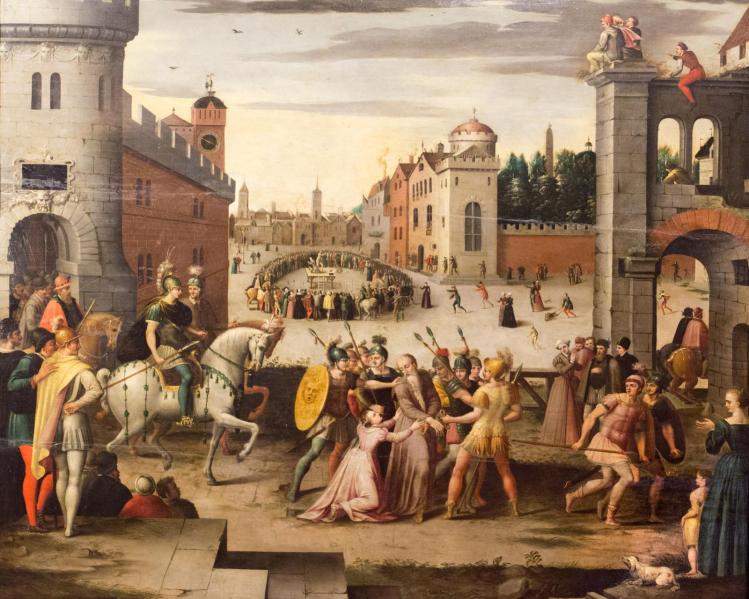
One of the leading Christian intellectuals of his day, More climbed to the highest ranks of political power only to be jailed and murdered by his own government. A series of uncanny echoes make More seem almost our contemporary. More, too, had to deal with an erratic, petty, and sadistic autocrat (King Henry VIII) who believed that not only secular government but all cultural life should submit to his will. More, too, watched as millions of his fellow Christians contorted their faith to match the impulses of their head of state. More, too, had to navigate a world in which one man managed to thrust his capricious, lascivious impulses and whims upon a whole society. Prefiguring many Catholics of our time, More believed for longer than he should have that he could manage a tyrant’s excesses and perhaps steer him toward better ends. He even helped King Henry VIII write his 1521 book Defence of the Seven Sacraments against Protestantism. But soon after Pope Leo X praised his book, Henry turned on him, casting himself as the only leader of the faithful in England.
By the time More grasped the futility of guiding such a man, it was too late. He was arrested and imprisoned in 1534 for refusing to swear the Oath of Supremacy that made Henry the absolute authority over political and religious life in England. Yet despite his long imprisonment and show trial, More remained generous, lighthearted, and altogether free from the sway of revenge—right up to the final seconds before his beheading. The writer of Utopia (1516), one of the most hopeful political tracts in the Western canon, More never lost his hope or succumbed to resentment. He never yielded to hatred against those who had conspired against him and inflicted loss after loss upon him. On the contrary, during his last months in jail he wrote a letter to his beloved daughter Margaret in which he resolved to focus his “whole study…upon the Passion of the Christ and mine own passage out of this world.” The result of this final set of meditations was A Dialogue of Comfort against Tribulation (1535). Unlike Utopia, the text is rarely read by nonspecialists, yet it contains immense spiritual wisdom for Christians striving to overcome fear and resentment.
In the Dialogue, More explains how fear in response to rising authoritarianism can damage both political discernment and Christian faith. As in Utopia, More interweaves his fiction with true events. The setting is the Catholic kingdom of Hungary as Christians prepare for the invasion of Suleiman the Magnificent, ruler of the Ottoman Turks. Suleiman is at their doorstep with his sights set on Vienna, a pillar of the Christian empire. The fictional protagonists of the dialogue are Vincent, a naïve young man of the world and his wise but dying uncle, Anthony.
More’s characters say some uncharitable things about Muslims, but the joke is that Suleiman “the Turk” is a tongue-in-cheek proxy for Christian autocrats like Henry VIII. More’s jest is that a foolish, mendacious tyrant (like Henry) who claims to embody the nation might as well be a foreign adversary. Greed and folly are central to More’s portrait of the Turk. His indefatigable avarice drives him to grab everything he can for himself. He makes outlandish promises of wealth for his friends and punishments for his enemies but is a notorious liar who never keeps his word.
Beginning to panic at Suleiman’s approach, Vincent laments to his uncle that Christians are divided among different factions as they face their inevitable decline. In their despair some wonder if they should embrace the strongman even if he is no friend of true Christianity. Given the gathering storm, Vincent wants to “stabilize and strengthen the walls of our hearts against the great surges of this tempestuous sea.” How can he manage his crippling fear?
In the voice of Anthony, who is also at death’s door, More offers his advice. He begins by examining the psychological experience of fear. Christians fear political loss and domination by others; they fear becoming a religious minority in their own land; and they fear living in an autocracy. More suggests that such fears lead us into grave spiritual errors and foolish political judgments. When we yield to fear, he says, we end up making one of two mistakes.
The first mistake is “pusillanimity” or the cowardly evasion of difficult moral decisions. According to More, such cowardice often wears the mask of realism and false humility. Rather than suffer for truth, one feigns skepticism about what can be done. Since nothing ever changes, since the strong will do what they want, the safest option is to ally oneself with the powerful and accept the moral compromises that follow. The cowardly end up lowering their expectations for political change and withdrawing from civic engagement out of fear of moral pollution. Anthony says:
They forget God’s help in keeping them safe, and they leave undone much that they should have done. Some even abandon their place and seek their own ease and comfort in a life of quiet and contemplation, wrongly convincing themselves that they are being humble by doing so. God is not content with this way of acting.
More’s account of cowardice calls to mind Scheler’s “romantic,” who looks to imaginary versions of the past as a refuge from the volatile present. Catholics attached to nostalgic tales of throne and altar or the glories of the Habsburg monarchy might sense that Trumpism is both profoundly modern and profoundly irreligious. Yet out of fear of being associated with their “secular” neighbors, they soon accommodate themselves to the project of Christian nationalism. “This may be bad,” they reason, “but at least I won’t be mistaken for woke!”
The second error diagnosed in the Dialogue is “scrupulosity.” Distracted by fear, one misperceives the world and dwells on minor distresses and temptations. Constantly afraid of God’s displeasure, the scrupulous person “doubles the fear” of every moment of life and sees sin where none exists. Carping and overly critical, they invoke God’s judgment everywhere they look, searching for subtle impieties and persecutions to condemn. Soon even fellow Christians become objects of their resentment. More’s examination of judgmental scrupulosity calls to mind Scheler’s warnings about the new convert or “apostate.” The apostate is always shadowboxing with their own past. Having passed through a dramatic conversion, they are in perpetual conflict with representatives of the world they left behind. Many of the most zealous advocates of the new Catholic right—from Ahmari to Vance to Vermeule—are converts to Catholicism (full disclosure: so are we). But even those who grew up in the Church can fall prey to resentment.
Smoldering anger, vindictiveness, cowardice, and resentment are all affective vices that need healing and transformation. The remedy that More prescribes at the end of the Dialogue is a strange yet beautiful contemplative exercise. Imagine, he writes, the bloodiest battle, full of enemy troops but also demons and monsters. Take in the vast darkness and feel the hopeless despair. But then envision, out of nowhere, an unforeseen, impossible inbreaking of God’s kingdom into human time, as the darkness is suddenly suffused with the blinding light of angels. To help Vincent find his courage again, Anthony tells him to keep before his eyes “the incomparable and inconceivable joy” of the future communion with God. A holy resolve to embrace the wildest dreams of the City of God—this is the last and best utopia. It turns out that the ultimate antidote to the politics of resentment is More’s bold Christian utopianism. Its hope for the impossible, coming out of nowhere, is the secret of its strength, even in the face of martyrdom. Or perhaps that martyrdom is best understood as the seal and signature of its authenticity. “Let us consider these things well,” says Anthony in his last speech, “and the truth will surround us like a shield, and we will fear nothing.”
More’s insights may seem beside the point. Trumpism thrives on macho aggression toward its enemies and a shameless lack of scruples. So in what way is MAGA plagued by cowardice and scrupulosity? In fact, the nostalgic, romantic types are terrified of having to inhabit the cultural present, which is full of neighbors beyond their control. Whether they dream of the 1950s, the ancien régime, or an ethno-Protestant state, the slogan “Make America Great Again” feeds on their alienation from their contemporaries. Similarly, the “apostates” shudder at the moral taint of the secular world they have turned away from. MAGA exploits their obsessive fear by offering to sweep the unbelieving liberals off the board completely—a mass “clean up” of society that will wash away all the cultural contaminants.
Both of these kinds of fear lack courage because they lack hope: hope that God has in some final sense already prevailed. As Pope Francis wrote in dialogue with the world’s Muslim communities: “God, the Almighty, has no need to be defended by anyone.” His namesake St. Francis found solidarity with every creature by showing that the true Christian is the one with the fewest defenses—the one who gives away food, clothing, and shelter in order to be perfectly vulnerable to any stranger he might meet. Pope Leo XIV calls this kind of courage an “unarmed and disarming peace.”
Pope Francis was fond of the parable of the Good Samaritan, the story Jesus told to answer the question, “Who is my neighbor?” In the parable, solidarity only emerges once we overcome our own fear and resentment of the outsider, so that we can attend to his wounds. It is not enough for the American Catholic right to quietly drift away from Trump, and it is certainly not enough for journalists and academics who should have known better to quickly turn the page without owning up to the gravity and consequences of their error. If the root of Trumpism is partly found in the emotions, then a future beyond it will have to pass through some healing of those emotions. When all seems lost, when one’s project of political domination has failed, when one’s fantasy of community is replaced by a real one, hope can dry up and leave behind a toxic residue of resentment. This is precisely the moment when Christians of different kinds can ask themselves: In what—or whom—exactly do we still have faith?
We welcome your comments about this article. Please send your response to [email protected].