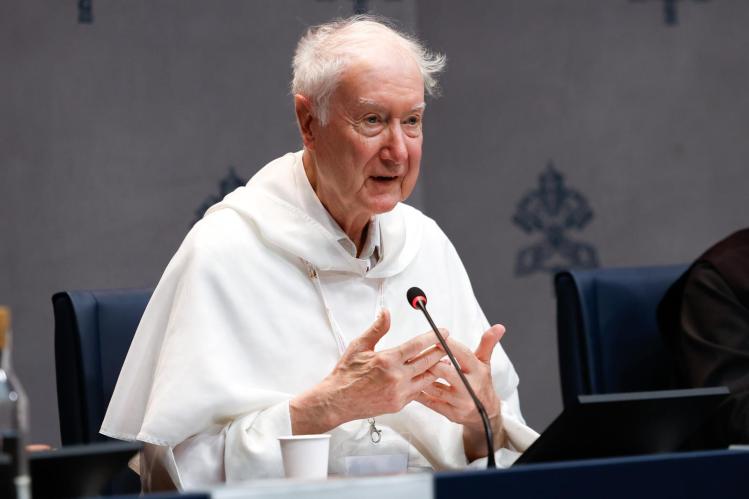
Cardinal Timothy Radcliffe is a Dominican friar and former Master of the Dominican Order. He is also an honorary professor of divinity at the University of Oxford. In 2017, he received the Michael Ramsey Prize for his book What is the Point of Being a Christian? and in 2024, he was elevated to cardinalate by Pope Francis. Cardinal Radcliffe spoke with Vincent Ray M. Daut, a campus minister at Ateneo de Manila University, on the university’s radio show. Their conversation has been edited for clarity and length.
Vincent Ray M. Daut: You’ve been a member of the Order of Preachers for more than sixty years. What made you decide to become a Dominican friar? Who are some of the figures that made an early impact on you?
Timothy Radcliffe, OP: I grew up in a very Catholic family. We had been Catholic for centuries, and, to be honest, I never really thought much about my faith. I left my Benedictine school and became good friends with someone who was not a believer. He said to me, “All that you Catholics believe in is untrue.” That became an obsession for me: Is it true or not?
I remembered an order whose motto was “Truth”—“Veritas.” I couldn’t recall which order it was, so I wrote to the Benedictines, my old schoolmasters, and they told me it was the Dominicans. That motto was really what drew me to the order. So, I wanted to become a Dominican before I had ever even met one, which might not have been a bad thing.
I entered a province that was quite poor. So when I was sent to study in Paris at the time of the Second Vatican Council, I was told I had to get a job, and I ended up working as the assistant to Yves Congar, the French Dominican theologian. I met him twice a day. Often, it was just a matter of getting him coffee, talking to him, and asking what he needed, but I also got to know him extremely well and came to admire him greatly.
That whole generation of French Dominicans had a wonderful knowledge of the tradition but, at the same time, an openness of mind. There was Congar and there was also Marie-Dominique Chenu, Congar’s teacher. They called Chenu the grandfather of the Second Vatican Council.
Chenu was a wonderful, warm, and loving human being; at the kiss of peace, he would give you a hug and pull your hair. He was a marvelous example of what it meant to be alive in Christ.
VD: During the Synod on Synodality in 2023, you ended your second meditation by quoting the Italian hermit and writer Carlo Carretto, who died in 1988. His so-called “Ode to the Church” reads as follows:
How much I must criticize you, my Church, and yet how much I love you! You have made me suffer more than anyone, and yet I owe more to you than to anyone. I should like to see you destroyed, and yet I need your presence. You have given me much scandal, and yet you alone have made me understand holiness.
Why do you still remain in the Church, despite the scandals and corruption you have experienced firsthand?
TR: I remain because Jesus remains. He says, at the end of Matthew’s Gospel, “Behold, I am with you until the end of time.” So if Jesus remains in his Church, how can I not?
Jesus has borne all the sufferings of the Church, which is at once wonderful, holy, corrupt, and sinful. He made it not only for people who are saints, but also for people who are sinners. We all have our place; we can all belong. It was only divine inspiration that could have made Peter the rock of the Church—poor old Peter, who betrayed God, who denied Jesus. Therefore, I think the Church is immensely spacious. It has room for everybody.
I deeply regret the awful failures of sexual abuse. They have turned so many people away from Christianity and the Church. But I cannot leave.
VD: Jesus remains, yes. But Jesus also had to die a real death, and a horrible one. How should we understand his death?
TR: That is a big question. It took four different Gospel accounts to present it. It is such a deep mystery that no single account would be enough. But let us just take one small aspect.
In Mark and Matthew, Jesus dies saying, “My God, my God, why have you abandoned me?” This was a terrible scandal for many early Christians. How could Jesus say that he was abandoned by God on the cross?
St. Augustine wrestled with this text all his life. In the end, he said something very beautiful: Jesus embraced our sense of being abandoned. He embraced all that we live. Even on the cross, he took upon himself our deepest sense of abandonment.
This is why we are not abandoned. God has visited every dark corner, every hidden place of our suffering. He has embraced all our despair and held it close to himself. So whenever we feel that God is far away—and we all feel this at times—we can know that even then, he is near.
I love the Book of Hosea, where God says to Israel, “I will lead you into the wilderness, and there I will speak to you tenderly.” Whenever you find yourself in the wilderness, feeling alone or deserted, it may be that God is about to speak to you tenderly in a new way.
Christians have always seen Jesus’ death and resurrection as the victory of life over death, of love over hatred. On Easter Sunday, we sing the beautiful Gregorian hymn Victimae paschali laudes: “Death and life fought a spectacular battle. The Prince of Life died and rose again and reigns.”
It is a victory of life. It is a victory over all that might harm you or me. We all have intimations of death. I had terrible cancer two and a half years ago, and I nearly died. But I need not fear, because in Jesus’ victory, love has triumphed over hatred, and life has triumphed over death. That is why St. Paul can say, “Death, where is your victory?” It is defeated.
VD: What does that victory actually look like? The four Gospels give us very different pictures of Christ’s resurrection. Could their meanings differ, too?
TR: In Mark, we see how Jesus comes to embrace us in our abandonment. In John, it is the other way around: we follow the path to see the glory of God on the cross. Jesus says, “When I am lifted up, I will draw all things to myself.” These are two paths to the same mystery. In Mark, we begin with God’s path to us, but in John, it is more about our sharing in Jesus’ path to the cross. They do not contradict each other; they complement each other.
I think it is rather like the Church today. You have people, often of an older generation, who are deeply shaped by the Second Vatican Council and think, “Gosh! We are going out into the world,” embracing the great discovery of the secular world. Then you have younger people who go in another direction. They were brought up in the secular world and now come in to discover the mystery and tradition.
People often see that as a contradiction. Young and old Catholics criticize each other: “Why are they so conservative?” or “Why are they so progressive?” But that is the wrong mentality. Those are two adventures, both valid. In the same way, the four Gospels give us four ways of approaching a mystery that is beyond all of us.
Take another mystery: What is Christ’s glorified body like? In 1 Corinthians, Paul says that anyone who claims to know what the risen body is like is a fool. However, I would say that we can take a small step into the mystery. We first have to ask what it means to be bodily.
Sometimes, people think of the body as a lump of flesh that gets in the way of our relationships with others. There is this mythology that if we were not bodily, we could communicate directly. You see this in Gnosticism and Manichaeism. Many people still hold to this myth that the body is a barrier.
But the good news of Christianity is wonderful. It tells us that our bodies are not obstacles but a means of being close to each other. Our bodies have evolved so that we may love face-to-face, presence-to-presence. Our bodies are gifts that open us to others.
Now, of course, they can also close us off. We can be deaf, blind, or otherwise unable to connect with others. But that is not because we are bodily. And I would propose this way of thinking: the risen body is bodily in a way that is totally open and able to receive and give love. We cannot begin to imagine what that is like. But all the Resurrection stories show Jesus passing through barriers. In John’s Gospel, he passes through the closed door into the upper room. The same happens in Luke’s Gospel.
I love the fact that at the worst moment in human history, Jesus says, “This is my body, I give it to you.” For me, that is the basis of all sexual ethics—that we can actually dare to say to someone we love, “I give myself to you forever.” Not in our case as priests, but for married people, that is the beautiful vocation: to say, “I give myself to you.”
To be bodily is to be able to become a gift. It is what Blessed Pierre Claverie, the Dominican martyr who died in 1996, called “white martyrdom”—to become, in every aspect of our being, a gift to others.
We all touch the mystery of the risen body to the extent that we do not hide ourselves, withdraw ourselves, or hold ourselves back, but instead try to give ourselves, in all our vulnerability, fragility, frailty, weakness, and strength. And in doing so, we take a small step toward the glorious risen body of Christ, totally given and received, a complete gift from heaven.
VD: That glorious risen body still has wounds, though.
TR: Yes, I think it is so wonderful. The risen Jesus appears in the upper room and shows them his wounds. One Easter preface (which says it better in Latin than in English) states that he is forever wounded. This means, among other things, that we should never be afraid of getting hurt.
One of my brothers, Herbert McCabe, was one of the great theologians of the twentieth century. He was my next-door neighbor for twenty years. Herbert liked to say, “If you love, you get hurt, you may even be killed. If you do not love, you are dead already.” So, if we get married, we are going to get hurt—but we must not be afraid of it. If you are a seminarian and you get ordained as a priest, you have to live it as a life of love, and that means sometimes you get hurt. If you do not get hurt, then you have not lived.
There is a story, I think from the French writer Charles Péguy, about a man who goes to heaven. Jesus says to him, “Show me your wounds,” and he replies, “I have none.” It meant he never lived.
Those wounds show us that the failures we have, dead ends we encounter, or the ways we are touched by death, are never the end. In my life, there have been times when I have done things that I know are wrong, and I may guess that the same is true for you. But we believe that the dead wood of our lives will flower. Nothing wrong that we have done is going to be dead forever.
People are often ashamed of their bodies; many even despise them. Many people suffer from illness, anorexia, self-harm, and other things because they do not like their bodies. The Resurrection means that we can embrace our bodily existence. As I said earlier, our bodies are gifts. They may be fat, they may be thin, other people may see them as beautiful or ugly, but it does not matter. God sees them, and he sees them as beautiful. In every one of us, he sees the beauty that is sometimes hidden. The Resurrection teaches us to be unafraid of our bodily existence.
VD: I appreciate that. Many people also suffer from social circumstances, from things beyond their control like poverty and government corruption. What do you tell them when they ask, “Where is the new life Christ promised us?”
TR: Let me respond this way: Have you ever seen the film Of Gods and Men?
VD: No, Father.
TR: You simply must see it! It is the story of the Algerian martyrs, the Trappist monks who dared to stay. They did not run away; they remained to serve their Muslim neighbors, and they all died for their faith.
If we want to become witnesses to new life, we must invite the young to the perilous and dangerous adventure of Christianity. Christianity is not safe. It invites you to live in a way that is crazy. I do not know about the Philippines, but in Britain, we have a health-and-safety culture. Everything is about being safe—and I understand it. Terrible things have happened, such as the sexual-abuse crisis, so we have to make sure people are safe. But ultimately, if you are a Christian, you are invited to give away your life. That is dangerous.
There is a reason Tolkien’s The Lord of the Rings is so popular. Young people love it because it is a story of adventure, risk, and heroism. That is the story, according to Tolkien, of the Eucharist. Tolkien wrote it for his son Michael, and he said it is the story of his Catholic faith. He used to come to Mass at our Dominican church in Oxford. The star on the forehead of the character Aragorn is taken from the star on St. Dominic’s forehead, an image in our chapel.
If you want to be a witness to the Resurrection, to new life, be brave. Do not be afraid. Give away your life in a way that may even seem foolish. Christianity that is just about being nice to people may do no harm, but it will not offer much life.
The world certainly needs life. We are entering a new multipolar world; sometimes we are not even sure what is happening. In 1989, with the fall of the Berlin Wall, a Japanese American named Francis Fukuyama wrote a book called The End of History and the Last Man. He believed that Western liberalism had triumphed and the world would eventually evolve to become like the United States. But that is not happening. What we see instead is a new world we are only beginning to understand. We see the rise of China. We see the terrifying rise of Russia and its invasion of Ukraine.
I think the big challenge—and it is an enormous challenge for the Church—is this: How can we become genuinely intercultural? I love the image in John’s Gospel of the net that is hauled in, bringing in all those fish, I think 154, and remaining unbroken. From the beginning, that was understood as a symbol of the unity of a Church in which all cultures are welcomed. I think the Church becomes a symbol and sign for the whole world, showing how, with all our different cultures and ways of being human, we can somehow find unity in Christ. All cultures that are rich are multicultural, and so I think the challenge is how to be truly multicultural.
There are two traps: first, relativism, which says, “There is no truth, only your truth or my truth”; and second, fundamentalism, which says, “There is truth, and I have it, and you do not.” We have to find our way between relativism and fundamentalism, toward truth that is ultimately deep and mysterious. We must be confident in our faith and confident in proclaiming it yet humble enough to learn from other people.
The Church embraces the glorious multiplicity of spiritual paths. Just look at religious orders. The Jesuit path, with the Ignatian Spiritual Exercises, is quite different from the Carmelite path, with Teresa of Ávila’s ascent of the mountain, or the Dominican path, which is highly democratic. Those are all very different and, thanks be to God, they are all possible.
The challenge is to accept complexity. One of my first teachers was a Sri Lankan Dominican, a convert. His mother was Buddhist, his father was Anglican, he studied under Wittgenstein, and he became a Catholic to hold it all together. He once said, “It must be possible to find God in the complexity of human experience,” and that is the challenge today.
This is why we should read novels, watch plays, or follow interesting vlogs. The temptation of relativism and fundamentalism is oversimplification. They reduce complexity to slogans. The truth of humanity is complex. God is simple, but we are not God. It is only as we draw near to God, only as we are caught up in the divine mystery, that we shall become—very slowly, very painfully, and very joyfully—simple. Simplicity is the result of a lot of joy and a lot of sorrow. It is a sort of Resurrection.
VD: One final question, which draws on the title of one of your recent books: What is the point of being a Christian today?
TD: You know, Vincent, I wrote the book because a friend of mine had a son who said, “Yeah, Dad, I can see it, but what’s the point of being a Christian?” His father told me this over a meal, so I had to write a book. The son read it, and said, “Okay, Dad, I think I can see what he’s getting at, but why go to church?” So I had to write another book. The father has since died—otherwise I would be writing another one.
The point of being a Christian is, I think, to show that there is a point to being alive. Being alive means that we live for a glorious end that transcends all our imagining. Being alive is not just having a beating heart and a pulse; being alive is living for what transcends us.
I have another little book, which I wrote with a young Polish Dominican—I have to promote my books, you know—called Questioning God. We take eighteen questions in the Bible, eighteen conversations between God and humanity, and we discuss each of them. All our Gospel preaching has to be like this: conversational. And you only have a good conversation if you are confident that you have something to say but humble enough to know that you have something to learn.
I love the word “confident.” It comes from the Latin word confidens, which means “to believe together.” I think young people all over the world are desperately looking for something to believe in. We have something that is extraordinarily beautiful and also true. Let us share it with confidence. Do not force it on people. Do not use it to hurt others. Share it gently and humbly as a gift.
We welcome your comments about this article. Please send your response to [email protected].