One of the most fascinating bits of liturgical history in the United States concerns how the liturgical movement and the Catholic Worker movement interacted during the first part of the twentieth century. At the heart of that story is a friendship between Virgil Michel, OSB, and Dorothy Day. Yet this was more than a personal friendship. The trends that they represented together exemplified a way of “reading” the liturgy that placed the prayer of the Church at the heart of the project of social reconstruction—a project that remains necessary in our own time.
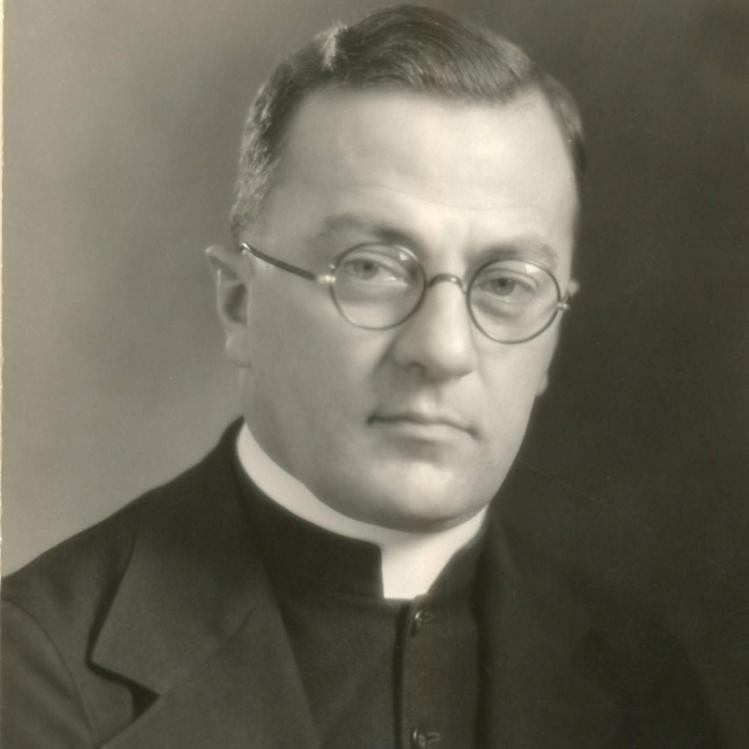
Michel (1890–1938), a monk of St. John’s Abbey in Collegeville, Minnesota, was one of the pioneers of the liturgical movement. He founded Liturgical Press, began the periodical Orate Fratres (later renamed Worship), taught at St. John’s University, and promoted Catholic Church renewal far and wide. But he is best remembered as a strong advocate of the belief that social justice is not something added onto the liturgy; it is integral to it.
He regarded the unbridled pursuit of wealth as idolatry and an abomination. Echoing Pius XI’s encyclical Quadragesimo anno, “On Reconstruction of the Social Order,” he referred to it as a “pagan creed.” But what was his solution? Cooperative farms? Workers’ movements? Labor unions? He applauded all these things. Yet he was not a union organizer, nor did he run a hospitality house or a farm cooperative. Rather, he supported those who did those things, and taught that the liturgy was essential to grounding such efforts and making them effective. His vision of a strong link between liturgy and social justice became the unique contribution of the American Church to the worldwide liturgical movement.
Michel was brilliant yet very practical; a teacher yet also a visionary; German by heredity yet truly American, with a can-do attitude and a willingness to lean into the future. He was seriously devout and strictly loyal to the pope as Christ’s vicar on earth; his view of Catholicism was formed by the Church of the long nineteenth century. He was, at the same time, well aware of the apathy and appalling failures of the Church (both in Europe and the United States) to educate, teach, and reform. He was not much of an economist, but he was good with theological praxis and with languages. Above all, he was a person of indefatigable energy. There was never a day when he didn’t write, and it was not unusual to find him writing on two or three topics in a single day—not to mention the time he spent speaking and teaching in the classroom and in other settings. He organized conventions and meetings and conducted wide-ranging correspondence, particularly with those involved in social movements.
Michel was a good friend to the Catholic Worker. He sent them books from Liturgical Press, which they devoured. He taught them to pray the Liturgy of the Hours and sent them booklets to use for that purpose—Latin on one side, English on the other. In his historical memoir of the New York Catholic Worker, Wings of the Dawn, Stanley Vishnewski described what that looked like on an ordinary day at the Worker. “Every evening at seven, Margaret or Big Dan would start banging on a dishpan or a handy pot and its clamorous noise resounding throughout the store would summon us to the kitchen where, facing each other in two rows, we would recite the office of Compline.” Not only the Hours but also the Eucharist became part of the routine at the Catholic Worker. Active participation in the liturgy was seen as an expression of the dignity of each person regardless of what they possessed in worldly terms. William Gauchat of the Cleveland Catholic Worker in his 1940 article, “Helping the Hobo to God,” explained that “the poor who have nothing, and are despised by everyone for having nothing, can offer to God a gift of infinite value in the Mass. At Mass the poor are rich, and the rich are no more than the poorest of the poor.”
Michel argued for his vision in simple terms. In Tra le sollecitudini, Pope Pius X had said that active participation in liturgy is the indispensable source of the true Christian spirit. In Quadragesimo anno, Pope Pius XI had said that the true Christian spirit is needed for social reconstruction. Therefore, Michel said, active participation in liturgy is indispensable to social reconstruction. It was a logical syllogism. He believed in the necessity of social movements such as Catholic Action, the Catholic Worker, Campion Propaganda Movement, Friendship House, and the Grail, and he formed links with all of them. But also, and more importantly, he believed that social movements needed the liturgy. Alternatives to capitalism offered without God would never solve social problems, he argued, because, as Jesus said, “Without me you can do nothing” (John 15:5). He was convinced that both toxic individualism and dehumanizing collectivism are rooted in unbelief.
Underlying Michel’s socioliturgical vision was a single unifying theological concept: the mystical body of Christ. Through baptism one enters Christ’s mystical body, and thus is related to all others in the body. Sufferings are shared. The flourishing of each is the benefit of all. To use another biblical image, all are branches of the one vine that is Christ. In the liturgy we draw on his life, which becomes the source of a common life full of vigor. In the words of Michel, no one can say to another person, “I don’t need you.” Active participation in the liturgy renews our communion in Christ’s mystical body, and the grace that flows through the liturgy empowers us to seek the common good.
Michel carried on correspondence with Day and visited the Worker. She in turn visited St. John’s Abbey. Day was influenced by Benedictine monasticism even before she became a Catholic, so her sympathy with Michel, a Benedictine monk, was natural. In fact, an argument can be made that the whole ethos of the Catholic Worker—work, prayer, hospitality, stability—bears the fingerprints of the Rule of St. Benedict. Maurin was likewise influenced by the Benedictine lifestyle, as it embodied the mutual benefit of work and prayer expressed in St. Benedict’s maxim “Ora et labora.”
It might seem that Michel, the liturgical pioneer and academic, was very different from those two Catholic Worker founders. Michel was an institution-builder. Day and Maurin were anarchists. Yet for both Day and Maurin, as for Michel, there was also a common faith trajectory toward solidarity and humility. The theological term for this is kenosis, the self-emptying love of Jesus which led him to become one of us and ultimately to give his life for us.
Kenosis was key for the revolutionary politics of the Catholic Worker. Day discovered her calling in prison. Maurin was often mistaken for a bum. Their calling was to live with the poor and in solidarity with them. As a way to avoid paying taxes for war, they earned too little to be taxed. The paradox of kenosis is that those who “lose themselves” in Christ will find themselves. They accepted the radical demands of the Gospel and also experienced its liberating effects.
In his way, too, Michel experienced self-emptying, though not by his own choice. For all his dynamo-like energy (or perhaps resulting from it), he had a crisis of nervous exhaustion in 1930. He suffered sleeplessness, headaches, emptiness, and the inability to work or even to pray the Hours. To aid his recovery, his community sent him to live with the Chippewa in northern Minnesota. He immersed himself in that community, who lived very simply and were close to nature. Among the Chippewa, he found life and health again. That treatment was twice repeated, after which he returned to St. John’s in 1933.
Through his humbling breakdown and immersion into a community of people who helped him recover, he arrived at a deeper level of insight and passion for the realities to which he had committed his life: Christian solidarity, justice, and the liturgy. Virgil Michel died of pneumonia in 1938. Dorothy Day and the Catholic Worker community were “overwhelmed with sadness” at his passing. “What a loss we all suffered,” she wrote in 1953, “when this great priest died at the age of forty-eight.”
The seminal insight Michel brought to liturgy—that social justice is organically related to liturgy because of the very nature of the mystery we celebrate—remains a potent one. It was alive in the liturgy debate at the Second Vatican Council, and it remains alive in Latin American theology today. It is a Gospel affirmation of the strongest kind. In the field of pastoral liturgy, that insight has been sidelined by the distractions of the so-called “liturgy wars” and polarization over the past forty years. Yet it waits to re-emerge.
We welcome your comments about this article. Please send your response to [email protected].