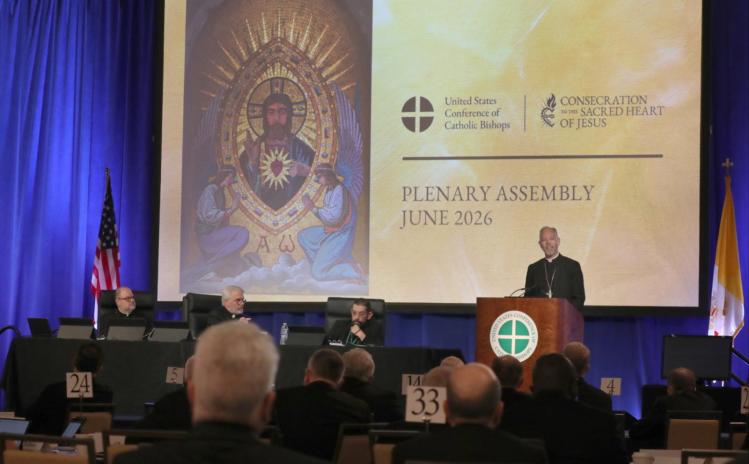
At their meeting last week, the U.S. bishops debated proposed revisions to the U.S. church’s guidelines for dealing with sex abuse, the so-called “Dallas Charter.” First promulgated in 2002, the document has been periodically updated, and the bishops were ready to vote on further revisions, including adding language to emphasize the right of accused priests to “the presumption of innocence.” The committee chair insisted there had been sufficient consultation, but other bishops suggested that additional feedback from victims, priests, and diocesan review boards would strengthen the revisions. Bishop Oscar Cantú of San Jose, California, argued that further input could bring more buy-in from local churches, but acknowledged that perhaps many of his brother bishops had become “synodality-weary.”
That weariness of synodality’s inclusive discernment was evident in the final votes: a motion to postpone that would allow more time for consultation failed 126 to 73, with five abstaining, and the charter revisions then passed with even more support. Despite several bishops’ insistence that they would like more time to consult their presbyteral councils and review boards—noting there was nothing to be lost and only more credibility to be gained with more deliberation—the committee chair, Bishop Barry Knestout of Richmond, Virginia, maintained, “I’m not quite sure what’s gained through the additional time.” Yet disagreement about several issues persists, including whether the document should also address abuse of adult victims, not just children and young people, and whether to include accused bishops, as well as priests, under the recommendations.
On a topic as sensitive as sexual abuse, it was surprising to see such tone-deafness. But that wasn’t the only part of the meeting that seemed to eschew a consultative approach. Presentations on the bishops’ voting guide, Forming Consciences for Faithful Citizenship, and about Catholic colleges and universities both lacked engagement with affected constituencies. Even on the topic of synodality itself, the U.S. bishops seem to prefer listening primarily to themselves.
Faithful Citizenship has long been a political football for the bishops’ conference. For years, critics have called for a new document that incorporates the teachings and priorities of Pope Francis; the original was first written in 2007, six years before Francis was elected. Division among the bishops has prevented anything beyond minor tinkering every four years, although a significant change was made in 2019 when the bishops added wording that made abortion their “preeminent priority.” Before the 2024 presidential election, the bishops again punted, saying there wasn’t enough time for a new document. Instead, they announced plans to prepare a new guide before their 2027 meeting, to be ready in time for the 2028 election.
But now, even after Francis’s pontificate has ended, it looks like a new document might not happen at all. Instead, the bishops will continue to use the existing one “as an evergreen and foundational source document,” according to Archbishop Shelton Fabre of Louisville, chair of the Committee on Domestic Justice and Human Development, who gave an update during last week’s meeting. He announced that efforts will focus on new communication strategies, especially video and social media to reach young people, helping local parishes, and resources to train priests and deacons. At the end of his remarks, Fabre noted that he looked forward to “continued listening and collaboration as a body to these ongoing efforts” (emphasis mine), meaning among the bishops’ themselves. There was no mention of input from others who work in fields that intersect with politics or on issues affected by political decisions, or from the group of Catholic moms lobbying the bishops to make the guide more focused on Catholic social teaching.
Notably, Fabre said the decisions, including to keep the old document, were based on conversations during “fraternal dialogues” from last November’s meeting. These dialogues are held in executive session, not open to the media or other viewers. The bishops’ conference has increasingly moved its work behind closed doors, especially after the very public controversy over whether to deny Communion to President Joe Biden in 2021. Supporters say private meetings allow for more frank discussion and promote unity among the bishops. But the downside, obviously, is less transparency about issues that affect all of the people of God.
Another conversation that happened behind closed doors followed a presentation at last week’s meeting about Catholic colleges and universities. In the presentation, Santiago Schnell, provost of Dartmouth College, argued that Catholic institutions are failing because they have imitated secular institutions that prepare students for careers rather than for a life of faith. The antidote is to “waken the Catholic imagination” and strengthen Catholic identity to create scholars who will become the next doctors of the Church, Schnell said, with particular attention to increasing the percentage of faculty, administrators, and students who are practicing Catholics. Among the topics Schnell suggested for discussion in the closed session was bishops’ involvement in institutions in their dioceses. “You could be more vocal,” he told the bishops. “I think you are being too respectful. You own the word ‘Catholic.’ We academic administrators don’t.”
The occasion for that presentation was ostensibly the twenty-fifth anniversary of the U.S. implementation of Ex corde Ecclesiae, Pope John Paul II’s 1990 apostolic constitution that sought to give bishops more oversight over Catholic higher-education institutions in their dioceses. But Schnell is an administrator at a non-Catholic institution. A mathematical biologist, he previously served as a dean at the University of Notre Dame for four years, but his other higher-ed administrative experience is at public institutions, as was his own undergraduate and post-graduate study. It is odd that the bishops did not choose to hear from administrators of Catholic institutions, or from the Association of Catholic Colleges and Universities. The discussion that followed was held privately.
At last week’s meeting, the bishops also received an update on the synodal process from Auxiliary Bishop Juan Miguel Betancourt of Hartford, Connecticut, chair of the USCCB’s Synod Implementation and Evaluation Task Force. Betancourt traced the history of synodality and described the current implementation phase, intended to culminate in an ecclesial assembly in Rome in October 2028. He noted that in the United States, there is still “confusion” about what synodality is and “inconsistency” at the local level, in part because of negativity on the part of some priests. “It is important to continue to find ways to bring priests on board with synodality,” he said, adding that younger priests “often express discomfort with the term ‘synodality,’ associating it with problematic models abroad and a fear that synodality may resemble conciliarism or undermine pastoral authority.” These observations, Betancourt noted, came from feedback requested from USCCB leadership—but only from brother bishops.
The fate of synodality in the Catholic Church is unclear, and the U.S. bishops’ apparent aversion to consultation outside of their own body does not bode well. Yes, Pope Leo XIV mentioned synodality in his first words as pope, and he has been open to collaboration. And many Catholic institutions have embraced synodality, including sixteen U.S. Catholic colleges and universities who recently received a $10 million Lilly Endowment grant to support it. But those who have been suspicious of or even antagonistic to the project from the beginning likely hope synodality will fade. If the U.S. bishops’ meeting is any indication, they may get their wish.
We welcome your comments about this article. Please send your response to [email protected].