The phone rang at two in the morning like a siren in a war zone. I sat up quickly and answered the call in a hushed voice, careful not to wake my wife or the children who had found their way into our bed during the night.
How unaffected we become even by the most unusual and extreme circumstances when those circumstances become routine. There is nothing normal about waking from deep sleep to make decisions that mean life or death. Nothing normal about rushing into work as the rest of the world sleeps to pull clots out of blood vessels deep in the brain, to straighten necks and backs twisted and broken and bent in violent falls or collisions, to take a knife and drill to an anesthetized patient’s head. But for the last ten years, since finishing residency, this kind of work has become my routine.
“Luke Tomycz, neurosurgery. What do you need?” I whispered hoarsely into the phone. I was covering call for a colleague, and a physician assistant was calling me from a trauma center about a fifty-minute drive from our apartment in Jersey City. “Sorry to wake you, but we got a kid here, sixteen years old. Self-inflicted GSW [gunshot wound] to the head. His pupils are fixed and dilated bilaterally and he’s got no movement at all to stimulation. The bullet goes through and through. We ran him by the adult neurosurgeon on-call first who said, ‘Nothing to do,’ but then they realized he was just a kid so they wanted to get your input as well.” Was I pleased to hear the patient was essentially braindead? No, of course not. But I will admit that I was relieved to be able to quickly agree with the other neurosurgeon, hang up the phone and go back to bed.
But I wasn’t destined to get back to sleep that night. Another call came within forty-five minutes. A child from an Orthodox Jewish family who had been involved in a car accident about three months ago and had undergone decompressive craniectomy and ventriculoperitoneal shunting was now suffering from a relatively acute change in mental status at the rehabilitation facility. I looked at her CT scan and immediately recognized a rare but well-described complication causing shifting of the brain: “syndrome of the trephined.” Urgent cranioplasty or replacement of the bone flap combined with reprogramming or tying off the shunt typically resolves the symptoms.
I untangled myself from the limbs of my sleeping son and tiptoed across the room. Phone. Wallet. Hospital badges. Glasses. Car keys. I showered and dressed, jumped into the car, and started speeding down an empty I-95, merging onto Garden State Parkway near the Raritan Bay. I prayed a rosary in the car. Pray for us sinners, now and at the hour of our death. The barren expressway felt like a sort of open-air cathedral in the summer night.
When I arrived at the hospital, I made my way up to the pediatric ICU and spoke to the parents of the child with sunken-flap syndrome. Her prior craniectomy had been done at the same hospital and I called ahead to ensure that the bone flap had been banked and was available for replacement. They asked a few questions and showed me pictures of their daughter before the car accident that had left her neurologically devastated. I could tell they were living in a strange limbo, between hoping beyond hope that their daughter would yet improve and a growing recognition that nothing in their family would ever be the same. “The other two girls in the car somehow got out with hardly a scratch,” her mother mused without anger or resentment, but with a sort of nagging bewilderment.
I sat at the nurses’ station to write a note in the medical-record system. Just as I was starting to make my way to the operating room, the PA who I had spoken to on the phone appeared. “Have you gotten a chance to talk to the mom of the GSW kid?” “Not yet. Maybe it can wait until after the OR?” But hearing that no one from our team had yet spoken to the mom, I reluctantly agreed.
The ICU is the setting for so many disasters. When I’d first arrived that night, I’d passed a room where a mother was weeping, her face buried in the chest of a teenage boy who lay immobile with tubes coming out of his mouth. The PA led me to precisely this room, warning me as I walked in that the mom had been told very little about her son’s prognosis. I wanted to get straight to the point. I didn’t have much time as another urgent case was set to start.
The boy lay motionless. His head was wrapped but the gauze was soaked with blood. His eyes were closed, his face grotesquely swollen. His chest rose and fell mechanically in time with the machine. IV towers surrounded him like eerie witnesses, beeping and flashing in the darkness of the room. His mother sobbed quietly with her face sunk into the blanket over his chest. She looked up at me as I came in. I sat down, remembering the importance of sitting even when you are in a rush. I introduced myself and announced the bad news. “I reviewed all the scans. I’m very sorry but there’s nothing for me to offer surgically. Sometimes a gunshot wound to the brain leads to a focal injury or localized blood clot that can be removed. But in your son’s case, the injury is diffuse, and his exam indicates that there’s already been very profound damage done to the brain.”
For the next twenty minutes, I did very little talking and simply listened. Her son was kind, he was funny, he was a good kid and a good brother. He was worried about his mother as she herself was suffering from chronic illness. He tenderly cared for her when she felt ill. Yes, he was sometimes depressed, but she just didn’t see this coming. She couldn’t imagine he would kill himself. She didn’t even know that her husband kept a rifle in the house. He was sometimes bullied at school, and she blamed herself for not relocating him. “This is just the worst thing that could ever happen,” she kept repeating. “How am I gonna tell his brother?” “How are we going to live through this?” I didn’t know what to say. My phone rang. They were ready for me in the OR. I told the mother that I would be back, but I had to go now. She nodded and feebly thanked me and sunk her face back into the sheets of her son’s bed.
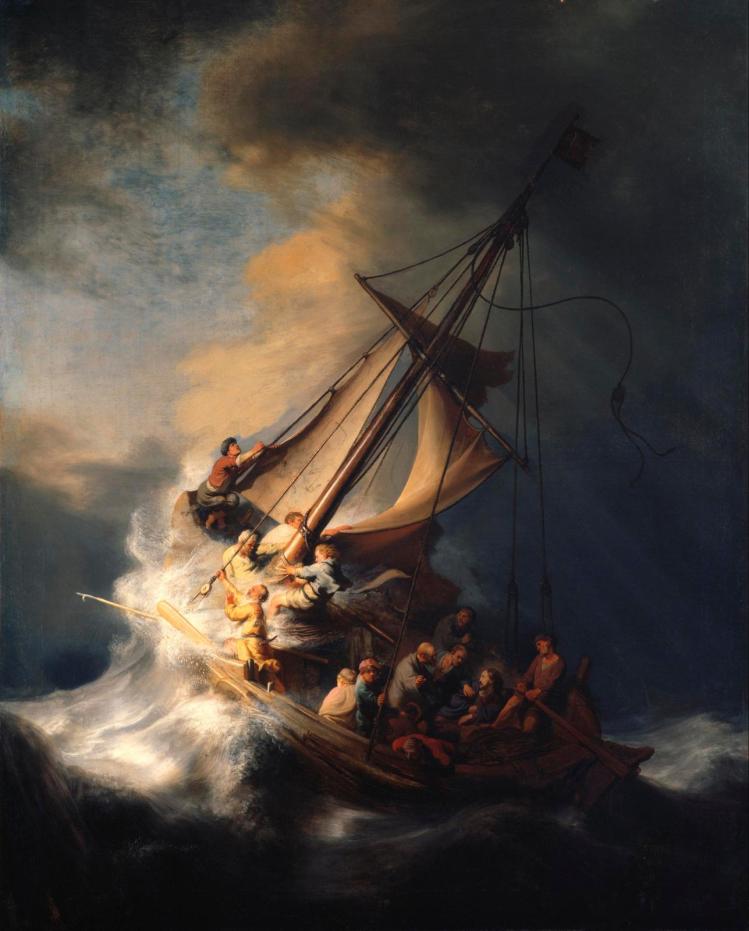
The case went well. I compartmentalized. I focused. I probably even joked with the staff some in the OR. I like to keep the atmosphere serious but somewhat light when I operate. Everyone seems to function better that way. I got home early in the morning, exhausted and spent. I listened to the daily Gospel reading as I walked through downtown Jersey City and the reading jolted me. Christ was with his disciples in the boat and while he slept a storm threatened to sink the boat. “Teacher,” they said as they roused him. “Do you not care that we are perishing?” I choked up as I walked through the crowded city streets. I was going to join my family. Hours earlier, I had watched a mother lose hers.
I’ve never claimed to hear the voice of God, but that is not to say that he never speaks to me. “Teacher, do you not care that we are perishing?” his disciples asked him. We ask the same question. We all do, again and again, through this unpredictable life, marked with loss and regret and death. And just as he responded to his disciples, Christ spoke to me that night: “Why are you afraid, do you still have no faith?” Of course I care, he says. This is why I came. I came to save you. I know you feel hopeless. But you have no reason to fear. You cannot comprehend the depth of my love for you. I am your God. I have conquered death. I will make all things new. What a tremendous promise: to make all things new, to restore all that is lost, to repair all that seems irreversibly broken. I trust that God said as much to this mourning mother. I pray that she heard him.
We welcome your comments about this article. Please send your response to [email protected].