Despite their often-dark themes, there is something very reassuring about reading Louise Erdrich’s stories. At all times, you know that you are in the hands of an expert storyteller. The thirteen stories in her latest collection, Python’s Kiss, are varied in genre, style, and setting, but each feels like a small, well-crafted gem.
Over the course of her prolific career, Erdrich has published more than twenty books and won both a Pulitzer Prize and a National Book Award. Python’s Kiss is her second short-story collection, after The Red Convertible: Selected and New Stories, 1978–2008. One of the most surprising but ultimately satisfying things about Python’s Kiss is Erdrich’s flexible approach to form. The collection moves seamlessly from a story that is essentially a Western—the 2026 O. Henry Prize–winning “Love of My Days,” set in the Dakotas in the late nineteenth century—to two stories that fall firmly in the speculative-fiction category, “Domain” and “Asphodel,” both set in an imagined future where the dying can upload their consciousness onto servers and “live” forever.
Erdrich uses this somewhat familiar scenario to tell two very strange tales. In “Domain” the protagonist infiltrates the afterlife in order to track down and murder her father, who failed to upload his grandchild’s consciousness onto one of the digital servers after the child suffered an accident and died while in his grandfather’s care. “Asphodel” is set in the same server, and once again focuses on parent-child violence. In it, a mother’s contract for the afterlife allows her to have a virtual child, but she needs to periodically delete and reset the child. The 8,037th version, though, resists being erased.
At some point in both stories, our understanding of whose story we are really following or what their true motivations are gets upended. This instability of perspective and character runs throughout Python’s Kiss. To list every example would ruin some of the surprises, but in just about every story, it is possible to identify a character or an object that is not quite what it first appears to be.
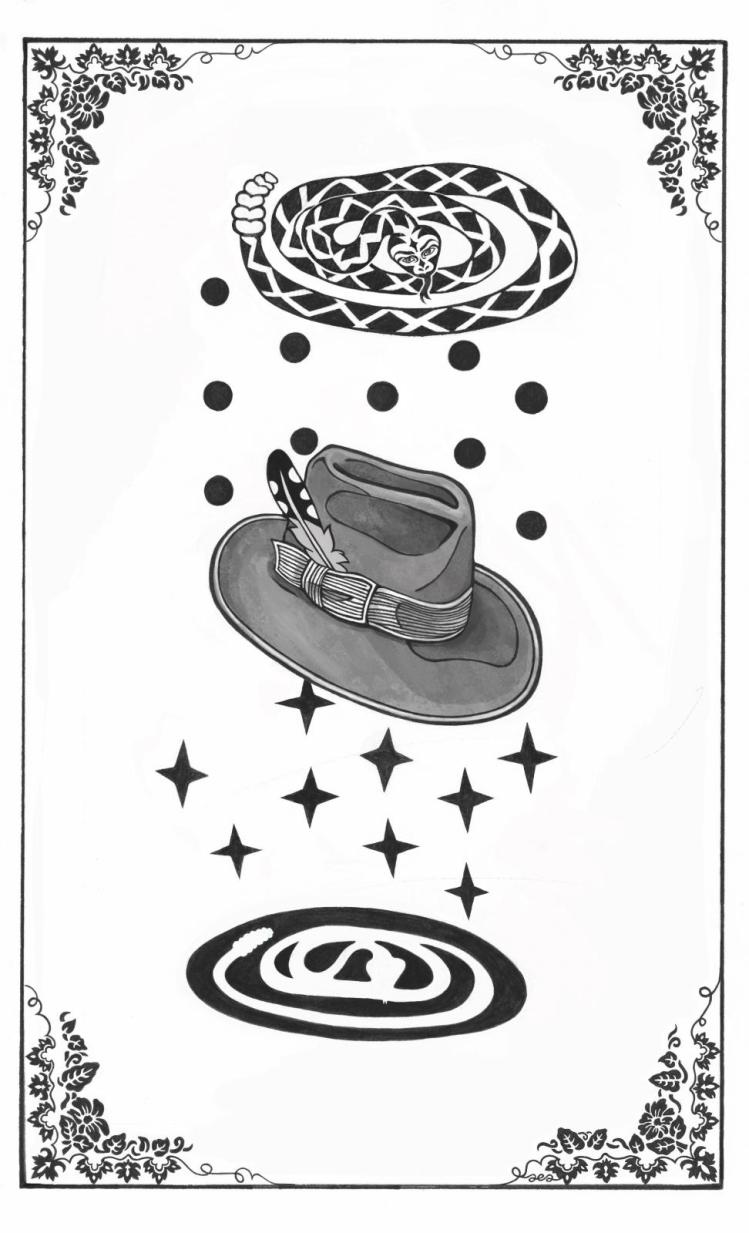
Take, for instance, “Borsalino,” one of the six previously unpublished stories in the collection. The story begins with the narrator telling us about her special hat with a snakeskin coiled in the inner band. We learn that there is something magical about the hat—the snakeskin shakes to warn her of impending danger—but that is not the big revelation of the story. As a young woman, the narrator traveled to Venice, where she met a mysterious young man named Enzo, who turns out to be a ghost (or possibly a vampire?). She returns to Venice sixteen years later with her husband and two young daughters. While busy taking photographs on a water taxi, the narrator hits her head on a bridge; right before impact she snaps a photo of her family that catches her husband’s eager look of anticipation at the coming collision. As it turns out, her apparently loving spouse is a monster, and our narrator needs to enlist Enzo’s help to get rid of him. It is a satisfying twist—surprising and revelatory. She tells us:
But far, far worse, and the reason we fought incessantly, he had begun having these “accidents” with the children. He was so adept that I never saw what happened, nor did anyone else. Who would believe it? He put on such a show as a wonderful father. In academic circles now it would be said he “performed fatherhood.”… And now the photograph I’d taken had showed me a truth: only one of us was getting out of this marriage alive.
Enzo doesn’t directly kill the husband. The narrator tells us, “A few years afterward, my husband took his own life. I had left him and taken our children. He could have gone to court to get them, but we’d brought charges he couldn’t face. Many who knew him held that against me, but it was a matter of survival.”
We can read all this as simply another example of what genre writers have been doing forever—using the conventions of the form to get at a deeper truth. Here that truth is that some seemingly wonderful spouses are actually abusive predators. But “Borsalino” takes on a darker resonance if we know anything about Erdrich’s own marriage. She separated from her husband in 1995; two years later, facing charges of sexually abusing his children, he committed suicide.
Of course, it is reductive to read an entire short-story collection through a biographical lens, but it is hard not to think of Erdrich’s personal history when reading several of these stories. It sheds an interesting light on “Domain”—on the protagonist’s homicidal rage at her father, a celebrated writer and scholar (like Erdrich’s ex-husband), for not adequately protecting her son. It colors the grief that overtakes the bus driver in “The Hollow Children,” who is transporting students in the middle of a whiteout and fears that he hasn’t done enough to keep them safe. And it adds another valence to “Wedding Dresses,” one of my favorite stories in the collection, which begins with the protagonist Dora finding out that a leaky pipe has led to the destruction of her four wedding dresses. Most of the story consists of Dora telling her niece the backstory for each dress, and why each marriage ended, but there are also sections where she tells the reader a truer, fuller story. She tidies things up for her niece, withholding the more traumatic details. As Dora begins to tell her niece about each marriage, “she entered a mad streak of work so she could put the gorgeous damage out into the world.” She salvages what she can from the wreckage of the dresses, and repurposes them into something beautiful and new.
Anger, violence, and resentment are present in these stories, but they do not define the characters. Many of the stories contain traumatic events at their core, but these are related by third parties or presented within frame narratives. In the titular story, for example, the plot is mostly about the few weeks the narrator lived with her grandparents when she was eight, her attempts to train their guard dog, and her uncle’s courting of a young woman despite her father’s objections. But in the middle of this larger story, the narrator recounts a brief anecdote about attending a school presentation of exotic animals. At the climax of the show, a large python escapes and begins making its way through the crowd. It comes face to face with our narrator, but rather than attacking her, it gently touches her right cheek with its tongue and slithers off. She doesn’t know what to make of this encounter.
It isn’t until a hundred pages further into the book, in the story “December 26,” that we read: “If you are…touched by the tongue of a snake, it is somehow good.” So in “Python’s Kiss,” the snake of the title, which initially appeared to be a threat, was bestowing a blessing of sorts. Throughout the collection, we are reminded that things that appear to be good can turn out to be a curse, while things that appear to be threatening can end up saving us. We usually don’t know the true nature of things or people until we have lived with them for a while, and we often don’t understand our own story until later, when we try to tell it.
Python’s Kiss
Stories
Louise Erdrich
Harper
$32 | 240 pp.
We welcome your comments about this article. Please send your response to [email protected].