Remnants of the poems of Alfred Tennyson still make an occasional appearance outside the college survey course. Judi Dench’s character read from “Ulysses” in a James Bond movie. Helen Mirren read the same poem on The Late Show to a visibly moved Stephen Colbert. Colum McCann borrowed a Tennyson line for the title of his novel Let the Great World Spin. And in the Dustin Hoffman movie Marathon Man, a gruff professor scolded his graduate students for not recognizing a quote from the Victorian laureate: “You can’t compete on a doctoral level and not know ‘Locksley Hall’ and ‘Locksley Hall Sixty Years Later.’”
But the legacy of Tennyson for many of us is not the poems themselves. He lives for us rather as an embodiment of the struggle to unify or balance or just cope with colliding ways of understanding the world. Darwin’s exact contemporary, Tennyson lived at an inflection point, with science ascendant and religion on the defensive. In his new biography, The Boundless Deep: Young Tennyson, Science, and the Crisis of Belief, Richard Holmes returns us to a time when advances in scientific and intellectual understanding produced not only perplexity but actual crisis. If AI dazzles and alarms us, the challenge it poses is nevertheless continuous with how we understand ourselves to be navigating a technocratic world. In Tennyson’s time, new discoveries in astronomy, geology, chemistry, and biology displaced age-old assumptions and redefined common sense. What you previously took to be the laws of how the world worked suddenly looked like placeholder myths—or rather, like myths about ourselves rather than descriptions of the world as it really is. The crisis was existential, not merely epistemic, and it landed especially hard on religious belief.
One of the benefits of reading Holmes’s portrait of Tennyson here, as well as his previous volume about Romanticism-era science, The Age of Wonder (2008), is that he reminds us how much of what came to be called the Victorian crisis of faith preceded Darwin’s account of evolution. It was Tennyson himself who gave us the definitive Darwinian image of “Nature, red in tooth and claw,” and he published that line almost a decade before On the Origin of Species. A profound change was already in the air. Prior to Darwin, books like John Herschel’s A Preliminary Discourse on the Study of Natural Philosophy (1831) and A Treatise on Astronomy (1833), Charles Lyell’s Principles of Geology (1833), and especially the anonymously published and runaway bestseller Vestiges of the Natural History of Creation (1844), all contributed to a new picture of the world as something much vaster and much older than previously assumed. This new picture represented the world in natural terms without leaning on a framework of a natural theology. It began competing with, rather than supplementing, orthodox religious descriptions. This implicit competition is part of the reason Tennyson added a religious prologue to his great poem of philosophical struggle “In Memoriam A.H.H.”
As Holmes noted in The Age of Wonder, the converging discoveries and theories in new academic fields gave momentum to the “notion of a great network or connection of sciences” that was “beginning to form a single philosophy and culture.” The word “scientist” itself was coined in the 1830s. This culture of the sciences solidified as Tennyson came of age. In 1831, his classmate Darwin boarded the HMS Beagle and sailed for the Galapagos. It was a fertile time for new ideas, a stressful time for old ones.
Richard Holmes has made a brilliant career out of immersing himself in the life of his subjects. In his remarkable memoir-reflection Footsteps (1985), he describes his attempt to get inside the life and mind of Percy Bysshe Shelley by seeking out the places Shelley went and imaginatively entering into a dialogue with him. “I felt I had the password,” he wrote. His new Tennyson biography began as a Covid project, and so, Holmes confesses, he couldn’t do his usual “footstepping” here. Instead, he does that work imaginatively, tracking Tennyson from his difficult childhood in Lincolnshire to his student years at Cambridge, through his formative friendships, a formative loss, his early poetry, his struggles with money, then finally his marriage and his elevation as poet laureate. It’s a fascinating story on its own, and Holmes tells it with his customary vividness and sympathy. We think easily of the Victorian era as stuffy, repressed, and imperialistic, but Tennyson’s life is full of hesitation, self-doubt, and grief. The timing of that doubt and grief makes him a good case study for the era’s larger crisis of belief.
Tennyson’s story began in a parsonage, where the bitterness of his father, a disappointed, alcoholic clergyman who felt “cheated by life and besieged by his large family,” had a “deeply damaging” effect on his eleven children. Alfred, Holmes writes,
was threatened by exactly the same fatal inheritance as his Tennyson brothers—lethargic drifting, disabling depression, alcoholism, mental instability, or simply black spiritual despair. He struggled with these for all his youth, and certainly for his first forty years. But he did not succumb; he was not extinguished. He wrote poetry instead.
Poetry channeled but did not dissolve this inheritance of personal struggle. Tennyson’s best friend Arthur Hallam described him as being full of “over-anxious thought” and cut off from “light mental pleasures.” Another friend captured his indecisiveness with some wit: “Alfred Tennyson has reappeared, and is going today or tomorrow to Florence, or to Killarney, or to Madeira, or some place where some ship is going—he does not know where.” Tennyson forever worried about his siblings. He couldn’t commit to any one of the three women he courted when he was young. He was frequently ill. Depressed and anxious, he admired the psychological intensity of the new writings of Edgar Allan Poe. Even for a tobacco-stained age, his smoking habit was conspicuous. After meeting Tennyson, chain-smoking is what caught Thomas Carlyle’s eye. Later, Edward FitzGerald, the translator of The Rubáiyát of Omar Khayyám, said Tennyson “must smoke twelve hours out of the twenty-four.”
Even as he began writing poetry as a teenager, Tennyson kept up with advances in science. Already he felt the pressure of new knowledge on old beliefs: “The oxygen and carbon and all the rest of it unsettled me a little, and made me less able to believe, made my faith heavier, duller.” Tracking this unsettledness, for himself and for the broader culture, will give Tennyson a career.
His richest meditation on the crisis of belief began as an elegy. The death of his friend Arthur Hallam devastated Tennyson. Too grief-stricken to write an obituary, he began composing poems that he didn’t publish or share. For sixteen years, he kept adding verses to what became the book-length In Memoriam, which Holmes calls “Tennyson’s masterful surging poem.” Here, personal anguish becomes spiritual bewilderment, and a philosophical and scientific problem becomes an existential crisis. In Memoriam gave us “Nature, red in tooth and claw.” It gave us the phrase “honest doubt.” It gave us verses of spiritual struggle like this one:
I falter where I firmly trod,
And falling with my weight of cares
Upon the great world’s altar-stairs
That slope thro’ darkness up to God
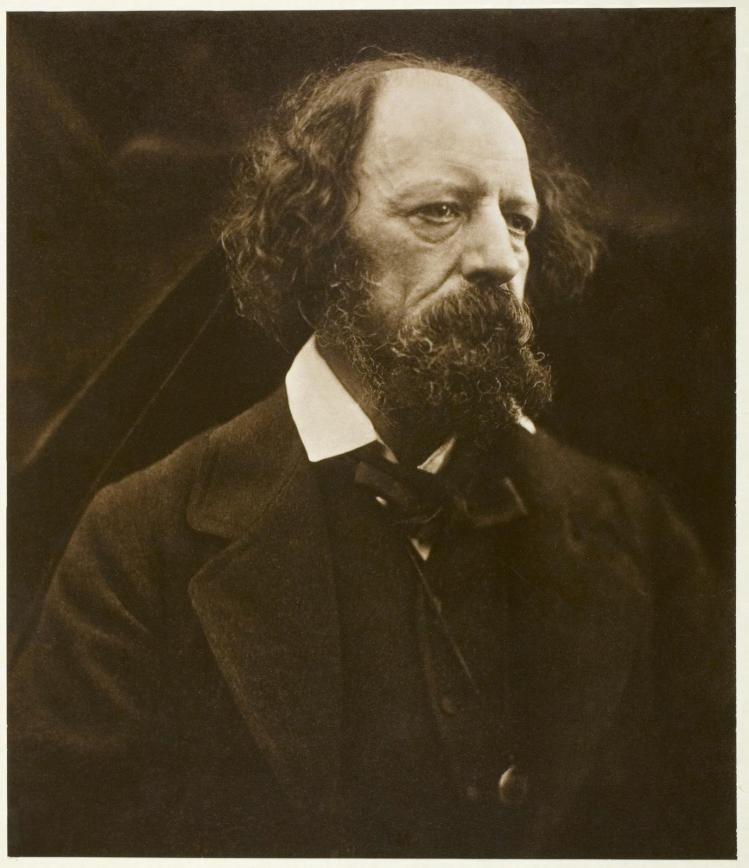
In Memoriam helped Tennyson manage his grief over Hallam’s death, and it gave him a mechanism for registering the existential implications of new scientific ideas. The poem also helped gain Tennyson a wife. Fearing the public reaction to the poem’s skepticism (honest doubt is, after all, still doubt), and worried about how the woman he wanted to marry (Emily Sellwood) would receive it, Tennyson wrote a prologue affirming his own conventional faith. Then, still anxious, he sent an anonymous copy to her. The poem and its prologue became a test exchange, a little like Levin’s shy word-game proposal in Anna Karenina. Undaunted by Tennyson’s honest doubt, Sellwood accepted the poet’s sincerity and then his offer of marriage. The public also enthusiastically accepted the honest struggle of the poem. After it was published in 1850, sixty thousand copies of In Memoriam sold within a year. Among the poem’s champions was Prince Albert. Soon after its publication, In Memoriam led to Tennyson succeeding Wordsworth as poet laureate. Like Dickens and Darwin, he grew out a big beard and became an eminent, if somewhat reclusive, Victorian, retreating to the Isle of Man, where Holmes leaves his story.
The argument between modern science and traditional religious belief is usually told on the Enlightenment’s terms. It is an argument about sources of truth and the nature of evidence and trustworthy reasoning. Holmes’s project, showing us scientific knowledge ascending against a background of Romanticism, is a helpful redescription. Setting the context this way refocuses our attention from empirical method to imagination, from fact to picture, from reasoning to felt experience, from accumulation of detail to gestalt. Scientific discoveries and theories were not just adding to the store of useful facts about the world. They were reorienting a generation.
Edward FitzGerald captured this broader impact in a letter to a friend:
I often think it is not the poetical imagination, but bare Science that every day more and more unrolls a greater Epic than the Iliad—the history of the World, the infinitude of Space and Time! I never take up a book of Geology or Astronomy but this strikes me.
In another letter, he marvels at Lyell’s observations about the thousands of years of work of Niagara Falls on the limestone and on fossilized animals. It’s not his quest for understanding that seems satisfied but rather his need for inspiration. Science becomes here a vehicle for awe: “It is not only that this vision of Time must wither the Poet’s hope of immortality; but it is in itself more wonderful than all the conceptions of Dante and Milton.” Surely images from the Hubble and the Webb telescopes have had similar visceral and emotional effects for us in our day.
The crisis of faith in Tennyson’s time reminds us that religion and science come into conflict when they do because they are both comprehensive pictures of the world and our experience. The breathtaking increase of scientific knowledge in the nineteenth century had implications not just for laboratory experiments but also, and maybe especially, for what people saw when they looked up at the night sky or at the tide lapping a beach, or what they thought when they recited creeds in church, or what they felt when a child was born or died. The era produced other kinds of responses, too. Crisis of faith is not inevitably conquest of faith. The rise of the Oxford movement and an energized Evangelicalism lie just beyond the boundary of this book’s story, offering different answers from Tennyson’s to the teeming questions of the day. Still, Tennyson’s honest doubt clearly struck a chord.
The Boundless Deep is one more vivid volume in the magisterial body of Richard Holmes’s biographical work. One can only hope there will be more. Here he summarizes the scale and the stakes of a crisis that Tennyson spent a lifetime poeticizing, and whose stakes go on reverberating:
It was both an intellectual and an imaginative crisis, the revelation of a whole new world and mankind’s transformed place within it. Today it is difficult to appreciate the profound, bewildering impact this would have had. But a modern equivalent might be the discovery of life—intelligent life, not mere bacterial life, but an entire civilization—on another planet. Our whole view of Creation would have to change.
The Boundless Deep
Young Tennyson, Science, and the Crisis of Belief
Richard Holmes
Pantheon
$35 | 448 pp.
We welcome your comments about this article. Please send your response to [email protected].