Discussion of AI can be overwhelming—both because of the oversaturation of discourse about it in the media and the rapidity of its ongoing incursion into our lives. This is precisely the challenge faced by Pope Leo XIV, who has made AI—and technological acceleration more generally—one of the central themes of his pontificate. How should Christians articulate a theologically grounded response to a phenomenon that is reshaping so many aspects of human life, including the experience of faith?
At the moment, pessimistic perspectives on AI are perhaps more prominent than optimistic ones, with skepticism about the technology emanating even from people who work in the industry—for example, Mrinank Sharma, the Anthropic safety researcher who just resigned with the warning that the “world [is] in peril.” There seems to be a general sense that AI is a fait accompli that few have asked for, yet to which we are all being subjected.
At the same time, as AI insinuates itself into our collective experience, many people, including people of faith, are using large language models (LLMs) as tools for their deepest and most personal inquiries—engaging these LLMs in the roles of partner, therapist, and spiritual advisor, or using them in place of prayer or as a form of prayer—with results ranging from psychotic breaks to spiritual epiphanies.
Amid all this ambivalence, Roman Catholics, and especially laypeople, are increasingly engaging AI directly as an instrument of evangelization and catechesis. An evolving network of digital Catholicism is becoming increasingly mainstream and central to the religious experience of many young people. In my own social-media feeds, for instance, I regularly encounter advertisements for the Catholic AI app Truthly, a Catholic chatbot designed to provide instant, reliable, and conversational answers to questions about the faith. And Truthly is not the only app like this: its competitors include Justin, sAInts Chat and Magisterium AI—all examples of the emerging domain of “faith tech,” which has begun attracting major investment. These apps raise new questions about how faith formation is mediated by the ever-evolving conditions of digital space.
As with other technological developments, the Church continues to emphasize caution without altogether foreclosing the possibility that AI could be an effective tool for the Church. Pope Leo XIV recently remarked, “The task…is not to stop digital innovation, but rather to guide it and to be aware of its ambivalent nature.” Leo XIV’s rhetoric carves a careful path between two poles of Christian response to technological acceleration. One pole is represented by the optimistic evolutionary mysticism of Teilhard de Chardin, which could view machine learning as a new phase of the embodiment of the Holy Spirit in the material world. The opposite pole is the radical techno-pessimism of Jacques Ellul, which sees technological “progress” as a parasitic, self-evolving process in which the tools we use come gradually but inevitably to use us, and from which the only escape is the irreducibly human community of the Church.
The Church’s fullest pronouncement on AI so far has been Antiqua et nova, the Vatican’s document on the relationship between artificial and human intelligence, published by the Dicastery for Culture and Education near the end of Pope Francis’s pontificate. Insisting on the qualitative distinction between human intelligence and its artificial counterpart, Antiqua et nova affirms the need for a “wisdom of the heart” through which to discern the right and wrong uses of AI.
More generally, the intersection of theology and technology has become increasingly prominent in public discourse: Peter Thiel’s recent talks in Rome on AI and the Antichrist frame the current moment in explicitly apocalyptic terms, prompting Catholic thinkers to articulate a more coherent theological response and underscoring the Church’s potential role as a bulwark against technocratic acceleration.
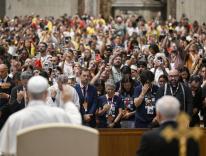
While Leo XIV has not yet spoken to AI’s ethical complexities at such length, he has made clear the height of the stakes. When in November he addressed more than fifteen thousand young people via video at a national Catholic youth conference in Indianapolis, Leo pointed to the risks AI poses to cognitive and spiritual development: “AI can process information quickly, but it…cannot offer real wisdom. This is a very important human element.” Perhaps the most memorable line from Leo’s address was his warning, “Don’t ask it to do your homework for you.” More recently, in an address for World Communications Day in early January, he used even stronger language: “Do not renounce your ability to think.” Leo has recently instructed priests not to use AI chatbots to write their homilies, and warned them not to chase “likes” on social media. These are all signs that his pontificate is becoming increasingly sensitive to the influence of digital technology on the life of the Church.
But if it’s a theological priority to distinguish between human and artificial intelligence, what’s the point of having these Catholic apps simulate the human element in the first place? How is their catechetical function enhanced by their being not only informative but conversational and even somewhat pastoral? And if AI shouldn’t “do your homework for you,” or do your thinking for you, why should it be playing any role in spiritual formation at all?
It’s with these questions in mind that I’ve been experimenting with the Catholic AI app Truthly. The app offers a simple and accessible user experience: ask it questions about matters of Church doctrine and theology, and it provides detailed answers and references for further reading. But in addition to all this, it also seeks to involve the user in further dialogue. Much like other LLMs such as ChatGPT and Claude, its responses often end with questions encouraging further conversation, like a teacher encouraging a student (“What do you think about the role of digital platforms in faith formation?”).
But unlike the most popular LLMs, which have broad access to web searches and constantly evolve their datasets and therefore their “perspective,” Truthly is more strictly limited to the boundaries of its catechetical function; it purports to deal strictly in the “timeless truths” of the magisterium. Asking a question outside of those bounds elicits a response such as “My function is limited to providing information that aligns with Catholic teaching and values.”
In its conceit (and in its very name), Truthly is emblematic of the way American Catholicism tends to operate in virtual space: like other Catholic content, it offers an easily accessible articulation of the capital-T Truth—something that comes at an especially high premium in a world where a superabundance of information creates uncertainty and ambiguity. Need answers? Here they are, offered with the certainty of a theological encyclopedia and the affect of a podcast host.
In short, Truthly offers a magisterial clarity of a very particular kind—not the living tradition of the Church with all its dynamic tensions, but a representation of the faith at its most rigidly dogmatic. When I asked it about controversial issues like blessing same-sex unions or women’s ordination, it was less immediately forthcoming in providing references to the Church’s more marginal voices and “dissenting” theological perspectives. Catholic theologians who explore these perspectives do exist, of course, but their work seems to be intentionally excluded from Truthly’s design—or at least sidelined by it. When asked directly about such theologians, it makes a point to remind the user that “not all aspects of [these theologians’] thought align perfectly” with the Church.
Truthly reflects the same conservative theological orientation that characterizes many, if not most, Catholic social-media spaces. In these spaces, and in the robust array of Catholic “faith tech” (like the widely advertised prayer app Hallow) we see the emergence of a sort of techno-Catholicism that leans into the accelerating digitization of faith experience, and seeks to populate virtual space with very clearly defined versions of Catholic identity. These versions are well suited to digital culture at large, which tends to flatten nuanced discourse and cluster users into fixed identities.
But in spite of these tendencies, Truthly is not an inflexible interlocutor: when prompted with a more personal inquiry, it adopts a more pastoral rhetorical mode. I tested this by asking it questions about vocational discernment. In addition to providing me with external resources, it asked me probing, qualitative questions about my spiritual life. Thus, while careful to note its nonhuman and nonauthoritative status, the app does open a space of relationality that exceeds its doctrinal function.
In this strange interplay of personal responsiveness and programmatic doctrinal certainty, the experience of interacting with Truthly is not unlike talking to some priests. In particular, it calls to mind the “manual tradition” that dominated Catholic moral theology in the nineteenth century, amid the analogous techno-cultural upheavals of the Industrial Revolution. Confessors in this era would consult official manuals of moral theology, prescribing exactly which penances should be applied to particular sins. This confessional culture was especially important in the spiritual formation of Catholics in the United States. Truthly can feel like an accidental heir to these manuals, applying clearly defined dogmatic certitude to the particular needs and interests of the individual user.
It’s interesting to reflect on these concepts of “dogma” and “certitude” in the context of language-based AI, which operates with such a different relationship to “truth” from that of human beings. LLMs generate language using a probabilistic algorithm—when they “speak,” they are not employing words as symbols that refer to some fact or idea. Rather, they are arranging “tokens” (the units in their data set, such as words, letters, and punctuation) according to the statistical probability of their appearing in a given sequence. It is a process not of symbolic representation, but of statistical prediction. This is the crucial point of Antiqua et nova: whereas the “intelligence” of an AI system consists in its ability to “produce appropriate responses,” our intelligence consists in the uniquely human faculty of intellectus, “the intuitive grasp of the truth…apprehending it with the ‘eyes’ of the mind.”
But this classical Thomistic-Aristotelian understanding of the self—a perceiving and rational “I” that observes reality from within—is hardly taken for granted by modern philosophy and cognitive neuroscience; and it is significant that the origins of AI and machine learning have run parallel to twentieth-century scientific and philosophical perspectives that reject the classical view. Alan Turing’s seminal work, which formed the basis of early advances in machine learning, treated the mind not as a metaphysical entity, but as an operational process: the criterion for intelligence was not the presence of some essential, interior intellect, but the evidence of an external performance. According to the famous “Turing test,” if an artificial intelligence can be mistaken for a human one, then it is indeed functionally intelligent. Alongside later developments in cybernetics and neurology, subsequent models of machine learning came to model intelligence in terms of associations and patterns that can be trained, rather than an “I” with consciousness making active cognitive choices.
The radical implication of such functionalist models of cognition is that the human mind itself may not in fact grasp and represent truth in the classical sense but should instead be understood as a mimetic interplay of linguistic patterns—or a network of habitual psychological associations and socially conditioned behaviors. Whether or not one accepts such a view, it was precisely the abandonment of the need to recreate the interior life of conscious “subject”—a “ghost in the machine”—that allowed AI research to shift toward systems optimized for performance rather than understanding.
Significantly, this modern skepticism about our ability to grasp and represent objective truth, or about the importance of that ability, was officially rejected by the Catholic Church when it first appeared. In some ways, this rejection was strengthened by the previous Leo, Pope Leo XIII, who stood at his own crossroads of techno-social change, a connection Leo XIV emphasized in his Ash Wednesday homily. Leo XIII’s encyclical Aeterni patris called for a revivification of Classical Thomism, the very perspective from which modern machine learning and cognitive neuroscience depart so radically. This means that today’s hyperdogmatic Catholic chatbots are something of a contradiction—their algorithm relies on a model of intelligence that implicitly rejects the older, classical model on which many of the Church’s teachings are based.
But a question remains: Are these apps even effective at what they purport to do? Do they, in fact, empower users to “seek, live, and share the truth” in a way they otherwise couldn’t, as Truthly’s advertisements promise? I put this question to Fr. Gregory Pine, a frequent contributor to online Catholic channels like The Thomistic Institute and Godsplaining, where he shares consistently nuanced takes on the Church’s presence in the digital realm. Pine acknowledges that at least one of the reasons digital Catholicism is leaning into AI is simply that it’s “the thing to do”—Catholics are taking up space in a sector where more and more people will seek guidance and trying to use it for good. More to the point, many of the most prominent Catholic content creators often rely on these AI companies, and other Catholic faith tech, as sponsors, and so they have a natural incentive to support the apps as a valid apparatus of faith formation.
But the deeper pedagogical, and therefore catechetical, problem, Pine observes, is the fact that automating intellectual synthesis may in fact be detrimental not only to intellectual development but to the process of faith formation itself. As Pine puts it, the task of the human intellect is that of “pulling forth from the potentially intelligible, something actually intelligible.” In other words, we have to be able to make sense of reality for ourselves, in order to actualize our potential as rational creatures. This goes not only for our apprehension of the material world around us, but also for the apprehension of ideas. Our ability to read and write for ourselves is not only a functional means to an end but also an intrinsic aspect of human flourishing.
Some commentators raise even stronger objections. Marc Barnes, for example, has written an article in New Polity titled simply: “Delete Magisterium AI.” In a debate with Magisterium AI founder Matthew Harvey Sanders on the Faith and AI Project podcast, Barnes argues not only that it’s confusing to offer ostensibly certain truth in a probabilistic medium but also that AI bot is inherently unfit to serve as a catechist because personhood is an essential aspect of catechetical truth itself. The truth of the Church is transmitted in “eyewitnesses in a chain of catechesis…going back to someone touched by the Lord.” In short, the teachings of the faith can be transmitted and received only by persons.
Concern about the dangers of “disembodied knowledge” can be traced back through the history of language technologies. In the myth of the origin of written language in Plato’s Phaedrus, the Egyptian King Thamus is concerned that the gift of writing will cause people to lose their embodied memory—and therewith their capacity to participate personally in the Truth—as they become habituated to recording their words with external symbols. “Embodiment” is another prominent theme in Antiqua et nova and plays a key role in the Church’s resistance to the incursion of the virtual: while virtual space can be relational, it can never be sacramental—for sacramentality requires the communion of human persons, body and soul, in physical space and time.
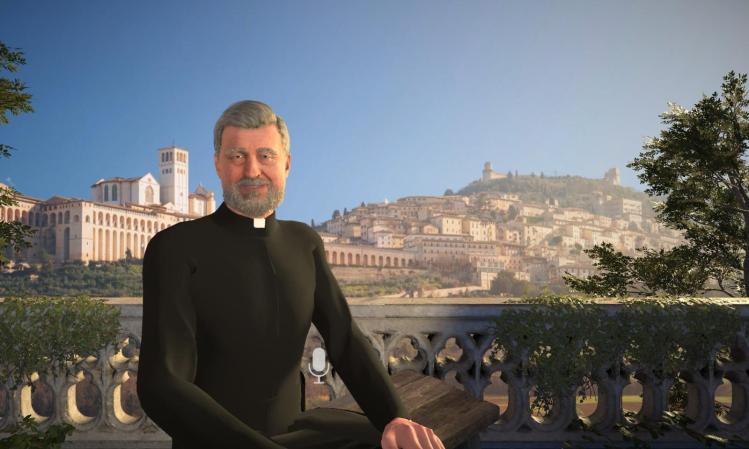
Hence, while some Protestant churches have explored “digital sacramentality,” occasionally offering virtual baptisms and Communion, the Catholic Church still categorically rejects those innovations. The Catholic AI “Justin” was originally named “Fr. Justin,” debuting in the role of a digital confessor—but this was swiftly rejected, and within a day “Fr. Justin” was “defrocked.” Notably, Pope Leo XIV has refused to authorize “artificial” versions of himself—emphasizing in his first interview as pontiff that “if there’s anyone who shouldn’t be represented by an avatar, it seems to me, it’s the pope.” If digital experience splits reality, as the AI ethicist Luciano Floridi argues, by bifurcating time and space, the physical and the virtual, embodiment and intelligence—the Church insists on putting it back together by anchoring sacramentality firmly in the material world.
I asked Truthly itself about some of these tensions. After praising the depth of my questions (it’s not as sycophantic as ChatGPT, but still quite obsequious), this is how Truthly replied: “While AI can provide information and assistance, it will never replace the personal encounter with God that faith offers…. Ultimately, faith invites us to go beyond what is seen and measured, opening our hearts to the infinite love and wisdom of God.”
This statement may not seem theologically remarkable, but surely it is remarkable that a machine is able to produce a coherent theological utterance at all. Precisely because of the swiftness of AI’s development, “we have already forgotten how weird this is,” as Jasmine Samra writes. As we theorize about the distinction between a human catechist and an artificially intelligent one, it is worth reminding oneself—and marveling at—how very strange it is that we are living at a moment when the latter could be so compelling as to make such a discussion necessary.
As these apps, and other Catholic faith tech, continue to grow in visibility and popularity, there is increasing need for a holistic theological response. While many of the objections to AI are raised on the basis of Classical conceptions of consciousness and personhood, we may need new theological categories to adequately address the subject: the Church’s venerable theory of intellect and personhood will not help us predict how actual human persons, much less whole societies, will evolve in response to AI.
Theology itself is always intimately bound up with the discourse technologies of its time—Thomistic theology is inherently tied to the written word, just as the Gospel originally arises from the spoken one. While changing discourse technologies do not change the nature of truth itself, they do change the way truth is understood, experienced and expressed. It remains to be seen how much Truthly and other Catholic media technologies, with their capacity for simulated relationality, will transform the way the Church’s message is received and lived.
We welcome your comments about this article. Please send your response to [email protected].