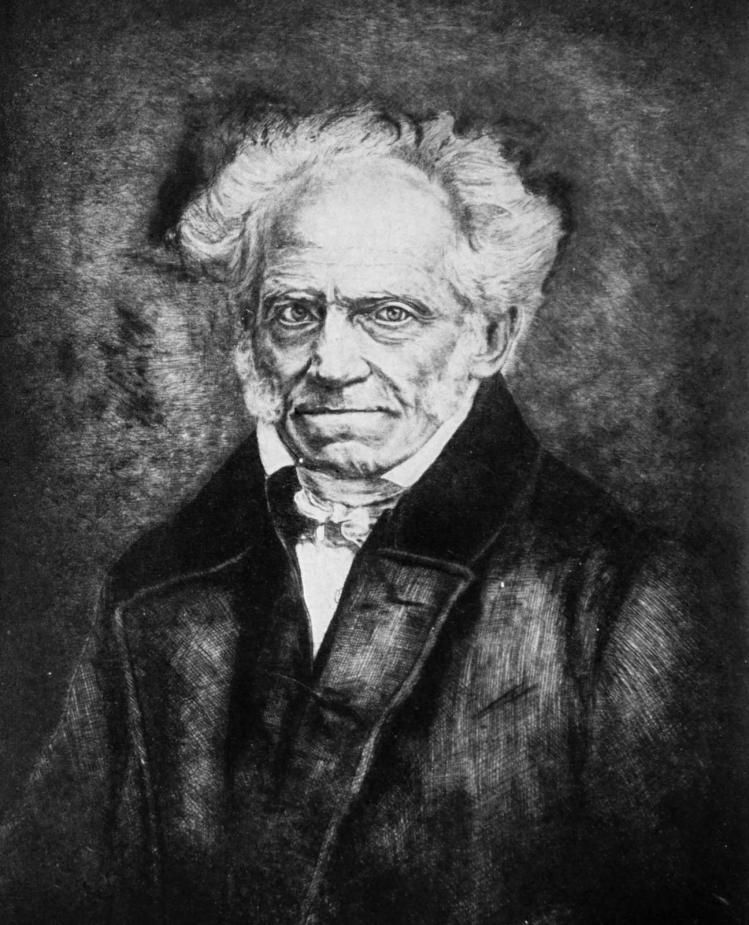
In 1807, Johanna Schopenhauer sent a spectacular letter to her nineteen-year-old son, who would shortly rejoin his mother and sister in Weimar after a stint working as a merchant’s apprentice in Hamburg. At the prospect of this little family reunion, Johanna groaned with misgivings. “You are not an evil human,” she began her letter, “you are not without intellect and education; you have everything that could make you a credit to human society. Moreover, I am acquainted with your heart and know that few are better, but you are nevertheless irritating and unbearable, and I consider it most difficult to live with you.”
The rest of Arthur Schopenhauer’s life would appear to corroborate this claim: the German philosopher never married, had no intimate friends, and never experienced any lasting romantic relationship. The creatures closest to him were his poodles, of which he had several. When a boyhood friend tried reconnecting with him in middle age, he was appalled at how disagreeable Schopenhauer had become. Even Goethe thought him “difficult to know.”
What was wrong with him? Schopenhauer himself believed he was born with a melancholy temperament. The scholar David Bather Woods, in his admirable new biography, Arthur Schopenhauer: The Life and Thought of Philosophy’s Greatest Pessimist, wonders whether the death of Schopenhauer’s father in 1805 doesn’t offer a better explanation. Until then, at least, Schopenhauer’s life had been fairly comfortable. Born in Danzig in 1788, he was mostly raised in Hamburg, the eldest child of wealthy, cosmopolitan, and Anglophilic parents. In 1803 and 1804, the Schopenhauers took their son on a grand tour of Europe that included France, the Netherlands, Switzerland, Austria, and England, where the teenage Schopenhauer spent a miserable twelve weeks at a boarding school in Wimbledon.
Shortly after the family’s return to Hamburg, Schopenhauer’s father drowned in the canal behind the family home. As Bather Woods shows, Schopenhauer’s later preoccupation with suicide was shadowed by the family’s suspicion that his father had killed himself. But in the immediate short term, his father’s death meant that he was free to abandon the career trajectory that had been laid out for him, and to live the philosophical life he longed for instead. In an ironic twist, Bather Woods claims the very life made possible by his father’s death “was itself the primary source of Arthur’s misery.” Schopenhauer genuinely believed this vocation was something worth sacrificing personal happiness for. “Life is an unpleasant business; I have resolved to spend it reflecting upon it,” he wrote to the poet Christoph Martin Wieland.
What’s more, with enough inheritance to live on, Schopenhauer had no need of a salaried profession, no desire to start a family, and didn’t care enough to set up a proper home for himself. (He didn’t buy his own furniture until he was fifty years old.) And though he completed his dissertation, On the Fourfold Root of the Principle of Sufficient Reason, and was awarded a doctorate in 1813, he was temperamentally unsuited to academia. Schopenhauer’s brief stint as a Privatdozent (an unsalaried university lecturer) in Berlin eventually came to naught: only a handful of students attended his classes, which he’d arrogantly scheduled to coincide with Hegel’s lectures on the philosophy of history. He even engaged in a dispute with Hegel during the test lecture he had to give to qualify as a Privatdozent. As the University of Berlin’s chair of philosophy, it was up to Hegel to decide whether to let Schopenhauer be a lecturer. Charitably, he did so.
Like Kierkegaard and Nietzsche after him, Schopenhauer instead became one of the great renegade philosophers of the nineteenth century. And like them, he needed to be patient; recognition of his originality and genius was slow to arrive. The publication of The World as Will and Representation in 1818, when Schopenhauer was just thirty, was not the runaway success he’d hoped for, even if Goethe “dipped into it on several occasions,” as Bather Woods writes. When Schopenhauer approached his publisher a decade later about the possibility of a second edition, he was politely told there were still 150 copies left from the original printing.
Strangely, given his freedom to do as he wished, The World would remain the only major work of philosophy Schopenhauer ever published. Parerga and Paralipomena, the 1851 essay collection in two volumes that finally led to a broader public interest in his work, was more of an expansion of the themes of The World than a standalone work in its own right. Then again, Schopenhauer was simply not interested in the “architectonic connection or coherence,” as he put it, of German philosophy as commonly practiced at the time. As he teasingly wrote in the preface to its first edition, The World contains only “a single thought,” albeit one whose consequences were so far-reaching it would change the way we conceive of our existence.
What was it? As Bather Woods shows, Schopenhauer’s “single thought” was actually the expression of “an entire worldview,” one that struck many early readers as pitiless and miserable in the extreme. At its most basic, his idea was that all existence is the manifestation of an ungovernable will-to-life: “The will, considered purely in itself, is devoid of knowledge, and is only a blind, irresistible urge,” Schopenhauer claimed. Recognizing that we are both a part of the world and exist apart from the world, Schopenhauer’s philosophy posits estrangement as one of the basic realities of the human condition. In a celebrated passage, he compared the individual being to a boatman “trusting his frail craft in a stormy sea that is boundless in every direction, rising and falling with the howling, mountainous waves.”
Since we cannot know what this vaster will that wills all things to exist actually is—indeed, since it is, strictly speaking, not a “thing” at all—we remain the blind subjects of a process of unending struggle and strife with only a few, fleeting moments of respite, like sex and aesthetic experience. In other words, life is a state of almost uninterrupted suffering. “If suffering is not the closest and most immediate goal of our life, then our existence is the most inexpedient thing in the world,” Schopenhauer writes in the opening sentence of “On the Sufferings of the World.” In the same essay, he pitilessly distills his belief that existence is really a kind of cosmic blunder, a terrible mistake remedied only by death. “If one imagines the sum of distress, pain and suffering of every kind,” he wrote, “then one will have to grant that it would be much better if the sun had not been able to produce the phenomenon of life any better on earth than on the moon.”
Though he felt there was some “metaphysical truth” to the Christian notion of original sin, Schopenhauer remained an avowed atheist. For him, human suffering was not the result of any sin, individual or collective; rather, it was inherent in the nature of our existence. We have been made to suffer for no other reason than that we exist. The idea that “a God such as Jehovah, who wantonly and for pleasure creates this world of distress and misery and then even applauds himself with ‘everything was very good’—that is unbearable,” Schopenhauer wrote.
But given that we’ve nevertheless been willed to exist, what are we to do? One of the virtues of Bather Woods’s biography is that it encourages us to follow Schopenhauer’s pessimism through to the kernel of compassion at its center. “Schopenhauer’s picture is bleak because he severely doubts that we will ever come close to the happiness we so crave,” Bather Woods writes; “but it would be far bleaker, intolerably bleak, if in the midst of it all we couldn’t still love one another.”
Schopenhauer might not have put it in quite such syrupy terms, but the point is a crucial one. The basis of his ethics was a kind of solidarity of the suffering. In one of his later essays, he even suggested that we greet our fellow beings, not as “Monsieur, Sir, etc.,” but as
Leidensgefährte, Soci malorum, compagnon de miseres, my fellow-sufferer. As odd as this may sound, still it is consistent with the matter, sheds the proper light on others and reminds us of the most essential things, of tolerance, patience, forbearance and love of one’s neighbor, which everyone needs and therefore everyone owes as well.
Though Schopenhauer renounced some of the most meaningful experiences in life—marriage, children, friendship—he was no self-enclosed hermit, either. With a rich sense of the world he inhabited, Bather Woods shows that Schopenhauer spent most of his adult life in the rapidly expanding cities of Berlin, Dresden, and Frankfurt, and even made a number of long journeys to Italy. Bather Woods also singles out “worldliness” as one of Schopenhauer’s core values, and repeatedly demonstrates that his thinking was the result of an active engagement with the turbulent and changing world around him. His daily routine included reading The Times of London, which during the 1830s and ’40s carried a number of reports on the use of solitary confinement in prisons in Pennsylvania. These reports clearly affected Schopenhauer, who in the second edition (1844) of The World added lines about “Pennsylvania’s strict penitentiary system” and its “horrible” use of boredom as “an instrument of punishment.”
Schopenhauer also helped destigmatize suicide by thinking and writing about it at length (no easy task, given his father’s fate), and as a student in Berlin he visited mental patients in the psychiatric wing of Berlin’s Charité hospital. “Minus the therapeutic intent,” Bather Woods writes, “it could be said that Schopenhauer pioneered the talking method later associated with Freud, for that’s all he appears to have done: he simply spoke with the patients.” He was also a passionate opponent of animal cruelty and kept up with the latest developments in the animal-welfare movement around the world, including corresponding with Ignaz Perner, the founder of the first German society for the protection of animals. Bather Woods also shows that Schopenhauer considered same-sex relationships natural, entertained thoughts about marriage that belie his sexism, and was appalled by the North Atlantic slave trade.
A little awkwardly, Bather Woods sometimes rushes to apologize for his subject, as though he suspects the reader’s health will not prove robust enough for Schopenhauer’s more unpalatable views. Bather Woods is thus quick to diagnose him early on as “regrettably sexist” and later writes that his views on race were “not admirable in every respect.” On occasion, Bather Woods says, Schopenhauer “revealed attitudes that were stuck in their time, or even lagging behind it in a deeply repellent way.” Bizarrely, he even faults him for not being a vegetarian. But I suspect most readers will understand that there is nothing shocking about a German man born in 1788 having held now antiquated views. What should surprise us is how far ahead of his time his thinking did lead him. I don’t think Bather Woods quite does him justice on this score.
To give just one example, Schopenhauer’s essay “On Ethics,” collected in the second volume of Parerga and Paralipomena, is an effective and often witty repudiation of the Eurocentric worldview so dominant in the nineteenth century. After declaring “our entire civilized world [to be] only a great masquerade,” Schopenhauer rages against industrialists, speculators, Christian missionaries, and the “bigoted, church-going scoundrels” in North America who enslave their “innocent black brothers.” He cites an 1841 book published by the British Anti-Slavery Society documenting the treatment of slaves in America and calls the slave-owning states “an infamous stain on the whole of humanity.”
Schopenhauer’s youthful discovery of Indian philosophy, particularly Buddhism and Hinduism—he called the Upanishads “the consolation of my life and it will be that of my dying”—inoculated him against high-minded colonial rhetoric and the fundamentally rapacious notion of “a European balance of power.” In “On Ethics,” he reserves special venom for British missionaries in India and the “thoroughly medieval manner” their supporters in Parliament express themselves about “the original religion of our species.”
I don’t mean to suggest that Bather Woods doesn’t acknowledge all this, only that his unnecessary apologies and disclaimers risk muffling the impact of Schopenhauer’s—and, by extension, his own—arguments. Hopefully not too much, because this worldlier, compassionate Schopenhauer might just be a necessary tonic for our contemporary ills. What better way to begin rebuilding our moral community than by greeting strangers as fellow sufferers? For this reason alone, the great pessimist’s ethics of compassion and solidarity is one we urgently need now.
Arthur Schopenhauer
The Life and Thought of Philosophy’s Greatest Pessimist
David Bather Woods
The University of Chicago Press
$30 | 296 pp.
We welcome your comments about this article. Please send your response to [email protected].