Aside from his many excellent novels, Philip Roth made two lasting observations about the social situation of American novelists. The first dates to a March 1961 issue of Commentary magazine; in “Writing American Fiction,” Roth lamented the difficulty that novelists confront when trying to convey the excesses and absurdities of actual American life, because it always beats the wildest imaginings. Just think, for a moment, about the latest news out of Washington, or the gargantuan Costco product you most recently bought. More than sixty years later, Roth remains right. His second significant observation was about life outside America. In a 1990 interview in The New York Review of Books, he reflected on Cold War–era meetings with European writers behind the Iron Curtain: “It occurred to me that I work in a society where as a writer everything goes and nothing matters, while for the Czech writers I met in Prague, nothing goes and everything matters.”
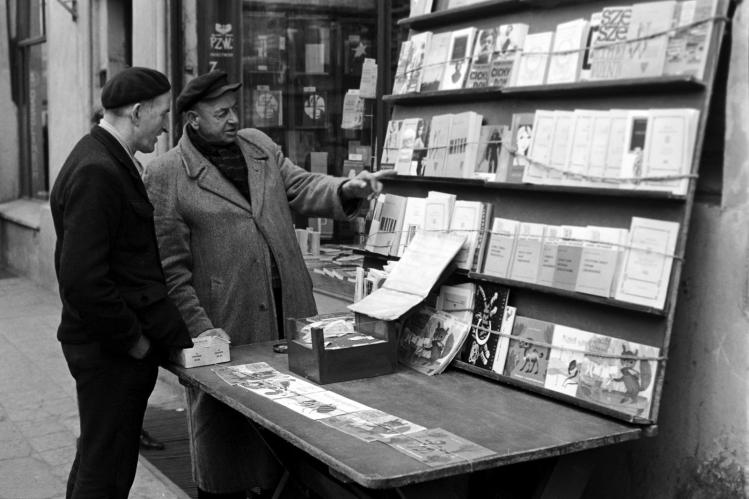
This insight came to mind repeatedly while reading The CIA Book Club, Charlie English’s spirited and challenging exploration of U.S.-backed dissident culture-warring in Communist Poland, a place where, for instance, a man was given an eight-year prison sentence in 1985 for distributing a brochure. English writes with verve and enthusiasm that match the genuine suspense and high stakes of successive efforts to get banned books and other materials into Poland and to get suppressed Polish writings out. English’s book is challenging because of the undeniable fact that those banned works from abroad—which Polish writer Adam Michnik describes as “a reservoir of freedom, of independent thought…of human dignity”—came courtesy of the CIA.
Did that make you wince? I imagine so. Because if you’re reading Commonweal, I’d wager you’re as committed to the free circulation of books and ideas as you are leery of the idea of a state intelligence service organizing this circulation. But don’t worry, you’re in good company in not liking this connection. The CIA didn’t like it either. Its Eastern Bloc–focused book-distribution program began in 1951 and concluded in 1991, but its existence wasn’t publicly acknowledged until the early 2000s. English’s source material includes interviews with some of the people directly involved with the program (the agency’s files remain classified), but the CIA itself does not seem to take much pride in it. According to the agency’s own former chief historian, Benjamin Fischer, the program was not in keeping with what the CIA regarded as its core function. English writes:
U.S. intelligence leaders liked to project [an image] of the CIA [as] an organization packed with spooks and paramilitaries who fought in war zones, in sharp contrast to the more intellectual pursuit of sponsoring books and publishing. “The bottom line was that it didn’t fit their image of themselves as CIA operators who went around recruiting spies,” [Fischer] said.
Indeed, among the hundreds of ordinary but crucial players in this story is a group of math and physics professors waiting for intellectual contraband at a Polish poultry farm.
The prime mover in what English declares “the most highbrow intelligence operation ever undertaken” was George Minden, a Romanian-born academic and anti-Communist who secured CIA funding for the Manhattan-based International Literacy Center. At one point, this organization was under investigation by the New York Post Office for “suspicious activity, and the CIA had to step in to explain the scheme to the chief postal inspector in Washington.” Beginning in the 1950s, Minden and his associates, working primarily with Polish exiles and émigrés based in France, created pathways for the delivery of books and periodicals into Poland. This country was the primary focus of the project because of its preeminent size, strong cultural identity among Warsaw Pact countries, and extensive antiregime diaspora. Materials included The New York Review of Books and Manchester Guardian Weekly, translations of Orwell’s 1984, and fiction, essays, poetry, and drama by Boris Pasternak, Hannah Arendt, Albert Camus, Virginia Woolf, Vladimir Nabokov, and John le Carré, among many others. In fact, much of English’s chronicle reads like the plot of a le Carré thriller, given the espionage involved in getting these forbidden works to Polish readers. The efforts ranged from balloon drops to anonymous direct mailings based on names and addresses culled from phonebooks to large-scale smuggling operations that involved tons of material brought into the country by tractor-trailers ferried from Sweden with switched license plates, code names, and police scanners monitoring Polish intelligence.
We live in an age when reading itself seems to be in terminal decline amid the metastasizing presence of artificial intelligence. As such, it’s tempting to enjoy English’s work solely for the delight of remembering a time when books were still an incomparable source of liberty and dignity to millions and therefore also the focus of high-stakes intercontinental intrigue. Books were so valued as a tool in the Cold War that the U.S. government was willing to spend millions of dollars on this secret CIA program.
As striking as that affirmation of books seems now, English can be a little too enthusiastic at times in presenting the original story. He’s given to distractingly clever chapter titles and goes in for needlessly breathless language and romantic image-making. He does this in service of stories whose combined human and geopolitical drama suffices to command attention more plainly. We read, for example, of a journalist working at an underground newspaper who had to pour cold water on herself to stay awake while singlehandedly preparing a special issue of the paper to cover an August 1988 mass strike.
Beyond an array of such anecdotes—in 1977, “a young Polish civil servant reached Sweden with 700 pages of secret material taped in watertight bags to his back and legs” that exposed the regime’s “corruption, brutality and incompetence”; the CIA “used cutouts to channel money to the [Polish] opposition” and one such “stand-up guy might be a multimillionaire who owned a group of shopping malls in New Zealand”—the book’s greater significance rests in the insights it offers into the history of modern Poland. This history runs from the early years of the Cold War to the 1980 emergence of the Solidarity movement led by Lech Wałęsa; the 1981 imposition of martial law under General Wojciech Jaruzelski and the suppression of Solidarity and widespread arrests of protesters and dissidents that followed; the brutal 1984 killing, by members of the state security apparatus, of the popular pro-Solidarity priest Jerzy Popiełuszko; and the formal legalization of Solidarity, fall of Communism, and first free elections, in 1989.
The Catholic Church exerts a recurring presence, spiritually and practically, throughout this history. In fact, while the CIA program’s general idea was to ensure that as many ordinary Poles as possible had access to materials otherwise banned or unavailable, there was at least one especially notable reader. Polish cardinal Karol Wojtyła sent thank you postcards for the English- and Polish-language books he received from the International Literacy Center in New York, though English notes he “probably didn’t know who was behind the scheme.” His appreciation for direct access to otherwise banned or unavailable titles mattered in a suddenly new way in October 1978. As English observes, “When Cardinal Karol Wojtyła was elected Pope John Paul II, the CIA told [President] Carter’s national security team with pride that the new pontiff had been one of the book program’s correspondents.” At a more ordinary level, parish churches around the country served as primary distribution centers for the materials. Given the pervasive influence of Catholicism in Poland, ironically strengthened by Communist efforts to diminish it, churches were reliable places to go not only to pray and be with others, but also to get good things to read. To his credit, English neither over- nor under-values the Church’s distinct and formidable role as the great counterweight to Communism and the Soviet-commanded state in Cold War–era Poland.
Even as the provision of books and periodicals from the West still mattered, technology became more important, ranging from typewriters and the hardware needed to publish and distribute newspapers to consumer-friendly audio-visual equipment (what Benjamin Fischer calls the “Radio Shack Revolution”) and finally, most decisively, to satellite dishes that gave ordinary Poles unmediated access to Western news and entertainment. At the same time, Minden and the program’s other U.S. proponents had to deal with different kinds of pressure domestically. Some of this came from skeptics within the CIA, who preferred covert operations that were straightforwardly military, as with agency support of the mujahideen fighting the Soviets in Afghanistan (Operation Cyclone). Meanwhile, officials at the State Department and White House wanted to sustain U.S. support of pro-democracy efforts but also to avoid blowback if a smuggling-operation-gone-wrong exposed U.S. involvement in another country’s affairs—especially a country squarely inside the Soviet sphere of influence. English notes that members of the Polish intelligentsia knew that, for all the covers, ruses, convoluted backstories, and supply routes, a very specific entity was funding their activities, and this was not openly discussed. Indeed, whether inside or outside Poland, or inside and outside the CIA, everyone involved in this decades-long, multimillion-dollar project wanted to keep it a secret. It’s an open secret now, thanks to Charlie English’s engaging new work, which brings to life a time and place where, as Philip Roth said, “nothing goes and everything matters,” and where reading the wrong literature was still considered a subversive and risky political act.
The CIA Book Club
The Secret Mission to Win the Cold War with Forbidden Literature
Charlie English
Random House
$35 | 384 pp.