Tochan, a shelter for migrant men in Mexico City, opened in 2011, a time when tens of thousands of migrants from Central America would make the perilous journey through Mexico riding atop the train called La Bestia (The Beast). While they’d often rest for just a few days at shelters across Mexico, men tended to stay longer at Tochan. “They could always stay for three months,” said Gabriela Hernández, the director, “but most would stay maybe two weeks, one month. Very few asked for asylum. The majority wanted to continue to the United States.” Because it was difficult to enter the United States legally, most would pay a coyote—a smuggler—several thousand dollars to get across the border.
An attempt was made under the Biden administration to facilitate legal entry for people seeking asylum; in January 2023, Customs and Border Protection (CBP) launched the CBP One app, which was used to request an appointment to assess a person’s right to asylum. The wait varied greatly and could be as long as several months, but the system worked fairly well. Several people I interviewed gained entry. Then, in January 2025, Trump canceled the app, ending the only way migrants in Mexico could enter the United States legally. His efforts to seal the border have been extremely successful, so very few are willing to pay a coyote to get them across. The majority of migrants—many of whom would qualify for asylum in the United States—are now languishing in Mexico. They don’t want to return to their home countries because of safety or economic concerns and are now looking for ways to survive.
No one I’ve interviewed recently rode La Bestia. Several hiked through the Darién Gap, a dangerous trek through the jungle on the Panama-Colombia border. Others took buses to the Mexican border, crossed the Río Suchiate on rafts, and then continued on alone or joined migrant caravans, walking for weeks through the country.
Tochan is now a veritable United Nations of migrants. “Right now there are more Venezuelans,” said Hernandez. “Seven out of thirty men. There are also more Hondurans, men from El Salvador, Ecuador, three from Afghanistan, one from Congo, one from Syria, and one from Russia.” I asked if she thought more Venezuelans would show up now that the country has been attacked. “On the contrary. Now the United States has more pretext to deport Venezuelans, and Mexico has more pretext to deny them refugee status.”
Men are staying much longer—one has been living there eight months—and most work in the informal economy, earning less than a Mexican who works the same job. Almost all are in the process of applying for refugee status in Mexico, something that requires regular meetings at La Comisión Mexicana de Ayuda a Refugiados (COMAR, the Mexican Commission for Helping Refugees) and takes at least a year.
Because the men will likely stay in Mexico long-term—and perhaps permanently—part of Tochan’s work now is to introduce them to Mexican culture.
January 6 is Kings’ Day, the last fiesta of the Christmas season in Mexico. It’s typically the day when presents are exchanged and when a sweet bread called Rosca de Reyes is eaten, although it can also be served on the evening of the 5th, as it was at Tochan. “It is to help them become part of the community within the shelter and outside,” said Hernández. “It is conviviencia. It is to show them Mexican culture. It is important that the men feel part of the community of Tochan and the community of Mexico.”
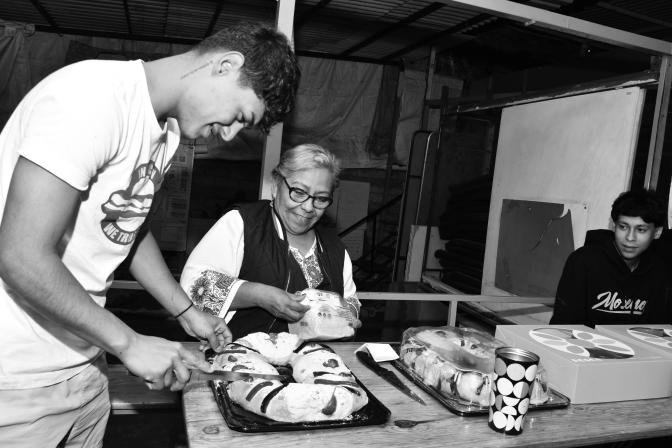
RIGHT: Gabriela Hernández prepares to serve the rosca. Inside the bread are small figures called muñecas—dolls. Whoever gets a slice containing a muñeca has to buy the tamales that are served on February 2 for a fiesta called Candelaria. “It was a very pretty thing,” said Markell Ochoa, a Honduran. “It is a chance to share something with others. There is nothing like it in Honduras.”
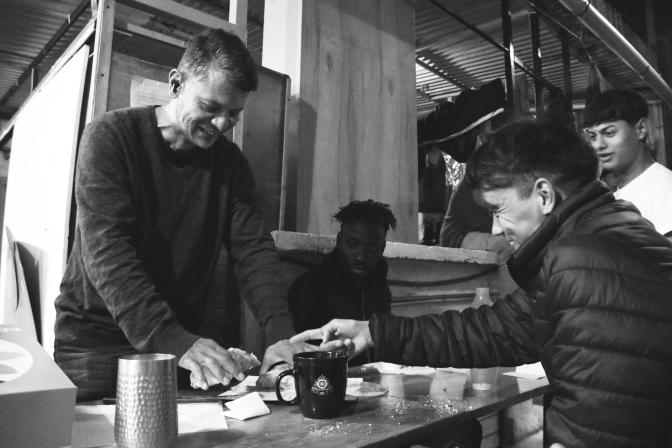
LEFT: A resident points to the plastic muñeca in the piece of rosca that Alexander Calderon just cut. A Venezuelan, he’d participated in protests after the election of Nicolás Maduro in 2024—an election many believe was illegitimate—and fled when he was warned that the police were looking for him. He works in a factory that produces dog food—five nights a week, twelve-hour shifts, earning 2,000 pesos (about $116 USD) weekly. Because he doesn’t yet have documents that allow him to work legally, he is “paid less than Mexicans doing the same work.” He told me he enjoyed the rosca celebration. “We have rosca in Venezuela,” he said, “but it is not as popular as here. In Venezuela, when a person gets the muñeca, they have to buy the rosca the next year.” When I asked if he would buy the tamales, he told me that he was a baker. “I will make the tamales,” he said proudly.
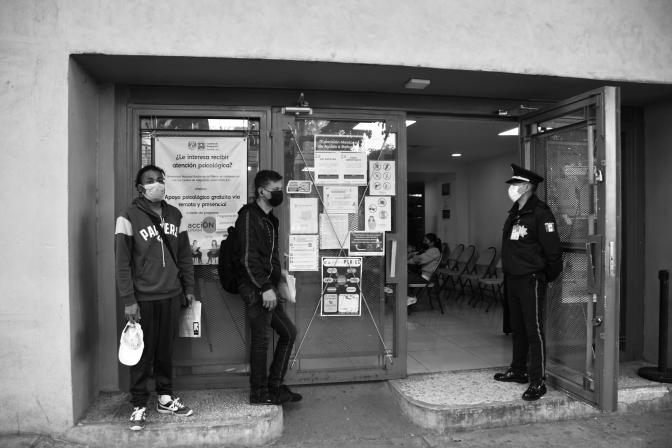
ABOVE: Calderon waits to enter COMAR. “I have to return every two weeks,” he said. There are no appointments—people show up and wait in line. He waited outside for about thirty minutes and then was directed upstairs where he waited for another hour before learning that his application for permanent residency would not be reviewed for at least two more years. “I have already waited for a year,” he told me later. “Now I must wait two more and there is no guarantee I will get it.” He was furious when he learned that. So furious, in fact, he forgot I was waiting for him out front and left without me.
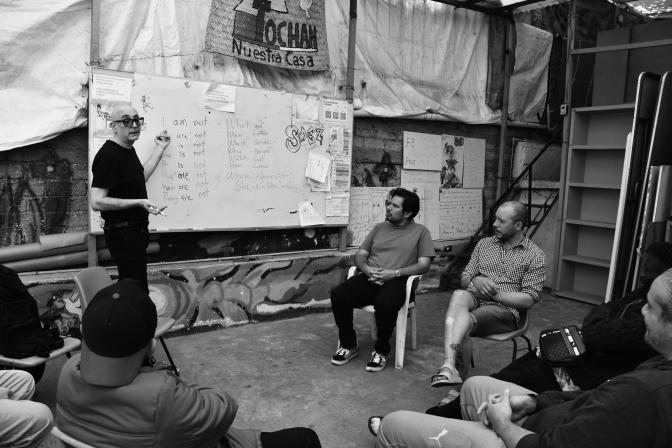
TOP RIGHT: English class is held for two hours on Tuesdays, led by Federico Barahona, an editor and English teacher. A handful of men generally attend. “Some are interested in learning the language,” he said, “but many ask questions about life in the U.S. and Canada.” One of the regular class attendees is Johan Manuel Carmago (on the right, wearing shorts). He worked as a nutritionist in a Caracas hospital but didn’t earn enough to support his mother and eleven-year-old son, so he decided to leave and ask for asylum in the United States. He used the CBP One app but never got an appointment. As he waits to get asylum in Mexico, he works in the informal economy. “One month painting, one month construction,” he told me. He attends the class because he’s interested in learning the language. I asked if he thought there was a chance he’d use the English he’s learning in the United States. “I have no hope of entering the United States,” he replied. “None.”
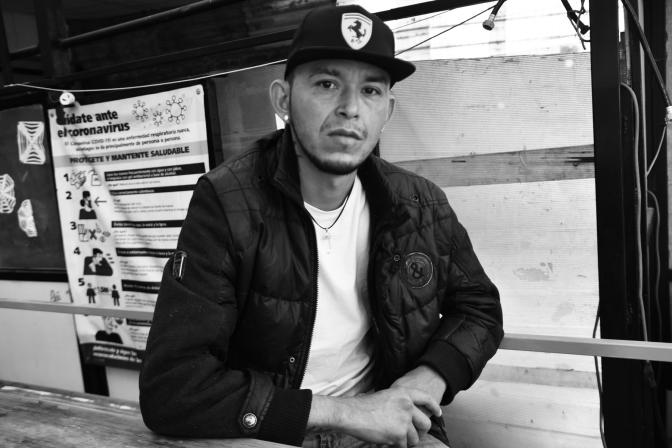
BOTTOM RIGHT: Geovanni Jimenez Morales was one of the lucky ones. A Salvadoran, he used the CBP One app in 2023 and gained entry to the United States, where he worked cutting down trees in Houston. “I knew [the United States] was a place to earn money, to have a house,” he told me. But after two years, he decided he’d had enough. “Life there is different,” he said. “People only live to work. They don’t share anything with their family, no fiestas, nothing. There is an American Dream but not everyone can obtain it.” He’s applying for asylum in Mexico.
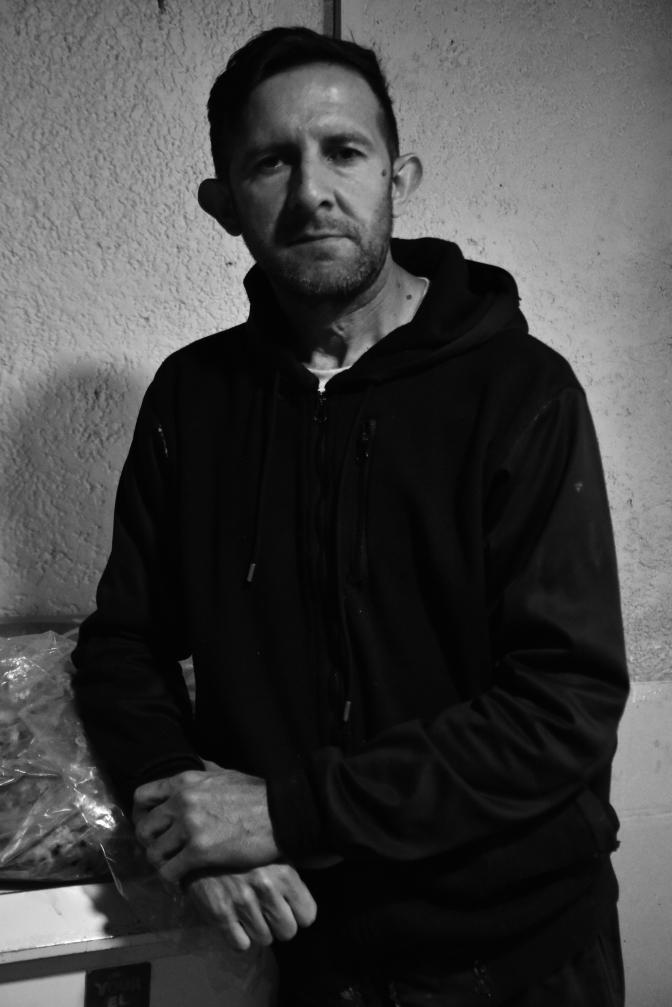
LEFT: The kitchen is headed by Jhony Anderson Rojas Guerra, who worked as a chef in Venezuela. He also participated in protests after the 2024 election, which put him at risk of being arrested. He used the CBP One app but never got an appointment. When I asked if he considered returning to Venezuela, he emphatically said no. “What has changed? Nothing has changed. It is not better. It is not worse. It is the same.” He’s applying for asylum but also said he may go to Canada.
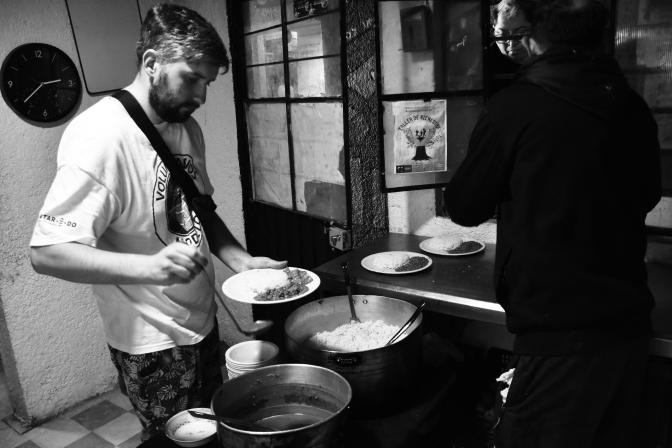
BELOW: Three meals a day are served at Casa Tochan and David (whose last name is omitted for safety reasons) often volunteers in the kitchen. Born and raised in St. Petersburg, Russia, he told me he fled the country for two reasons: he said the government tried to get him to join the army and, perhaps equally frightening, police had showed up at his house asking his parents where he was and why he was publishing negative things online about the war. He arrived in Mexico in November 2024. “I originally wanted to get to the United States,” he told me in very good English. “I will still try. Maybe there is a way. I will try my luck.” Until then, he’ll stay in Mexico where he said he felt “more free.”
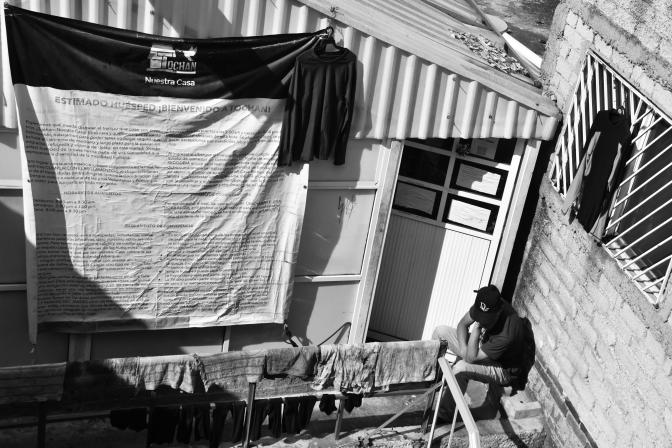
LEFT: A young man sits near laundry hung on a railing to dry.
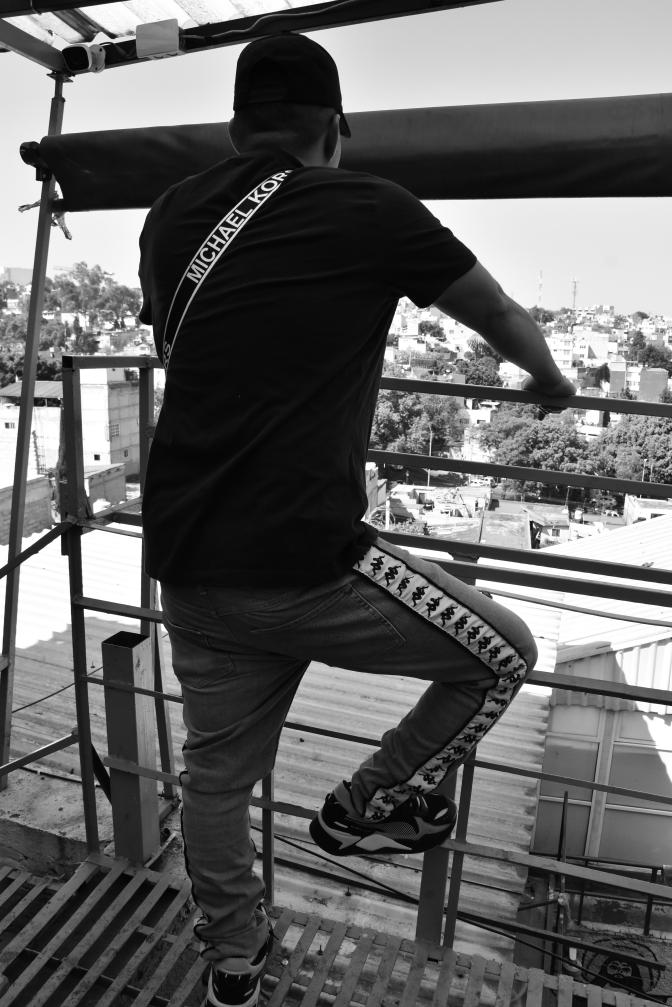
RIGHT: Few migrants pay a coyote to smuggle them across the border because it’s now more dangerous and more expensive. But Victor Manuel Martínez, a Salvadoran, took a chance, paying $8,000 he’d collected from family members. He was lucky and made it across. But his luck ran out three hours later when he was captured in San Antonio, held in detention for thirteen months, and deported. “I will establish myself here,” he said. He may move to Ciudad Juárez to be closer to his daughter, who lives in California. “One day I want to buy a little land, build a small house.” He paused and thought for a moment. “With that money, I could have bought my land.” He didn’t want his face photographed.