In Florence, a city rich in unforgettable sights, one of the most memorable is at the Museo di San Marco. At the entrance to its former dormitory for Dominican friars is The Annunciation, a 1443 fresco by one of its members, Fra Angelico (c. 1395–1455). An angel with grand wings greets Mary, who accepts the invitation to be the mother of God. So begins the story of redemption that Fra Angelico spent his life telling through paintings of incomparable beauty.
The Museo di San Marco and the nearby Palazzo Strozzi are now hosting the two-venue exhibition Fra Angelico, on view through January 25. The largest exhibition ever of this artist, Fra Angelico presents eighty works spanning his entire career, some visible for the first time in centuries, along with seventy works by his contemporaries—artists he worked with, influenced, and learned from.
Fra Angelico was curated by Carl Brandon Strehlke, curator emeritus of the Philadelphia Museum of Art, with Angelo Tartuferi, former director of the Museo di San Marco, and Stefano Casciu, director of the Regional Directorate of National Museums of Tuscany. Its 440-page catalog includes essays by colleagues on each work in the exhibition and 360 color illustrations.
“We look at Angelico as an innovator and equal to his great contemporaries including Ghiberti, Brunelleschi, and Masaccio,” said Strehlke, who also curated a 2019 Fra Angelico exhibition at the Prado in Madrid. “Pope Pius XII, when opening the 1955 Vatican exhibition that commemorated the five-hundredth anniversary of the artist’s death, said that Angelico was able to narrate holy stories with the simplicity of the evangelists. For me, Angelico humanized the sacred.”
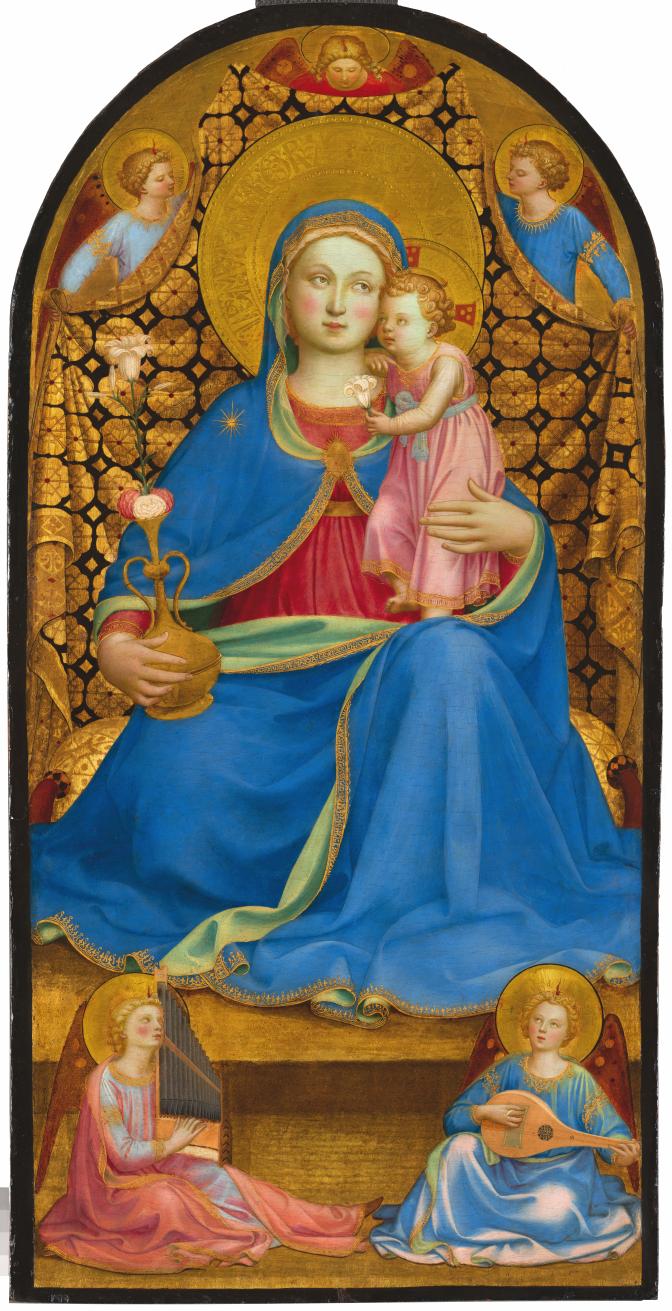
The artist and Dominican friar posthumously called Fra Angelico was born Guido di Pietro in 1395 in a village in the Mugello, a valley north of Florence. He and his older brother Benedetto trained for lucrative careers in Florence’s burgeoning book industry—Benedetto as a scribe and Guido as an illuminator. But by the early 1420s, both were friars in the Dominican Convent of San Domenico in Fiesole, near Florence. Their “Observant” branch of the Dominican order embraced austerity—prayer, fasting, and labor—but also valued learning and the emerging humanism of fifteenth-century Florence. The branch’s labor was preaching and, under the title Fra Giovanni da Fiesole, Guido was soon preaching with his paintbrush.
The decision proved fruitful for his dual vocation as an artist and a friar. He gained a steady stream of commissions and, because he was a friar, was able to work outside of the city’s tradition-bound guild. He was soon in high demand for innovative works and led an efficient workshop of assistants.
Among his patrons was wealthy banker Cosimo de’ Medici, who supported the transfer of Fra Angelico’s community from Fiesole to San Marco. In 1436, Cosimo and his brother Lorenzo commissioned architect and sculptor Michelozzo di Bartolomeo to reconstruct the church and dormitory as a religious and cultural center. As part of that seven-year project, Angelico and his assistants painted frescos that merit a pilgrimage to San Marco in themselves. They are included in the exhibition itinerary, which begins on the ground floor of San Marco in the Fra Angelico Room. Here, early altarpieces and smaller works show Angelico moving beyond his early training as an illuminator under Lorenzo Monaco (c. 1370–1425), a master of late Gothic ornamentation, and introducing perspective, chiaroscuro, and naturalism into his works to create realistic three-dimensional scenes.
Fra Angelico embraced the breakthroughs of Giotto (c. 1267–1337), who replaced the stylized figures of Byzantine art with more realistic renderings. Angelico adopted the use of linear perspective and shadow to bring depth to a two-dimensional image, practices pioneered by his contemporary Masaccio (c. 1401–28), who died prematurely at age twenty-seven. A Masaccio altarpiece, San Giovenale Triptych (1422) shows the artist’s naturalism extending to the portrayal of an infant Christ with his fist in his mouth. Nearby, Fra Angelico’s San Pietro Martire Altarpiece (c. 1422–23) employs a pala quadra—a single canvas instead of a traditional Gothic tripartite format—freeing the artist to portray human interactions rather than an array of statue-like figures. A sweeping panorama was still a novelty at the time. Angelico’s Thebaid (Stories of the Desert Fathers) (c. 1415–20), is a large earth-toned panel surging with scenes of friars in a cliffside community praying, gardening, studying, and tending to visitors above a river with boats in full sail.
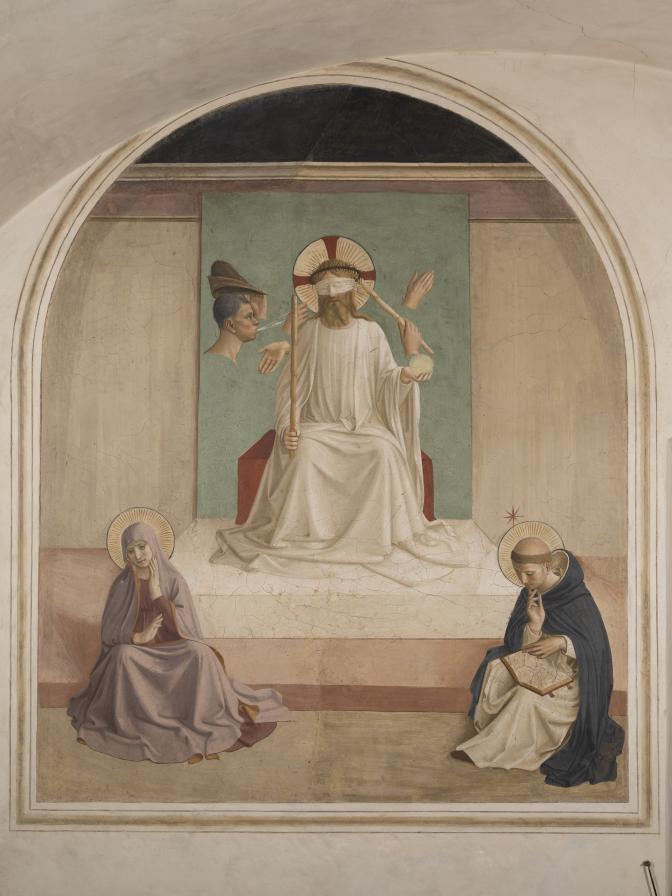
The San Marco itinerary continues in the dormitories of the friars, where Fra Angelico’s frescoes illuminate stair landings and corridors, as well as the convent’s forty-four cells. Lit by each cell’s single window, these scenes from the New Testament were conducive to private contemplation. In the surreal Mocking of Christ, the Virgin and Saint Dominic (c. 1438–39), a disembodied soldier’s head spits at Jesus.
Images of spare lyricism, Fra Angelico’s frescoes were admired by Michelangelo and later by Pope Pius XII, who described the painter as “a shrewd preacher” whose images for fellow friars had no need for gothic ornamentation. A frescoed Procession of the Magi painted by Angelico’s gifted pupil Benozzo Gozzoli (c. 1421–97) adorns the double-cell occupied by Cosimo de’ Medici during retreats. Pope Eugene IV stayed in these quarters when he visited to consecrate the completed San Marco complex on the Feast of the Epiphany in 1443.
As part of the six-year renovation of San Marco, Cosimo commissioned what is considered the first modern public library—a place for learning from texts, not just for storing them. During Napoleon’s occupation of Italy in the early 1800s, convents were suppressed and their artworks and books were seized and dispersed. For this exhibition, numerous codices are again on view in their original settings in the library. Donated by Florentine humanist Niccolò de’ Niccoli (1364–1437), they include sacred and secular manuscripts in Latin, Greek, Hebrew, and Arabic that advanced Renaissance culture. Fra Angelico, a learned theologian, would have consulted these texts as well as The Golden Legend, his thirteenth-century source of many stories. A section devoted to Angelico’s illuminations shows that he introduced naturalism to parchments as well as to altarpieces. In a manuscript from the 1420s, an ornate capital O frames a picture of a youthful Jesus on the shoreline pointing to two swarthy men rowing a small boat—the apostles Peter and Andrew, their faces wonderstruck.
In Palazzo Strozzi, eight galleries present large-scale works by Fra Angelico alongside those of his peers. For Angelico, the transition to a new visual language was not a linear process. Late-Gothic ornamentation often coexists with his early-Renaissance innovations. Angelico’s use of traditional and new techniques varied, but his goal remained constant: to draw viewers into prayerful contemplation. As visitors move through the galleries, which are organized by theme, the golden light of Angelico’s altarpieces induce reverence and wonder. Intricate patterns of haloes and shimmering gilded surfaces bathe viewers in light.
The artist’s originality is most evident in his storytelling and fidelity to nature—in lifelike facial expressions and botanically accurate renderings of Tuscan plants and landscapes. Such naturalism was endorsed two centuries earlier by the great Dominican theologian St. Thomas Aquinas (1225–74), who wrote that “because God’s goodness could not be adequately represented by one creature alone, God produced many and diverse creatures.”
Both the traditional Gothic and newer techniques are on view in Angelico’s grand Linaioli Tabernacle (1432–36), which is encased in a marble frame by Lorenzo Ghiberti. Commissioned by the Florence drapers’ guild, this altarpiece presents an enthroned Virgin and Child against a backdrop of sumptuous gilded fabrics. Angelico uses its predella—the row of small panels that runs beneath the main panel—for vivid storytelling. His images show the martyrdom of the guild’s patron saint, the evangelist Mark, whose killers are pummeled by hailstones.
A scene of ecstasy fills one side of Angelico’s The Last Judgment (c. 1425–28). On a flowering hillside, angels with delicately gilded haloes dance and embrace newcomers, welcoming them into paradise. On the other side, orange and brown devils lance sinners of all kinds, including clergy and royals still garbed for their worldly roles. The condemned endure punishments appropriate to their sins: the greedy swallow molten gold and the wrathful tear each other’s flesh. Dividing these scenes is a vertical row of tombs, starting with Christ’s, that draws the eye to the blue horizon and above, where Jesus is judge.
A quartet of tabernacles created for the Basilica of Santa Maria Novella and reunited here reminds us that the artist was as attentive as any novelist to the narrative power of small details. In Funeral and Assumption of the Virgin (early 1430s), on loan from the Isabella Stewart Gardner Museum in Boston, the intense faces of the saints are full of emotion as they ready themselves to lift Mary for burial. Another tabernacle depicting the Coronation of the Virgin glistens with golden haloes and trumpets.
On view in the next gallery is the San Marco Altarpiece (1438–42), regarded by many art historians as the first fully Renaissance altarpiece, with its imaginative storytelling and contemporary references, as well as its masterful use of perspective and naturalism—all in a single-panel composition. The monumental work was commissioned by Cosimo and his brother Lorenzo for the high altar of San Marco. With seventeen of its eighteen known pieces restored and reunited here, the altarpiece is visible in near entirety for the first time in centuries.
A central panel with a square format shows the enthroned Virgin and Child flanked by mingling angels and saints. In the foreground is St. Cosmas, whose weathered face resembles Cosimo’s. The Virgin and Infant Redeemer sit on a throne in the style of Michelozzo’s San Marco renovation, with a conch-shell semidome bordered by classical columns. Behind them is the realistically rendered convent garden and distant grove of trees.
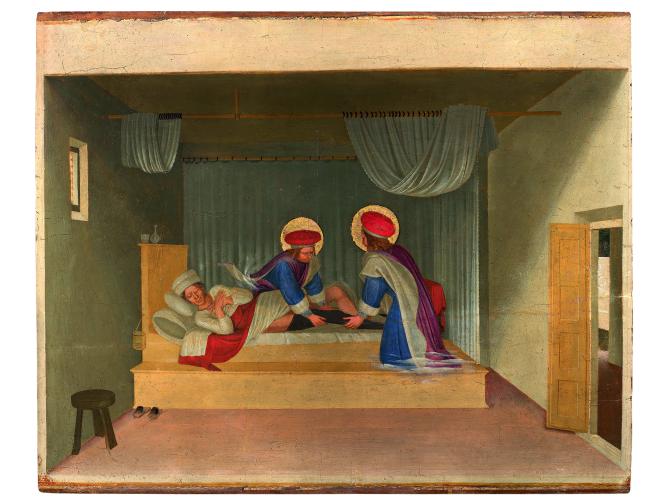
In the altarpiece’s nine-panel predella, Angelico recounts the martyrdom of Saints Cosmos and Damian, twin brothers who practiced medicine without charging a fee in the third century. When commanded to worship pagan gods, they refused and were sentenced to death. Set in the Piazza San Marco—now a busy bus station, then a scene of public devotional events—the predella follows the twins and their three brothers as they are stoned, pierced with arrows, thrown into the sea, rescued by angels, burned at the stake, and finally beheaded and entombed. In the final panel, the saints return to perform a miracle, replacing a steward’s gangrenous leg with the leg of a Black Ethiopian—a nod to the recent reconciliation of Western and Eastern branches of the Church.
Angelico and his contemporaries also created holy images for display outside of the cloisters. On view in the exhibition, for example, are several life-size painted crucifixes. With their mesmerizing realism and portability, these were often used for public devotional events, such as passion plays. Close-ups of holy faces were another cherished genre. Angelico’s Christ as King of Kings (c. 1447–50), with its bloodshot eyes, evokes the prophetic description in Isaiah 53:3–5 of “a man of suffering, knowing pain…. Yet it was our pain that he bore, our sufferings he endured.”
Papal commissions, including frescoes for two Vatican chapels, brought Angelico to Rome during the last decade of his life. Among the late-career works on view here, there are fewer ecstatic Madonnas and more Crucifixions. Gilt but not elaborately incised, and with fewer figures in the frame, these uncluttered paintings have a somber grandeur. Like Angelico’s frescoes in the San Marco dormitory, they are pared-down images of lingering power.
In the eighth gallery is Angelico’s stirring Lamentation over Christ (1436–41), commissioned by an ex-Dominican whose lay confraternity ministered to prisoners sentenced to death. The altarpiece was for their small church, where convicts attended Mass before execution. Angelico locates the dead Christ not in Golgotha but by the gallows outside the walls of Florence. Christ’s body lies in a shroud. Mary holds his head while Mary Magdalene kisses his feet. Behind them, the plain wooden verticals of a cross and ladder evoke a gallows. Christ’s face is remarkably peaceful in this image intended to console those who, like him, faced execution.
Nearby is the newly restored thirty-five-panel Scenes of the Life of Christ from the Silver Chest (Armadio degli Argenti) (c. 1450–52), commissioned by Cosimo de’ Medici’s son Piero to decorate a chest in the Church of Santissima Annunziata that held silver votive offerings. Unfolding like a graphic novel, the series presents thirty-two episodes from the life of Christ, beginning with the Annunciation and continuing through his crucifixion and resurrection. The words on its concluding panel, “Lex Amoris,” declare the triumph of the law of love that Jesus brought into the world.
Restoring and reuniting works that span the artist’s whole career, this exhibition offers an unprecedented itinerary through the evolution of painting in early-Renaissance Florence, as Angelico and his peers brought a new humanism into religious art. The innovations of these painters influenced a new generation of artists, including Domenico Veneziano (1410–61), Piero della Francesca (1417–92), Domenico Ghirlandaio (1448–94), and Ghirlandaio’s pupil Michelangelo (1475–1564), who, with Leonardo da Vinci (1452–1519), would take naturalism much further.
But what many exhibition visitors may find most striking is the way Fra Angelico found a new visual language to represent the Redemption as a story that encompasses both suffering and bliss. His influence extends far beyond the Renaissance to more recent artists, such as the midcentury modernists Mark Rothko and Philip Guston, who also sought to reconcile tragedy and hope in their art, albeit by very different means. The paintings in the Rothko Chapel in Houston, for example, invite us to contemplate the darker aspects of the human experience with their subtly varied dark hues. And in Philip Guston’s semi-abstract Flame, painted a year before his death, the lustrous black pigment shines, bringing light into darkness.
Fra Angelico died in Rome, where he is buried at the Basilica of Santa Maria sopra Minerva, in the chapel of St. Thomas Aquinas. His order calls him “the Angelic Painter” and describes him as “a theologian of sacred images equal to supreme theologian Aquinas, the angelic doctor” and “a supreme master of painting, to whom no one was equal in his art.” In 1982, Pope John Paul II beatified Fra Angelico, and at a Mass on February 18, 1984—on the anniversary of the artist’s death—he named Fra Angelico the patron saint of artists.