One winter, nearly a decade ago, I lied about reading Jane Austen. My family had gathered for Christmas Eve, and I was talking to my cousin Robin Heather, my most literary relative (really, my only literary relative). She’s read the Russians in the original. She translates French cookbooks. She once shipped a box full of free books—brand new hardcovers!—to my Houston apartment when she worked as a young editorial assistant at a publishing house in Manhattan. I’ve looked up to her my entire adulthood. At a previous Christmas gathering, we’d bonded over Pride and Prejudice, the only Austen novel I’d ever finished, so when she asked me if I ever ended up reading any of the others, I lied.
“Yeah,” I said. “Definitely.”
“Oh, great,” she said. “Which ones?”
Now I had to name some Jane Austen novels. I figured I should name as many as I could, since naming only one would increase my chances of having a discussion about a book I hadn’t read.
“Uh, Emma. And Mansfield Park. And, um, Northanger Abbey?”
“What’d you think?”
“Great. They were all really great.”
At this point, I must have excused myself, hurrying away to fill my plate with more pigs-in-a-blanket and wallow in my shame. We didn’t speak about Jane Austen again that Christmas.
But my shame motivated me. I became determined to redeem myself by actually reading all the novels I’d lied about reading. I started with Northanger Abbey and then moved on to Mansfield Park, enjoying the Gothic satire of the former and laboring to get through the latter, which seemed to be mostly about the moral danger of putting on plays (and the moral good of marrying your cousin, a subject that I would not be bringing up at any subsequent family gatherings).
But there was one sentence from Mansfield Park that I really loved. It describes Fanny Price’s rich, spoiled cousins and the aunt who openly encourages them to feel superior to Fanny: “Such were the counsels by which Mrs. Norris assisted to form her nieces’ minds; and it is not very wonderful that, with all their promising talents and early information, they should be entirely deficient in the less common acquirements of self-knowledge, generosity and humility.” Here’s a rare moment when the irony-loving Austen explicitly tells us the habits of mind and character that she values most. In her elegant, understated, and brutally perceptive way, she suggests that talent and education don’t mean anything if we’re deficient in these rarer virtues.
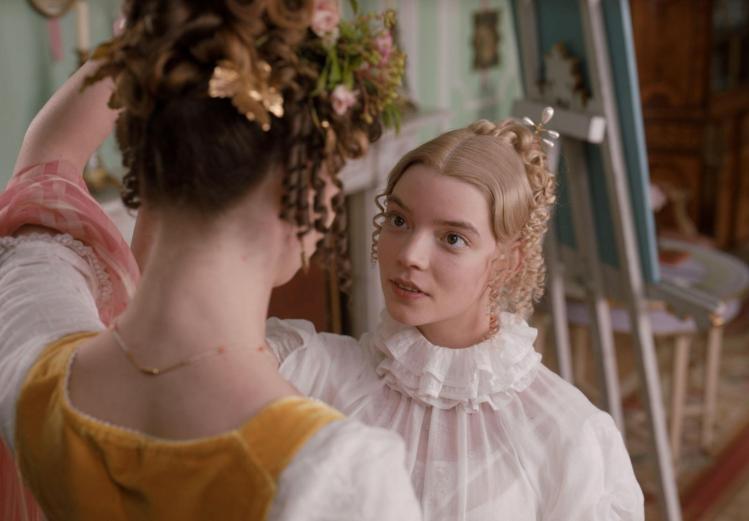
That sentence came back to me when I finally read Emma, the last novel published in Austen’s lifetime. Where Mansfield Park has a virtuous, sincere protagonist of limited means who is mistreated and unappreciated by most of the people around her, the “handsome, clever, and rich” Emma Woodhouse is a manipulative and overconfident protagonist who mistreats many of the people who adore her. She makes self-serving assumptions about other people’s thoughts and feelings and then ignores all evidence to the contrary. In various ways, Emma lacks “the less common acquirements,” and these deficiencies cause plenty of trouble for herself and others. Unlike most of Austen’s other novels, the central question of the plot isn’t “Who will she marry?” It’s “Will she ever become a better person?”
I found this thrilling. I loved the comedy of Emma’s overconfidence, the way she keeps misreading herself and others in crucial moments. I loved the sharply drawn secondary characters—Mr. Woodhouse, Mrs. Elton, Miss Bates—who also often lack self-awareness in ridiculous and hilarious ways. I loved Austen’s elegant sentences, full of unexpected and insightful phrases (“profitable humiliation,” “habits of gentle selfishness,” “the efforts of civility”). I loved the novel’s various relationships, sincere and fake, caring and cruel, attentive and indifferent. I loved the subtext-filled dialogue. I loved the plot twists. And I loved the novel’s free indirect narration, which keeps dropping hints about Emma’s many delusions while also offering a vivid and nuanced depiction of this young woman’s complex inner life and attempts to reflect on her actions, learn from her mistakes, and become “more acquainted with herself.”
Although I wasn’t young, beautiful, or particularly snobbish, I related to the young, beautiful, and snobbish female protagonist of this 1815 novel in one crucial way: We both prided ourselves on being right while frequently getting things wrong. Thinking highly of her own sense of judgment, Emma misjudges everything. Only in the book’s final volume does she realize “the blindness of her own head and heart” and “the deceptions she had been thus practicing on herself.” I saw—and still see—myself in Emma’s vexing and repeated discovery that the world outside her head is very different from the imagined reality she’d congratulated herself on perceiving.
The first thing I did after reading Emma was reread Emma. Without even noticing the change, I’d morphed from the kind of person who lies about reading Jane Austen novels into the kind of person who rereads Jane Austen novels. And rereading Emma is particularly illuminating, since so much of your first read is filtered through Emma’s distorted and limited point of view. Rereading the novel, you have the pleasure of knowing when she’s wrong—rather than merely suspecting it—and seeing how masterfully Austen weaves Emma’s misplaced confidence throughout the text.
Emma’s “errors of imagination” are comical precisely because she’s so sure of herself. Whenever she uses phrases like “there can be no doubt of” or “I have no doubt that” or just “undoubtedly,” we know that whatever follows will probably be very dubious indeed. We laugh at Emma when she laughs at others for their supposed misconceptions, “amusing herself in the consideration of the blunders which often arise from a partial knowledge of circumstances.” Rereaders know that she’s the one with the partial knowledge. Over and over again, the novel reminds us that, as Montaigne once wrote, “only the fools are certain and assured.”
At one point in the novel, after Emma argues with her “old and intimate friend” Mr. Knightley, the narrator begins a new chapter by telling us that “Mr. Knightley might quarrel with her, but Emma could not quarrel with herself.” This might be my favorite sentence in the whole novel. Emma is very good at debating Mr. K, using her own considerable intelligence and wit to defend her point of view. What she’s not good at—and here we might all recognize ourselves, if we’re honest—is scrutinizing and challenging her own confidently held opinions. The more I reread Emma, the more I came to see it as a book about how ego and overconfidence prevent empathy and clear thinking, warning its readers against being too certain about our own inevitably limited perspectives.
Over time, though, Emma learns how to quarrel with herself. Just as the close third-person narration reveals her delusions, it also reveals her eventual reckoning with those delusions:
With insufferable vanity had she believed herself in the secret of every body’s feelings; with unpardonable arrogance proposed to arrange every body’s destiny. She was proved to have been universally mistaken; and she had not quite done nothing—for she had done mischief.
In reflecting on her errors and admitting this to herself, she moves one giant step closer to “the less common acquirements of self-knowledge, generosity and humility.” Even as she remains imperfect, she becomes an example for us to emulate.
After my second read, I started assigning the novel in a college class I teach every spring on the relationship between fiction and empathy. It turns out that nearly a century before the word empathy entered the English language, Jane Austen was already exploring the many ways we attempt to read each other’s thoughts and feelings, sometimes successfully and sometimes not. And of all her novels, Emma is the most explicitly interested in the complexities of the human mind and (in one of the novel’s loveliest phrases) “all the wonderful velocity of thought.”
Emma’s mind gets her into trouble, but it also helps her grow—through honest self-examination and “the relief of quiet reflection.” She spends a great deal of time in her own head, trying to figure out what’s going on in other people’s heads. On nearly every page, we interpret Emma and the other characters as they interpret and misinterpret each other’s feelings. Sometimes, they even interpret the misinterpretations. (“If she had so misinterpreted his feelings, she had little right to wonder that he, with self-interest to blind him, should have mistaken hers.”) And in the end, Emma acquires a sort of empathic humility, realizing that the task of deciphering other people’s thoughts and emotions is never as easy as it seems. If we’re lucky, we might have the same humbling realization alongside her.
At this point, I’ve lost track of how many times I’ve reread Emma. I never get tired of it. Each time I assign it in class, many of my students love the book just as much as I do, while others can’t stand the book or its protagonist. This seems to reflect the general reaction to Austen’s work. (I once knew of a weekly bar-trivia team called Jane Austen Sucks.) As Emma herself wisely remarks to her father, “That is the case with us all, papa. One half of the world cannot understand the pleasures of the other.”
But I’m on Team Jane. And I’ll be binge-reading her work again this winter, in honor of her 250th birthday. Like all of us, Austen had her blind spots, but few novelists of any era offer as much perception, delight, and insight on every page. As I’ve learned over the years, all of her novels reward rereading. (Yes, even Mansfield Park.) Emma will always be my favorite, though.
When I finally saw my cousin again at another holiday gathering, I had to confront my own humiliating mistake. After some hesitation, I admitted that I’d lied about reading all those Jane Austen novels. “But I’ve actually read them now,” I added, pathetically. “And they are really great.” She handled my confession with grace, laughing it all off, but it was hard to tell what she was actually thinking.