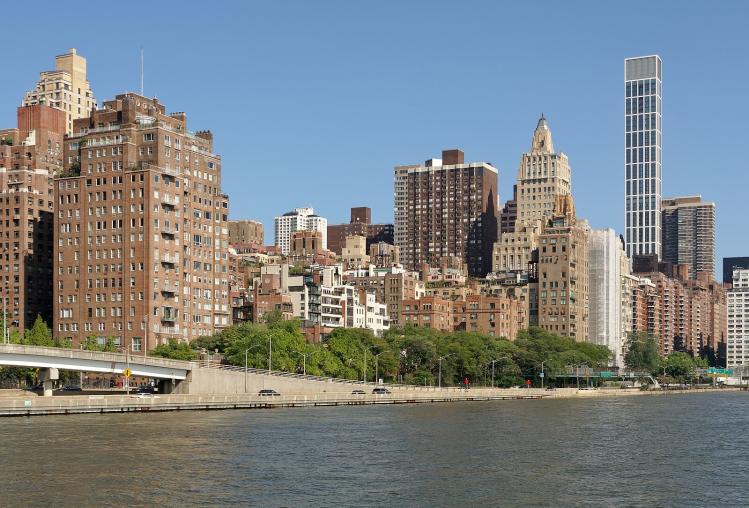
Every morning this summer, my children—ages seven and four—lined up at our living room window to check on the construction of a seventeen-story apartment building near our place in upper Manhattan. Like aspiring real-estate scions, they marveled at the structure’s vertical ascent day after day. Until one day they grew impatient. “When are they going to put the roof on,” my daughter asked, exasperated, “when I’m eight?” Sagely nodding in his pajama top and Spider-Man underwear, my son agreed. “And it still doesn’t have windows or even any bricks.”
My children have recently taken a keen interest in our neighborhood and its surrounding blocks. I earned some points when they learned my first apartment out of college was actually on our street. A two-bedroom on the top floor of a six-floor walkup, it was located on “the other side” of Broadway, as my daughter likes to describe that stretch of buildings running up the hill toward Amsterdam Avenue. They ask what the neighborhood was like back then, and I’ve enjoyed revealing its hidden past: the Chipotle on the corner of 157 and Broadway used to be a Twin Donuts; the Planet Fitness above it was a clothing emporium; and the apartment building they’ve been monitoring was first rumored to be in the works fifteen years before Daddy even met Mommy.
So far, I’ve avoided talking with them about the politics behind all our neighborhood’s changes: gentrification, tax abatements, housing policy, zoning laws. They might know that “Zohran” is going to be our next mayor, but they have no idea why an unknown insurgent hammering affordability won our block by forty-two points. Or why his success, and the city’s future my children will inherit, will likely be determined by the number of new apartment buildings they watch go up over the next four years.
My children’s curiosity inspired me to brush up on New York’s teeming and turbulent history to better understand how and why the city I’ve lived in for most of my adult life has changed. Three books—Bench Ansfield’s Born in Flames (W. W. Norton & Company, $31.99, 368 pp.), Jonathan Mahler’s The Gods of New York (Random House, $32, 464 pp.), and Jennifer Baum’s Just City (Fordham University Press, $29.95, 272 pp.)—were particularly instructive in tracking New York’s development from the 1970s, when the city was on the brink of bankruptcy, to today, when the majority of New Yorkers are burdened by sky-high rents and living costs.
New York has always been expensive, but I moved to the city the last time it could plausibly be called affordable. My half of the rent in 2001 was only six hundred dollars a month, thanks in large part to the uncertainty following 9/11 and the lingering effects of the first dot-com bubble. “Santa Claus is coming early for apartment hunters,” the New York Post reported in November 2001.
That same month, Michael Bloomberg won a tight mayoral race, on which he spent more than $50 million of his own money. Succeeding Rudy Giuliani, who was still wildly popular and almost universally respected, Bloomberg proudly proclaimed, “New York is alive and well and open for business.” Bloomberg celebrated New York as a luxury product, which meant gradually putting much of the city out of reach for the majority of New Yorkers. Over the course of three terms as mayor, he steadily accelerated New York’s transformation from a working-class city into a playground for the wealthy. “By 2024, New York was home to 349,500 millionaires, more than any other city in the world,” Jonathan Mahler writes in the epilogue of The Gods of New York, his panoramic account of the city between 1986 and 1990. “The top 20 percent of earners in Manhattan were making more than fifty-three times as much as its bottom 20 percent.”
Drawing on archival material and contemporaneous accounts, Mahler chronicles with confidence and clarity how the “egotists, idealists, and opportunists” of the book’s subtitle helped turn New York into “a city of entrenched poverty and extreme wealth, of celebrity, audacity, individualism, learned indifference, and resentment.” Manufacturing was giving way to finance, insurance, and real estate, (“FIRE”) and New York’s barely solvent government, under the leadership of Mayor Ed Koch, became dependent on the FIRE sectors for revenue. Mahler’s book is a character-driven page-turner: he mostly focuses on the personalities driving this epochal shift—chief among them Koch, Giuliani, and Donald Trump, whose first foray into Manhattan real estate was facilitated by a tax exemption worth about $168 million. Still, Mahler manages to tell in broad strokes the story of how the city quickly sacrificed millions of units of affordable housing for high-priced condominiums, residential towers, and shimmering glass office buildings.
Roughly around the same time Donald Trump was cashing in on the city’s largesse, Adrian “Popo” Vega, a professional handyman and an amateur “torch,” was hired to set fire to a vacant apartment in the East Tremont section of the Bronx. Vega botched the job, which ultimately brought the borough’s devastating pandemic of arson out of the shadows, as Bench Ansfield reports in the extraordinary Born in Flames. Ansfield debunks the myth that residents set fire to their own neighborhoods. The real culprits were building owners. The expansion of property insurance into Black and brown neighborhoods had been presented by lawmakers as a means of racial justice and redress, but it also meant that property owners like the landlord who hired Vega stood to make more money burning down their properties than renting them.
Ansfield associates the rise in fires with the rise of the FIRE industries Mahler tracks. They trace the pernicious effects on the city and its most marginalized residents, while taking local and federal governments to task for abandoning New Deal–era commitments to public and affordable housing. The book is a damning indictment of the private market for rental housing, a convincing case for social housing, and a tacit endorsement of many of the policies Mamdani campaigned on.
Jennifer Baum makes an equally strong case in Just City, her memoir about growing up in the RNA House, a subsidized cooperative on the Upper West Side. Back when affordable housing was still a priority, politicians, urban planners, and architects worked together to build on a massive scale. Between 1958 and 1975, Baum tells us, 138,000 apartments were built for middle- and low-income tenants as part of the Mitchell-Lama Housing Program. Almost five thousand of them were scheduled for the West Side Urban Renewal Area plan, where the RNA House sprang up. Her parents purchased their three-bedroom apartment for $3,800 in the late 1960s, well below market rate (and close to my family’s current monthly rent). Baum matter-of-factly recounts her childhood in this vanishing urban utopia. Like many New Yorkers, she’s desperate to recapture it. “It seemed my whole adult life I’d been searching for stability,” she writes, “for a physical and emotional place to call home.”
Meanwhile, uptown, workers have finally started adding bricks to the seventeen-story apartment building. It still doesn’t have a roof.