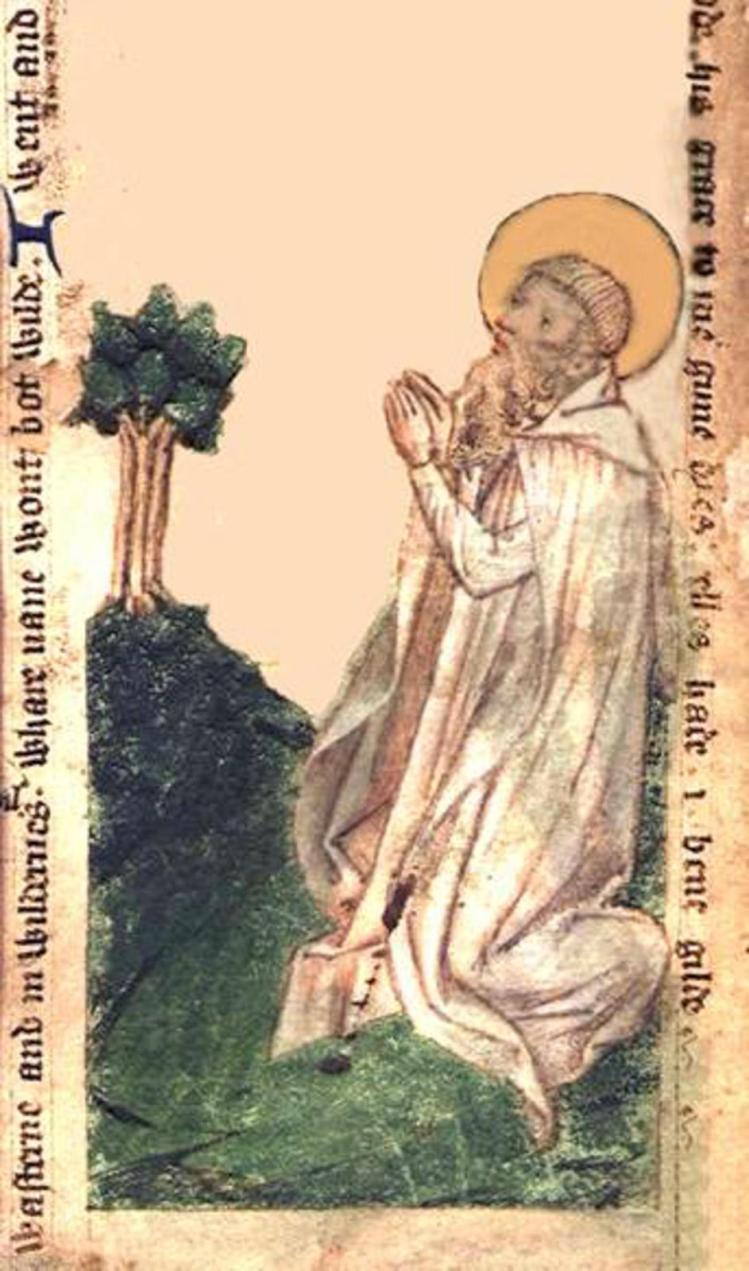
One morning in the late eleventh century, after a particularly violent storm on the coast of Lincolnshire, near what is today the town of Spalding, a young man went out to see if he could find anything worth retrieving from what the night’s rough swell had abandoned on the shore. He would have been hoping for something useful, perhaps the detritus from the wreckage of a ship. Instead, the young man discovered three beached dolphins, one dead and the other two dying. Not wanting to waste their valuable fatty flesh, he cut several “chunky pieces” from the dolphins. Just then the weather took a turn and the coast began to flood again. Godric pushed on, praying all the while, and returned safely to his parents’ home with the dolphin blubber. So ends the great conversion scene of the riotously itinerant and spiritually complicated St. Godric of Finchale: merchant, sailor, hermit, saint.
Godric was born to a poor rural family in Lincolnshire around the year 1070. It is actually slightly misleading to say that he had any single moment of conversion; even before the climactic episode with the dolphins, his modest upbringing was shaped by the virtues of a humble Christian childhood and youth. But although he seems to have had a contented home life, he soon became restless and began a career in trade. He would prove to be a natural entrepreneur, building a business for himself on foot and then later as a merchant marine, traveling to trading hubs in Northern Europe and then to Rome. Eventually, he would renounce worldly pursuits and all the wealth he’d accumulated. He became a hermit, took a vow of poverty, and founded a priory in Finchale (rhymes with “wrinkle”), the ruins of which one can still visit. (He also wrote some of the earliest extant music from this period.) According to his hagiographer, Reginald of Durham, Godric tamed the snakes of Finchale so that they would curl up at his feet while he sat by the fire. After spending much of his life making a small fortune, he died with a reputation for great holiness.
The life of Godric appears in three versions—one by Reginald, a close confidant of the hermit, and two others by anonymous monks. These were not available in English until 2022, when a translation was published by the Oxford historian Margaret Coombe. This volume is not only a staggering scholarly accomplishment, but also a work of gorgeous and lucid English prose, a true pleasure to read. Hagiography is its own genre, with its own distinctive narrative conventions. Essentially devotional works, hagiographies are intended to glorify the subject as well as offer inspiration and guidance to readers looking for models of how to live a Christian life. The result is often a static and one-dimensional character—a saint born holy who remains so throughout her life. Often the only drama is the strenuous resistance of temptation or the overcoming of natural attachments. A saint like Catherine of Siena, say, might desire to enter a convent against the wishes of her parents, and thus struggle between duty to God and to her family.
Godric’s story is quite different. Early on he was “striving to excel at what he had learned of commerce” and “began to engage in business and trade and to learn how to make profits.” Godric, “by the sweat of his brow, obtained for himself a very great wealth of riches because he sold in one place at a high price that which he had obtained elsewhere at little cost.” But success in the pursuit of wealth came at a spiritual cost, then as now. Godric would eventually escape “the shipwreck of sin” to make “a seedbed of virtue out of the treacherous practices of sin, and where the enemy had laid the fires of opportunity, there the man of God forged weapons of virtue.”
Even readers who have not struggled with the spiritual complications of success in business may find this account refreshingly down-to-earth. A typical saint’s life can seem somewhat alien to anyone with worldly interests or experiences. But there is another dimension to Godric’s life that makes his story unusual—the way it coincides with and exemplifies a period in the early Middle Ages when England first became a point of departure for the global trade that would define the economy in the West for hundreds of years. Godric’s hagiographies, intended to illustrate heroic virtue for his contemporaries, also illuminate a historical turning point when people were beginning to think in a new way about how their religious beliefs and practices related to commerce and wealth.
According to Reginald, the name Godric in “the Latin language means kingdom of God or deserving of the good kingdom or even worshipper or future protector of the reigning God.” This etymology is obviously specious, but it’s in keeping with the fawning tone of Reginald’s hagiography. (Reginald is hilariously satirized in Frederick Buechner’s 1980 novelization of the saint’s life, Godric, where Reginald is portrayed as a rather needy hanger-on.) The name is more likely from Old English, “god” and “ric” both having associations of power: god, obviously, and ruler or king. Indeed, it’s a name that seems more appropriate for a successful entrepreneur than for a humble saint.
The legend about the dolphins and the storm has spiritual significance, but it also offers insight into the economic structure of rural life in eleventh-century England. The practice of foraging after a storm would have been common in such a coastal community. As Reginald tells us, “Whenever the inhabitants discovered valuable items among these, they openly took for themselves whatever attractive or serviceable things they were lucky enough to find there.” “Private property” was more loosely conceived of than it is today, and it did not take priority over the imperative of survival—the imperative that also explains Godric’s willingness to slaughter two living dolphins for their meat.
Despite the material scarcity Godric grew up with, Lincolnshire was to become one of the central hubs of the immensely lucrative wool trade that would soon take off in England, solidifying its economic relationship with mainland Europe. Godric’s trajectory was typical of many merchants in this period: they would start out by traveling on foot to sell their wares and build networks of suppliers and buyers along their routes; then, having accumulated enough capital, they would settle into an urban area and secure for themselves or their sons a rather elevated position in society, far above the one they previously occupied. Godric himself never settled down, not until he became a hermit, and he spent his commercial career at the helm of a ship. Still, he belongs to one of the first generations to experience what we would call social mobility: a man who worked himself up from one class to another by means of his own efforts.
Godric is not the only saint with a commercial résumé. In the twelfth century, a wealthy Italian merchant named Homobonus (Latin for “good man”) would become the patron saint of businessmen, tailors, shoemakers, and cloth workers. But unlike Godric, Homobonus gained much of what he had by inheritance, as his father was himself a prosperous cloth merchant in Cremona, Italy. Homobonus carried on the family business. Butler’s Lives of the Saints tells us:
[Homobonus’s] business he looked upon as an employment given him by God, and he pursued it with diligence upon the motive of obedience to the divine law, and of justice to himself, his family, and the commonwealth, of which he thus approved himself a useful member. If a tradesman’s books be not well kept, if there be not order and regularity in the whole conduct of his business, if he do not give his mind seriously to it, with assiduous attendance, he neglects an essential duty, and is unworthy to bear the name of a Christian. St. Homobonus is a saint by acquitting himself diligently, upon perfect motives of virtue and religion, of all the obligations of his profession.
St. Homobonus remained wealthy throughout his life; he married and had children. Whereas Godric renounced the world to become a saint, St. Homobonus somehow managed to balance worldliness with saintliness (or so the hagiographies tell us).
Members of the nascent merchant class were likely anxious about their social position, unsure how to balance the Christian virtues with their newfound affluence. They would have been looking for models such as Godric and Homobonus, and contemporary hagiographers were eager to supply them.
Though little known in the canon of saints, Godric is a surprisingly frequent reference point in historical scholarship, such as Henri Pirenne’s classic 1914 article “The Stages in the Social History of Capitalism.” Pirenne’s article was part of a debate about the shape and nature of capitalism in the early twentieth century: Was it continuous with early periods of capitalism or a new and distinct phenomenon, particular to its time? Pirenne proposed that we answer this question by looking at the characteristics of “capitalists”—the holders of capital—in different historical periods.
In Pirenne’s telling, Godric is, essentially, the founder of a startup. Pirenne writes that Godric’s “operations consist in carrying to a foreign country goods which [he] knows to be uncommon there…selling them there at a high price, and acquiring in exchange various merchandise which [he] takes pains to dispose of in the places where the demand for them is greatest and where [he] can consequently make the greatest gains.” As Reginald put it, “Among the inhabitants these things were more desirable than gold itself, and so he most carefully and enthusiastically traded them in exchange for some other things which were desirable to the inhabitants of other countries. From these individual trades he accumulated a great deal.” One remembers the young man scouring the beach for treasures from a shipwreck, wondering where they might have come from and what they might have cost there.
A scrappy young entrepreneur whose only mission was to make a profit from consumer demands—not an unfamiliar picture. Pirenne ends his article “in the moral and political rather than the economic field,” writing:
[E]very class of capitalists is at the beginning animated by a clearly progressive and innovating spirit but becomes conservative as its activities become regulated…. [They] have at the beginning been nothing else than parvenus brought into action by the transformations of society, embarrassed neither by custom nor by routine, having nothing to lose and therefore the bolder in their race toward profit. But soon the primitive energy relaxes. The descendants of the new rich wish to preserve the situation which they have acquired, provided public authority will guarantee it to them, even at the price of a troublesome surveillance; they do not hesitate to place their influence at its service, and wait for the moment when, pushed aside by new men, they shall demand of the state that it recognize officially the rank to which they have raised their families, shall on their entrance into the nobility become a legal class and no longer a social group, and shall consider it beneath them to carry on that commerce which in the beginning made their fortunes.
Pirenne calls his assessment a moral one: the qualities that make a fortune are not the qualities that preserve one. What begins with “primitive energy” devolves into a sclerotic fixation with rank. One generation of a family climbs the class ladder; the next generation pulls it up behind them.
When Godric decided to abandon the world of international trade, he did not suddenly lose his influence or importance within his community. The historian Henry Mayr-Harting argued in his 1975 article “Functions of a Twelfth-Century Recluse” that to seclude oneself as a hermit in Godric’s time wasn’t to throw over all that one had gained in life, and that in fact holy men, like rich men, held a certain soft power. Mayr-Harting points out that many holy figures of this period were, before their great moment of pious renunciation, intimately acquainted with “the psychological tensions and disruptions of new economic opportunities.” In short, the medieval merchant and the medieval mystic had more in common than we might think.
Godric’s journey to sanctity, as related by Reginald, took place on an eventful but morally uncomplicated trajectory. He grew from spiritual strength to strength as supernatural virtues were added to his natural ones. Over the course of his sixteen years as a merchant, he demonstrated courage and wisdom as he traveled long distances, often over treacherous ocean passes, to places as far as Roman Dacia. “He provided a great standard of care to those who were sailing with him, comforted and forewarned them and, by affording them advance notice, gave them courage,” Reginald tells us. Gradually, Godric began to turn his attention to more important matters: “[H]aving learned about misery and perils from repeated experience, he began to visit some of God’s saints more zealously to worship and venerate them, to pray at their shrines and to submit entirely to devout veneration of the saints through prayer.” Reginald assures us that Godric was “not unequal or inferior to any of his contemporaries in any matter of morals or deeds or in his efforts at correct behavior.” Still, there are hints that, as a young man, he was susceptible to all the usual temptations, and that he “later came to realize that any sins he had committed in his youth had provided him with the means to grow in virtue.” After those sixteen years of business, Godric had had enough. He spent a couple of years as a proper hermit, and then—perhaps wanting to get back to the rise-and-grind challenge of building something, this time something for God—he founded his priory at Finchale.
A millennium later, the trope of the busy professional who longs for a simpler life persists—only now, instead of entering a monastery, he or she is more likely to “unplug” for a long retreat in some remote place or switch to a less demanding (and less lucrative) career and lifestyle. Such things are not usually done for overtly religious reasons, but they are often associated with a vague longing for spiritual enrichment. If only we could free ourselves from the purely transactional relationships of the rat race, surely we could find some peace.
St. Thomas Aquinas, writing at a moment of economic expansion in the thirteenth century, drew a characteristically careful distinction between natural and artificial wealth as it pertains to Christianity. Life-sustaining abundance—livestock, comfortable dwelling, land for your family—is completely acceptable in the eyes of God, and the process of acquiring it is in no way spiritually diminishing. On the other hand, the pursuit of pure capital—self-propagating artificial wealth, abstracted from anything natural or necessary—is a source of vice. Aquinas wrote, “By riches man acquires the means of committing any sin whatever.” The crucial difference is that a person would never be satisfied with any amount of this kind of wealth—they would always want more of it—because there was no natural need being satisfied. The pursuit of capital in this world could become all-consuming.
Godric’s success as a merchant very much exemplified the expanding availability of this “artificial wealth.” Indeed, Reginald admires Godric’s accumulation of so-called artificial wealth as evidence of a “shrewder mentality” than the kind that settles for the modest rewards of agricultural labor. There was obviously something canny about this enterprising saint, and even after he became a hermit, he wasn’t above striking a good deal: we read that an artisan struggling to make ends meet offered the saint a golden cross in exchange for prayers that the man might succeed in finding more buyers. Even still, from early on acquisitiveness has been identified as vice—how to live with such a vice, if not overcome it, was something that a layperson of the twelfth century would’ve needed a guide to, since there were suddenly many more occasions for this temptation.
Both Godric and Homobonus were saints of their moment, best understood in their historical context. But they are also instructive for our own, very different time, reminding us of the inevitable entanglements and tensions between faith and money. How one feels about wealth and the pursuit of it is intimately tied to one’s spiritual life; so is what one does with wealth. Tithing and almsgiving remain today major elements of Christian religious practice. While the Catholic Church doesn’t require parishioners to tithe any particular amount of money, practicing Catholics are still expected to commit a significant percentage of their annual income to the Church. In the Middle Ages, the sense that one’s wealth was not one’s own was relevant to both saints and laypeople, whether they decided to give it all up like Godric or St. Francis of Assisi or made hefty donations to religious institutions (St. Homobonus was, in all likelihood, a generous tither and benefactor). That same sense may be expressed differently today, but it hasn’t disappeared among Christians or in cultures shaped by Christianity. Though most of us are not going to give away everything we own to join a religious order, what we do with what we have—and how we get it—continues to be one important dimension of our moral lives.
The strenuous pursuit of wealth continues to be seen as incompatible with being a “good person,” let alone a saint. One thinks back to that young Godric on the shore, whose moral calculations were almost prelapsarian in their simplicity—feed your family, mitigate suffering, and keep what you’ve found. How far from that simplicity he must have felt at the pinnacle of his career as a merchant, with its complex profit calculations and seductive moral tradeoffs. No longer on the receiving end of a bit of good luck every so often, he was now on the side of those who not only made fortunes for themselves but were shaping a new system by which future fortunes would be made. He was also helping to shape new attitudes about wealth and its acquisition that would evolve into those we hold today. Anxiety about the effects of money on our souls goes all the way back to the first Christians and the Jewish prophets before them; but they begin to take recognizably modern form in the late Middle Ages, when, with the expansion of commerce, one’s “station in life” suddenly became more fluid and negotiable. Aquinas, a friar from an aristocratic family, could write theoretically about the tension we experience between doing well and doing good, but Godric likely felt it.
The priory at Finchale is today a picturesque ruin and the backdrop to a sprawling countryside vacation destination where one can rent something called a glamping pod and eat at a luxury café. Last year, the whole estate was listed for sale at the asking price of £5.5 million (though the abbey itself remains a protected historical site). One can imagine Godric smiling to himself at his legacy: a quiet place of contemplation just a short walk away from a bit of the “good” life that money can buy.