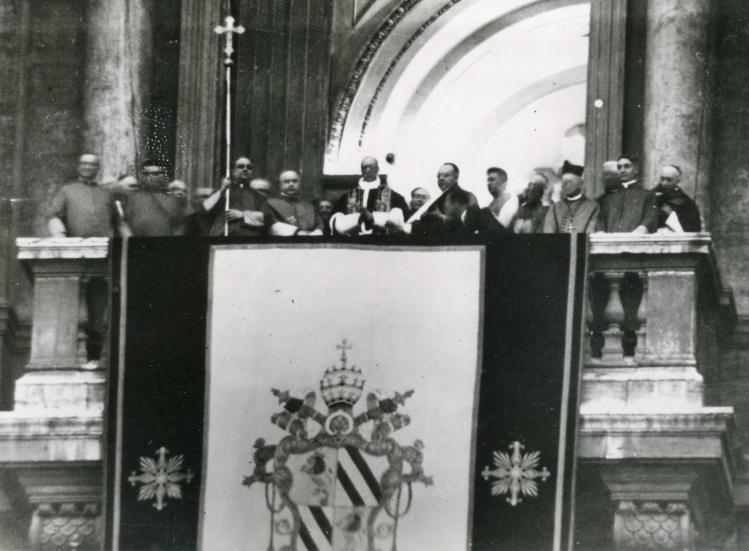
OF ALL memories of the coronation ceremony none is so vivid as the recollection of the face of Pope Pius XII as he was borne past us in the basilica. Alone in that vast assembly of happy, smiling faces, his bore a look of agony. His cheeks were sunken, his lips drawn, his eyes chilled and staring. There on the sedia gestatoria, the man with the most awful responsibility in the world, perhaps was already hearing the ominous words recited a few minutes later with the imposition of the tiara:
“By this sacred tiara, adorned with three crowns, know that thou art the Father of Princes and Kings, Rector of the World, and Vicar on Earth of Our Lord Jesus Christ, to Whom be all honor and glory now and forever, world without end.” Rector of the world! Vicar of Christ!
Perhaps I was the more forcibly struck by the expression of the Holy Father because I had had an opportunity to study his face within a few feet eleven days before, when he was still but cardinal camerlengo. He filed from the Pauline Chapel into the Sala Regia with the other members of the Sacred College, and turned toward the Sistine Chapel. The conclave was about to begin with the taking of the oaths.
Calmly and with face relaxed, Cardinal Pacelli walked with his fellow cardinals. His hands were folded, his head bowed. He radiated peace. Most of those who saw him then said later that although he had the bearing of one who expected to be chosen, and had already bowed to the Divine Will, the terrible weight had not yet begun to press upon him.
But with all the apprehension of his expression in that coronation procession, there was strength, the strength born of personal discipline and charity to others. Both were revealed in the careful thoughtfulness with which, ceaselessly moving his right hand, the Pontiff blessed first one side of the basilica and then the other as he turned himself to be seen. The discipline was shown throughout the ceremony in the tireless deliberate way he met each demand of the unfamiliar four-hour service. It was shown too in his courage as he sat erect on the throne of Saint Peter and saw bishops and archbishops kneel to kiss only his shoe and knee, not even a hand or cheek, a ritual emphasizing the life of lofty loneliness that he must lead until death. The charity was shown, as well, in the breaking of a century’s tradition by reception of the tiara in the open air where a full half-million might satisfy their desire to see, rather than the very few who were able to get choice locations in the basilica.
The piety and dignity that emanated from the person of the Holy Father throughout the service recalled to Argentinians present the Eucharistic Congress at Buenos Aires in 1935. The character of Cardinal Pacelli became known to many then for the first time. For the whole two hours he was drawn on a float in the Eucharistic procession, Cardinal Pacelli, the Papal Legate, knelt erect, with palms pressed together in an attitude of prayer before the exposed Host in the monstrance. Despite the acute physical hardship of the act, he had insisted that no other would do.
The same unsparing self-discipline was reflected in a little incident in 1936 when Cardinal Pacelli concluded his tour of the United States with an address at the Waldorf-Astoria. Without notes he delivered a speech of 1,000 words, speaking English, a language he had required himself to learn the year before at fifty-nine. To the amazement of all of us at the press table, he recited every word identically as he had released it. None of us ever had “covered” a speaker who did not in some way divert from his intended text. For the Cardinal it was a customary performance. A journalist told me he had checked the Cardinal’s lengthy address in French at the Vatican Press Congress and that not a word was altered in delivery.
The partial explanation lies in the custom of the Cardinal never to accept a speaking invitation unless it was given months in advance. Then each day he could be seen strolling for an hour beneath the palms and pines of the Borghese Park in Rome, clutching in his hand some flapping document. Here he satisfied the need for daily exercise his plan of life required.
Delight in speed
He begrudges the waste of a single moment of the day. Perhaps that accounts for his delight in speed, a liking he shared with the late Pope Pius XI. His chauffeur was accustomed to have the Cardinal Secretary of State arrive at the car fifteen minutes before he had to be at an appointment twenty normal minutes away, and they would reach their destination on time. One day as the Cardinal descended with his customary smile and “Thank you” to his chauffeur, a companion remarked flippantly: “I know why you say ‘Thank you.’ It’s because you like the speed.” The Cardinal hesitated a moment and then gravely replied : “No. I say it because of Christian humility.”
That quality Cardinal Pacelli, now the Holy Father, enjoys to the fullest. It has inspired love of him throughout the staffs at the Vatican. I learned that inadvertently four days before the conclave when I went to the Vatican and attempted to gain entrance to the cells to be used by the cardinals. At the foot of the Scala Regia, the monumental staircase leading to the Sistine Chapel, a Swiss Guard blocked my way. None were to be admitted, he said. Newspapermen were not exceptions. As I argued and pleaded, the two of us floundering through the debate in schoolroom French, a limousine suddenly passed beneath an arch and into the courtyard. The guard snapped to attention and the prelate in the rear seat doffed his hat.
“Cardinal Pacelli?” I asked.
“Oui, oui,” the guard said excitedly, beaming graciously for the first time. “Cardinal Pacelli … le Cardinal Camerlengo … le chef de Peglise.”
He said the latter proudly. Then he beamed again. We had a common friend. He listened silently as I began giving my arguments over again. In a moment he interrupted, summoned an aide, and dispatched the two of us to examine the cardinals’ cells to our hearts’ content.
The gentle geniality of the new Pope was experienced by the Princess of Siam, in an incident about which few persons have heard. The Princess arrived in Rome with her royal father, excitedly anticipating an audience with Pope Pius XI, but was taken ill with tonsilitis. The King went to the audience without his disappointed daughter. Several days later a prelate was showing the recovered Princess through the Vatican Museum when she told him of her disappointment. She added that she had been told in Berlin that the Cardinal Secretary of State was a great man; it would make her happy if she could meet him at least. The prelate phoned Cardinal Pacelli and was ordered to come with the Princess at once. As they chatted, the story of her lost audience came out. Whereupon Cardinal Pacelli called the papal apartments. What color dress was the Princess wearing? the voice at the other end of the phone asked presently. It wasn’t black, Cardinal Pacelli admitted, but it was a very reserved brown. Within a half-hour the Princess was in private audience with the Pope.
Living with his family
The new Holy Father has had more than the normal number of years with his family. Even when Cardinal Gasparri had summoned him to the Secretariate of State after his ordination, he continued to live at home. Brother Clancy, head of the Irish Christian Brothers school in Rome, still remembers Cardinal Pacelli’s nephews’ pride in him thirty years ago. They attended Mass with the other pupils on weekdays but on Sundays would say proudly: “We stay at home for Mass today. Our uncle celebrates it for us!” The father of His Holiness, Filippo Pacelli, one of the leading ecclesiastical lawyers of Rome, lived to be a nonagenarian, and attended his son’s Mass, receiving Communion from him every day.
The Pacelli home is in the new section of Rome, Prati, built thirty years ago. Quiet although completely built up, it nestles behind Castle St. Angelo, the old papal fortress, on the Tiber. The house is painted Pompeiian red, the picturesque color, seen all over Rome, which the Italian authorities denounced a few years ago, because it is incompatible with a militaristic nation of destiny.
Inside the quiet halls of the villa, peace rests lightly. The sitting-room, bathed by the southern sun, is dominated by the Pacelli papal coat of arms. The gold-woven red tapestry depicts two blue-clad angels holding a crown-topped shield divided into halves, one showing a dove carrying olive leaves, the other the tiara and keys of the Pope. Sacred pictures adorn the walls, one of them a study of Christ in His Agony. In the little court yard behind, mathematical neatness dictates the perfectly straight line of the low clipped box hedge and the little gravel walk.
The new Holy Father was born not here but in a Roman palace near the Chiesa Nuova built by Saint Philip Neri. As a little boy he became a member of the Catholic boys’ club operated by the Oratorian Fathers who direct the church. In the club, which is modeled after the little groups of boys Saint Philip Neri collected for oratorical discourses, young Eugenio delivered his first timid, halting sermon. It was the forerunner of many. He sang his first Mass and recited his first sacerdotal sermon in the church in 1889. Later throughout the world he preached in Spanish, German, Hungarian and Portuguese, as well as Italian, English and French.
Eugenio was distinguished as a youth for his unusual gravity. He was a brilliant student, succeeding especially well in history and languages. He led his college class at the Visconti Liceo, and won the Italy-wide essay contest on “universal history” sponsored for liceo students by the Ministry of Public Education.
His desire was to care for souls
At his ordination his desire was to care for souls. He was to wait forty years for the fulfillment of that simple ambition— and then not the souls of a parish but of the world were to be his responsibility.
Cardinal Gasparri called him to the Secretariate of State after he had passed a short time as a professor at the Roman Seminary. Set to work at the codification of canon law, a task ordered by Pope Pius X, Father Pacelli soon became the protege of Cardinals Merry Del Val and Delia Chiesa, the latter of whom became Pope Benedict XV. The rapid rise of the young priest in the Secretariate of State, how he was made an archbishop at forty-one and papal nuncio to Bavaria in 1917, how he became papal nuncio at Berlin in 1920, and how he was made a cardinal in 1929, has been told in every newspaper. It is unnecessary to repeat. The story of the past nine years as Secretary of State is also well known, but an incident of the calm, cool restraint for which Cardinal Pacelli became known through the chancelleries of the world may be mentioned.
As reporters went down the bay on the coast guard cutter on the morning Cardinal Pacelli arrived in New York for his American tour, none of us had any plan but to obtain a statement reflecting the Vatican attitude on the Reverend Charles E. Coughlin. The presidential campaign was just finishing and Father Coughlin had spoken frequently on the subject in his broadcasts. When we were admitted to Cardinal Pacelli in a hallway of the steamship, we were handed copies of a mimeographed statement of several hundred words in which the Cardinal explained his desire of getting to know America, and stated that his plan was merely a vacation trip. Father Coughlin was not mentioned. A reporter asked a question intended as a prelude to discussion of Father Coughlin. The technique usually was successful. The reluctant celebrity customarily had a few interesting things to say as soon as he was lured into answering questions. Cardinal Pacelli smiled and made no answer. Another question was attempted and the reporters surrendered, bowed and left. Cardinal Pacelli had survived scratchless the ordeal by New York ship news.
Another trip of the Holy Father gives perhaps the most important side of his character. As the Budapest express swayed and rattled over the rails on the way from Rome to the Eucharistic Congress last year, to which Cardinal Pacelli was also Papal Legate, the members of the Cardinal’s entourage were summoned to his quarters at about nine in the evening. With some of them wondering what extraordinary event could have provoked the Cardinal to call them at an hour so close to bed-time, they filed in.
“Kneel down,” he instructed as he dropped to his own knees. Then, with beads in hand, he led them in the recitation of the rosary.
Next morning the Cardinal was met at the train by an official party and a round of welcomes and official calls on government and church officials began. At half past twelve, with most of the members of his party wearied by the ordeal, the Cardinal shocked them by saying he was now prepared to say his Mass. Unnoticed by the rest he had fasted all through the receptions that he might not miss even for one day his sacerdotal privilege.
The Holy Father sat motionless on the sedia gestatoria as the ceremonier burned before him the oil-soaked oakum, warning him that “thus does the glory of the world pass away.” Each of the three times the oakum was burned before him he sat rigid, his eyes riveted on the flames as they curled and licked up before him for about twenty seconds. But then as the procession continued and with that thin right hand, so gentle yet so firm, he resumed his benedictions over the kneeling worshipers, we wondered whether any words of admonition were more unnecessary than were those to Pius XII.