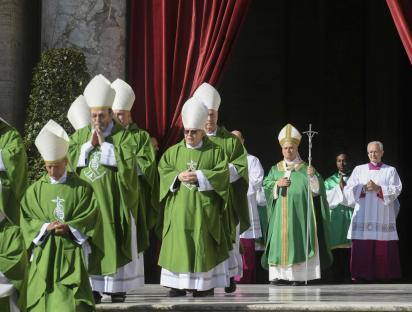
I AM WRITING this column as best I may in the midst of all the flurry and fuss of packing bags (and hunting a lost passport!) as I prepare at less than twenty-four hours’ notice to catch a boat tomorrow to sail for Rome on a newspaper assignment to aid in the reporting of no less an event than the election and enthronement of a new Pope for Christendom. It is a strange, almost uncanny experience, because it duplicates (with many differences) an almost identical adventure just seventeen years ago, in 1922, when I was dispatched at equally short notice on the same errand. Then, Pope Benedict XV, the Pontiff of the World War, had just died; now his great successor, Plus XI, the Pope of Peace, lies dead in the Sistine Chapel—the clouds of a possible second world war brooding over the world—and again a successor in the long line of the Vicars of Christ stretching back to Peter the Fisherman is to be chosen. And once more the men of the press are hastening from many parts of the world to join those of their craft already on the scene to do their best to report and interpret the momentous events that will be unfolded during these next few weeks in Vatican City.
Of course, at the very best, only a partial job of reporting will be possible, for the secret conclave of the College of Cardinals of Holy Mother the Church is really secret; and deeper and less recordable even than the silence of the Princes of Christendom, sealed with the vow of secrecy, will be the operation of that guiding Spirit promised to the Church in the beginning by her Founder, the ineffable working of the Holy Ghost. Nor is it likely that the efforts of the press to interpret what they learn, or surmise, of what will go on within the Sistine Chapel during the conclave—or of the gossip and guessing in the great whispering gallery which all Rome, within and outside Vatican City, becomes on an occasion like this—will be overly successful and reliable. However, all the world is eager to learn all that its press can report to it, and to understand as thoroughly as the press interpretations can aid it to understand the significance of the things reported.
It was so, in 1922, seventeen years ago; but much greater, I believe, is the world’s interest, and the world’s concern, today. Something utterly unforeseen in 1922 by the world (but not by the Church: for the Church, through Leo XIII, and all his successors had warned the world, but without avail) has happened since then, and the peoples of the earth are now confronted with an evil even worse than war. Now they face the ever-growing force of the world revolution of the new paganism, expressing itself outwardly in the various and increasing forms of the totalitarian state, moved inwardly by the spirits of materialism and organized atheism and idolatrous racialism and imperialistic nationalism, spreading, and coalescing, and threatening to overrun and vanquish utterly what is still left of the free peoples, and the institutions of liberty, and the culture of Christendom.
And since 1922, since that day, February 6, when Plus XI left the “prison of the Vatican,” in the hour of his election, and in the open air, from the balcony of St. Peter’s, gave his benediction, and his leadership, not only to his sacred city, but to the city and the world, that world has come to know that the world-wide, the universal, Catholic Church—super-national, super-racial, supernatural—will never, because by the very nature of its innermost being it cannot, yield to the forces of the new paganism.
Ever and everywhere, openly and freely where its branches are free and unfettered, partially yet determinedly and persistently where it is hampered or checked by secular might, secretly yet equally with permanent persistence where it has been apparently suppressed, the Church will, because that is its life, carry on its divine mission of teaching to men the truth that makes men free.
Now it waits for him who is to come to lead it forward again on that unending task. Whether his name shall be Pius, or Leo, or Benedict, or any other of the hallowed names chosen by the Vicars of Christ down the centuries, the task will not, for it cannot, change. This is the great fact about the election of a new Pope, and anybody can write it truthfully without voyaging to Italy; but how gladly I go to see, and seek the blessing of, the Holy Father that soon will be with the now sorrowing, orphaned children of the Church—the Holy Father who will claim all the children of all races and all nations as his own, because they are God’s children, and he is God’s Vicar on earth.