On his way out of town, the eminent sociologist Christian Smith nailed his ninety-five theses to the doors of the Basilica of the Sacred Heart, resigned his longtime professorship, and raged against the dying of the light in an essay in First Things: “I am done with Notre Dame.” Presumably, it’s mutual.
As Catholic scholars who also taught for years at Notre Dame, we recognize—and reject—Smith’s dyspepsia. He has failed to understand the unique place of the university in American Catholic history. Founded in 1842 by French priests whose new congregation aimed to restore Catholic institutions after the French Revolution in 1789, Notre Dame grew along with its region over the course of a century. It instructed and elevated to professional achievement numerous descendants of immigrants. Its students fought the local Klan in South Bend. And under the leadership of Fr. Theodore Hesburgh, it realized its aspirations to become a nationally prominent university for both women and men in the humanities and the sciences. With that success came danger.
Smith’s bitter critique of Notre Dame’s problems betrays a fundamental misunderstanding of its reality. “Catholic” means “here comes everybody,” even and especially when they disagree. See if it isn’t the same way in the Vatican; as the late Pope Francis said, “Todos, todos, todos!” Notre Dame is not merely a Catholic school; containing multitudes, it is also a shrine. School and shrine coexist—a difficult balance, especially when the beloved football team cements them. Alumni devotion to “Our Mother” has helped elevate Notre Dame far above the glacial outwash plain of South Bend: she has stood as a beacon to the same Catholic immigrants upon whom the American Protestant aristocracy looked down.
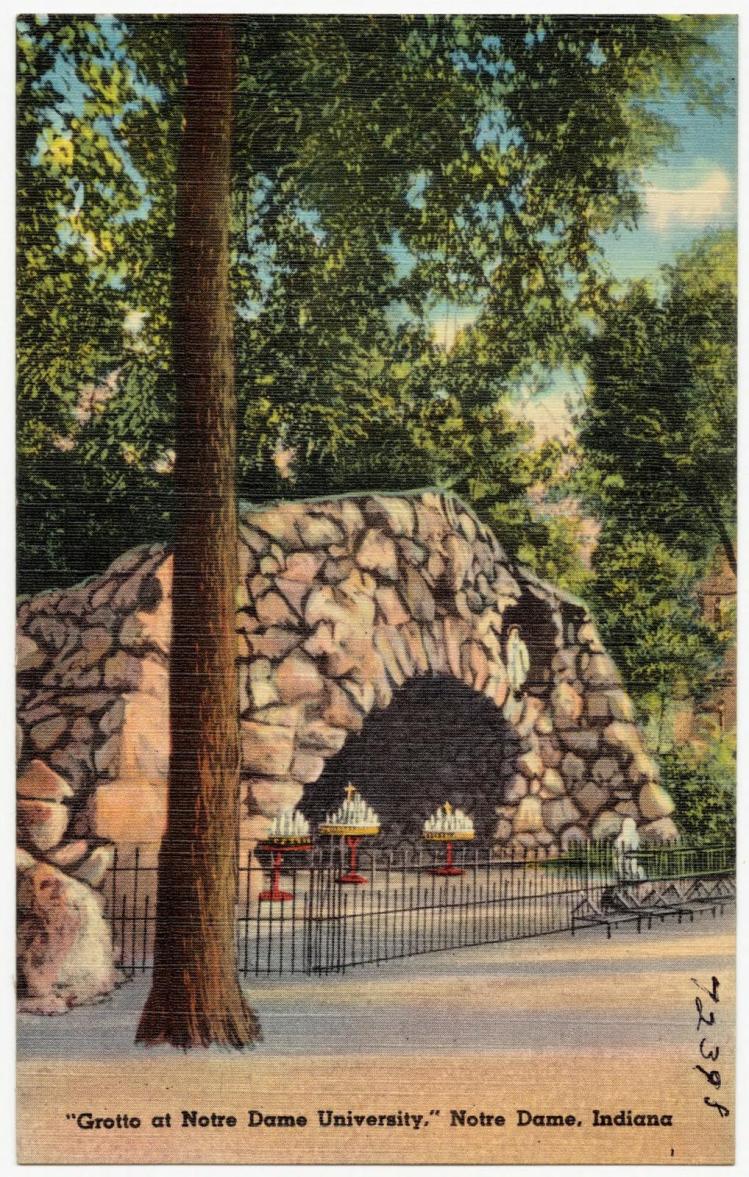
Anyone who makes the circuit of the place knows it is a shrine. Go up Notre Dame Avenue to the Main Building where Our Lady presides from the rooftop, or into the basilica where Fr. Edward Sorin deposited the hundredfold relics he procured. Head down to the Grotto where alumni and visitors pray under the statue of Our Lady of Lourdes and students propose marriage. Purchase a relic at the bookstore to bring home from the pilgrimage, and see to the expanded stadium presided by a holy icon, Touchdown Jesus, where the brave Fighting Irish brought surcease to beleaguered and despised Catholic immigrants. Before the priests’ residence, Fr. Corby forever blesses the Union troops at the Battle of Gettysburg. Can a powerful shrine, this stationary juggernaut, be a university?
Let’s dig into Smith’s theses. In his blistering indictment, he ticks down a laundry list of complaints against the nation’s richest and best-known Catholic university: It chases academic prestige; it craves mainstream acceptance, especially from Ivy League and Ivy-adjacent schools; and it shrinks from any conflict likely to impede its achievement of the first two goals. It cares about money, brand, and appearances more than substance.
As Smith acknowledges, many of his complaints ring true for higher education in general. Fundamentally, however, Smith’s focus is how these features undermine Notre Dame’s Catholic character. He argues that “the intellectual life of the university is precisely where Notre Dame largely fails to be Catholic.” It ignores its duty to keep its undergraduates in the fold.
What would that righteous intellectual life look like? For one thing, it would courageously defend the firm but unpopular truths of the Catholic tradition. Smith opines: “The history of Catholicism in America and the firmness of the Church’s positions on morally and culturally sensitive issues puts pressure on Notre Dame to adopt a version of Catholic higher education that won’t cause its representatives to be snubbed at the bar and on the golf course.” While “legitimate pluralism” must be honored, Smith tacitly suggests that opposition to the Church’s firm positions must not be given a platform. His essay has already been used as ammunition by those opposed to the appointment of a publicly pro-choice scholar to head the Liu Institute for Asia and Asian Studies.
Second, it would be distinctive. Smith writes:
In his earliest addresses, John Jenkins laid out a truly impressive vision for Notre Dame’s distinctively Catholic place in higher education. He boldly asked, “If we are afraid to be different from the world, how can we make a difference in the world?” But there were missteps and blowups over The Vagina Monologues being performed on campus and President Obama being awarded an honorary degree. At times, the uproar on campus seemed like Berkeley in 1964. In my estimation, those conflicts induced a reaction of wary defensiveness.
Third, in pursuit of distinctiveness, Notre Dame’s intellectual life would not be disquieted by the concerns that animate all people of good will. While Smith praises Catholic social teaching in theory, he is not overly impressed with Notre Dame’s commitment to working to make “the world a better place,” because nearly every other university expresses such a commitment as well.
Two defects mar Smith’s analysis of the challenges facing Notre Dame. First, his is a Protestant, not a Catholic, sensibility. The mixing of the sacred and the profane is par for the course at shrines. Trinket shops line the path not only to Our Lady of Guadalupe, but also to St. Peter’s Basilica itself. The hucksters and healers, the tacky and profound, the superstitious and the skeptical all mill around shrines. They demonstrate that nothing human is outside the reach and understanding of the Church.
Smith wants a purity for Notre Dame; shrines are never pure. They can, however, be profaned and polluted. In our view, these are the anthropological categories that help explain the controversies over both the performance of Eve Ensler’s play The Vagina Monologues a decade ago and the commencement speech given by President Barack Obama in 2009—two events in which we participated during our tenures as Notre Dame faculty.
In the spring of 2006, Fr. John Jenkins, then president of Notre Dame, issued a statement, over much objection, that permitted performances of The Vagina Monologues to continue but required each performance to be followed by a panel including “a sympathetic and thorough presentation of Catholic Teaching.” Together we served on one such panel, bringing our respective training in early Christianity and moral theology to bear on what was admittedly a challenging work. We did so because we were—and remain—in agreement with Fr. Jenkins’s statement that “Notre Dame’s policy on controversial events rests on the conviction that truth will emerge from reasoned consideration of issues in dialogue with faith, and that we will educate Catholic leaders not by insulating our students from controversial views, but by engaging these views energetically, in light of Catholic teachings.” His was a reasoned civility now departed from American public discourse.
In retrospect, we failed to recognize that for many associated with Notre Dame, the performance of the play was not merely immoral, but an abomination. To borrow from Purity and Danger, the classic work by the Catholic anthropologist Mary Douglas, the performance of The Vagina Monologues at Notre Dame offended against ritual purity, not merely Catholic moral teaching. Staging the play on campus risked outraging Notre Dame, Our Mother.
The controversy over Barack Obama’s 2009 commencement speech is amenable to similar anthropological analysis. Although the university regularly invited first-term presidents to serve as commencement speakers, the invitation to the pro-choice Obama inflamed the strong and loyal pro-life branch of the Notre Dame family. How could someone who defended the killing of innocent babies be allowed to speak on a stage under the shadow of the Virgin on the Dome?
Refusing to share the stage that year with Obama, Harvard Law professor Mary Ann Glendon declined the Laetare Medal, widely considered to be the highest honor in the American Catholic Church. The Honorable John T. Noonan Jr. spoke in her stead. A federal circuit court judge with a towering, fearsome, and faithful intellect, Noonan did not chastise Glendon for her absence; he pointed to another way. As a Catholic canonist, he appealed to the doctrine of the informed conscience:
One friend is not here today, whose absence I regret. By a lonely, courageous, and conscientious choice she declined the honor she deserved. I respect her decision. At the same time, I am here to confirm that all consciences are not the same; that we can recognize great goodness in our nation’s president without defending all of his multitudinous decisions; and that we can rejoice on this wholly happy occasion.
We endorse Noonan’s capacious and compassionate intellectual vision; we see it in the hearts and minds of Notre Dame’s current president, Fr. Robert A. Dowd, and its provost, John McGreevy. But we also recognize the challenge they face. Notre Dame the American shrine will always coexist with Notre Dame the global (that is, the Catholic) university. But then, learning and devotion have been in tension since the beginning of Christianity.