“An Uncertain Grace” is a suggestive title, but it hardly captures the riveting photographic collection that makes up Brazilian photo journalist Sebastiao Salgado’s first retrospective in this country. The exhibit, which opened in San Francisco and moved on to The International Photography Center in New York, is now on view in Norfolk; it closes later this year in San Diego. It should not be missed.
The grace in Salgado’s photographs is anything but uncertain. The nearly ninety black and white photographs rival the work of Henri Cartier-Bresson or Walker Evans. Like Cartier-Bresson and Evans, Salgado’s subjects are people tested by events and made memorable by the artist’s attention and discretion.
Salgado’s settings vary, from ritual to war, from survival to children’s games. There is a particular emphasis on the rigors of work in the third world—Brazil, India, Ecuador, Bangladesh—and on life and death in the face of famine and civil war. Salgado manages to be on the latest firing line. The New York Times Magazine (June 9) carried his photographs of oil-well firefighters in Kuwait. These were followed by an essay on the photographer by Matthew L. Wald.
Despite the weightiness of his subjects, Salgado’s photographs are neither overwrought nor sentimental. “I do not make pictures to give anybody a bad conscience,” he told Wald. “We can mind the problem of others and not be on the defensive about the problem.”
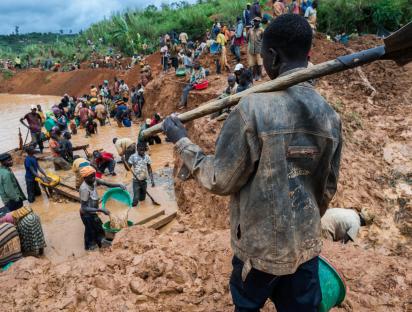
The problems. Scarcely ever has a photographer rendered them so lucidly, so unforgettably, and under such circumstances as this forty-seven-year-old former economist who was forced to flee Brazil in 1968 for political reasons. The exhibit opens with a 1986 series of photographs from Brazil’s Serra Pelada gold mine. When Pope John Paul II writes in Centesimus annus that “the human inadequacies of capitalism and the resulting domination of things over people are far from disappearing,” he might have been providing a gloss on Salgado’s photographs. At first look, the shots of Serra Pelada seem like stills from a motion picture set. Such scenes—masses of humanity laboring like insects in an open pit mine—could be from Land of the Pharaohs, but surely not A.D. 1986. But immediately, one confronts individuals in situations that reveal an essential element of their humanity: unself-conscious contemporaries, impervious to the lens of the camera but keenly attuned to Salgado’s own humanity, seemingly enslaved by circumstance but generally unbowed.
The Serra Pelada photographs are like Stations of the Cross. Sometimes all the photographer gives is a series of legs and feet struggling to dig into a muddy slope. In one photograph, an army of bodies ascends crude wooden ladders, ten across, twenty men deep, shoulder to foot, shoulder to foot, up from one landing in the Pueblo-like pit to the next. Another photograph depicts an angular, mud-covered Sisyphus from above as he makes the top of the ladder, a bundle of slag strapped in a bag to his shoulders. He is concentrating on securing the final rung and then moving onto the ledge. There is a keen, dramatic suspense in the moment: the man senses he might yet topple back eight stories into the pit below. The white of his eye, at the center of the photograph, indicates the total effort of his concentration not to loose his grip. The tag next to the photograph indicates the broader context: “In the Serra Pelada gold mine, each worker makes up to sixty trips daily, transporting bags of dirt from the bottom of the mine to the sediment dump on top.” Does this man still carry his burden? It seems inconceivable. But Salgado has immortalized him, much as Pablo Neruda did Cristobal Miranda and the sodium nitrate shovelers at Tocopilla.
From India (1990), a group portrait of three coal miners, black-covered magi whose eyes search the inscrutable camera’s eye for the star of deliverance. In another, six women in flowing saris and splendid headdresses clear a canal under construction by carrying the dirt out in wok-like pans balanced on their heads. Two clouds move unhindered in the background as the women ascend and descend a slope; one woman, going down, extends an arm to another coming up. Both clouds and women seem to be dancing, albeit to different choreographies.
A worker welds the hull of a boat in Brest, France (1990). We see his protective goggles through the eye of a huge steel clip being attached to the hull. It is like a Miro: a playful eye looking into the camera through a hole, the welding torch sending out a cascade of joyous fireworks.
Mali, 1985: the Prodigal Son’s mother. She is draped in black, and but one eye shows. Worn out by sand storms and chronic infections, the eye has become nothing more than a withered, onion-like film. The look on the woman’s face is not one of terror but of irreparable grief and separation. A pieta without even the comfort of the corpse. “The lamp of the body is the eye …. If your eyes are bad, your whole body will be in darkness.”
In 1984-85, Salgado worked with Médecins sans Frontières covering the great famine in the Sahel. His photographs from Ethiopia startled the world. Here, an Eritrean refugee, Giacometti-like, stands holding the limp skeletal form of his son. The man looks like a tribal chieftain cradling the last of his people. His gaze is that of an eternal judge, merciful but undistracted. And we…we will never be satisfied without his verdict.
Salgado depends on natural light, and his skill in using it is superb. In a photo of leprosy victims at a clinic in Chad (1985), exterior light from the right makes each face in the dark confines of the primitive waiting area distinct and discernible. At a Kenyan girls’ school (1986), fog swirls around a circle of chanting, swaying students; the grainy quality of the photograph makes the whole scene damp and windswept. In a tree full of children in Thailand (1987), eight young boys swing from boughs in a Shaker-like tree of life. They look simultaneously like tree ornaments and candles on an inverted Menorah. The sun breaks through with full force from behind the tree, obliterating whole sections where the foliage does not cover. These appear as liberated zones where the sparks of primeval creation have been made manifest. And yet, each child’s face is not overexposed but in proper contrast and focus.
Hope, humor, death, valor—they all have their distinct, honored place in this exhibit. Cultures are given their due. A Brazilian peasant (1983), stripped to the waist, holds his naked baby daughter next to a life-size portrait of Christ. The three are joined. Despite his poverty, the peasant sees and is seen by God. A Guatemalan woman (1978) watches a small girl, perhaps her daughter, from a small window within a door. The girl sells small candied apples unaware of the woman’s benevolent gaze. The beautiful fruit foreshadows a second, better Eden.
In 1963, Pope John XXIII’s Pacem in terris caused such a worldwide response that an edition of the text was published with Magnum photographs from around the world illustrating the text. Salgado’s photographs could easily do the same for Centesimus annus.
Viewing “An Uncertain Grace” is both exhausting and exhilarating. I had never had the experience of standing before photographs and finding my flesh tensed almost to the point of twitching. It happened here. Salgado’s photographs, heightened by his composition and technique, are profoundly social. “Man is made to live socially,” he told Wald, “and photography is an instrument of this.” His images are remarkably contemporary. Will they last? There is not the slightest doubt. They reveal something of God’s own attention and abounding presence.