Novels that foreground faith (or lack of faith, for that matter) are not exactly rare birds, but they don’t appear on my radar frequently. This year, however, three superb novels considering religious practice crossed my line of vision. I’m delighted to recommend all three as Christmas offerings.
Charlotte Wood’s Stone Yard Devotional (Riverhead Books, $28, 304 pp.), shortlisted for last year’s Booker Prize and widely reviewed (including in Commonweal), is surprising and moving, an utterly serious novel narrated by a middle-aged woman whose voice often crackles with dry wit. In a brief opening section, she arrives at what she calls a “nunnery” near her childhood home on the plains of rural Australia, a landscape that could be described as bleak or desolate or, a reader comes to see, as beautiful. Her husband has flown off to a new job in England and she probably will not follow. Instead, for four days she occupies one of the visitors’ cabins and, though she is an atheist, attends vespers and returns for lauds, not at all certain why.
Wood’s prose is precise and straightforward as it conjures up the landscape (“Although these plains bristle with a fine skin of pale grasses, they are almost bare as bedrock”) and the interior life of the unnamed narrator (“the hours are so long and there is so much waiting”). An environmental activist, she alternates brief, understated present-tense scenes with past-tense memories, in a steady tone resembling the manner of a doctor who treated her after the deaths of her parents: “She did not gush or emote, which was a great relief.”
The novel’s second section opens four years after the narrator’s brief sojourn with the sisters. Covid rages in the outside world. The sisters, by choice, already live with constraints that people across the globe suddenly experience involuntarily. Our narrator, whose marriage has ended, has now become a part of the tiny community, her role never fully explained. Though she accompanies the sisters in their religious practices and communal life, she says: “I haven’t ever joined. Not really.” Her own belief is sometimes “as thin as the light.” She finds the nuns whose faith is most childlike the most exasperating—“I fell in love with Jesus and want to live with him in heaven. As if they’re talking about some teen idol crush”—but she suffers when she wounds them.
This is a book filled with philosophical pondering, but the tension between the narrator’s unbelief and her growing attraction to religious practice makes it speed along. So do three startling appearances: a horrific plague of mice, described in gory detail; the return of the bones of a nun murdered in Thailand; and the arrival of a “celebrity” nun our narrator betrayed when they were classmates. Themes assert and reassert themselves in unexpected variations: the violence and suffering of living beings, social activism versus quiet contemplation, the difficulty of true forgiveness. The torturous deaths of female saints make intermittent appearances, as do memories of the protagonist’s generous, tolerant mother. This is not a story that seeks or provides neat resolution, but its lambent prose is full of great and difficult love.
Stone Yard’s narrator is infuriated by hypocrisy and fierce on the subject of nuns who “buried babies they called illegitimate,” decrying the “savagery of the Catholic Church.” Bill Furlong, the protagonist of Claire Keegan’s Small Things Like These (Grove Press, $20, 128 pp.), will witness some of that savagery, but Keegan’s narrative is so tightly focused on a virtuous character that it is hard to associate his story with savagery. Indeed, all of Keegan’s fiction, though fraught, is restrained. I have admired her work since reading the sublime Foster and have followed her other books faithfully, but I avoided Small Things, originally published in 2021. It simply became too painful to read any more accounts of Ireland’s Magdalene laundries, institutions where unmarried mothers were cast out from the community, imprisoned, and abused. As Small Thing’s afterword notes in understatement: “It is not known how many thousands of infants died.”
But I’m glad that I found Small Things Like These misshelved under “new releases” in my local library, waving its hand at me, because it is a model of how to treat a contemporary social or political issue in fiction. While Keegan’s novella is a fictional exposé of sorts, it is hardly another depressing report from the field of recent historical realism; it is, instead, a brief, intense exploration of action against injustice. Like all of Keegan’s writing, the prose is utterly faithful to the obligations of story itself—every word, every image, and every motif essential to its vision. Its dramatic arc and resolution are old-fashioned and satisfying. It is also a story set at Christmastime, exactly when it belongs.
Small Things is told through the sharp eyes of Furlong (a resonant name suggesting a small area), who has worked his way up to own his own coal business. The story opens in the mideighties. It’s a bleak winter in a little Irish town where people struggle to find enough warmth, so Furlong’s services are in constant demand. A collage of scenes in town and countryside sets the scene: Furlong notes that “the dole queues were getting longer” and sees “a young boy drinking the milk out of the cat’s bowl behind the priest’s house.” As if to highlight that priest’s house, a reader’s first vision of nuns shows them “talking to some of the more well-off parents.”
Bill Furlong is the kind of man who frets over cows left unmilked in the field when desperate farmers leave overnight. Fatherless himself, he was raised in the home of a Protestant widow. Instead of dismissing her pregnant teenage housemaid, a Catholic, as others might have done, Mrs. Wilson kept Furlong’s mother on and saw to the birth and upbringing of her child. After Furlong’s mother died, it was this benefactor who raised him. Mrs. Wilson’s decency has become the needle on his moral compass, guiding him in his care for his wife Eileen and their five daughters. The brief dialogue between Bill and Eileen is invariably telling: “We’ve not a penny owing,” Eileen tells Bill, “and that’s down to you.”
Both Bill and Eileen have long been aware of the laundry next door to their older daughters’ school, but haven’t paid much mind to the gossip about what goes on there. One day close to Christmas, though, Furlong makes a delivery and discovers what the townspeople have conspired to keep secret: young girls desperate to hold their babies or escape the laundry or both. Later, his discovery of one of them locked in the coal shed, shivering and filthy, will trigger a great moral crisis. Should he act or join the rest of the townspeople—and the priest, he surmises—in their silent acquiescence? His wife cautions him against interference; the Furlongs depend on the financial generosity of the nuns and on the neighboring school to educate their daughters.
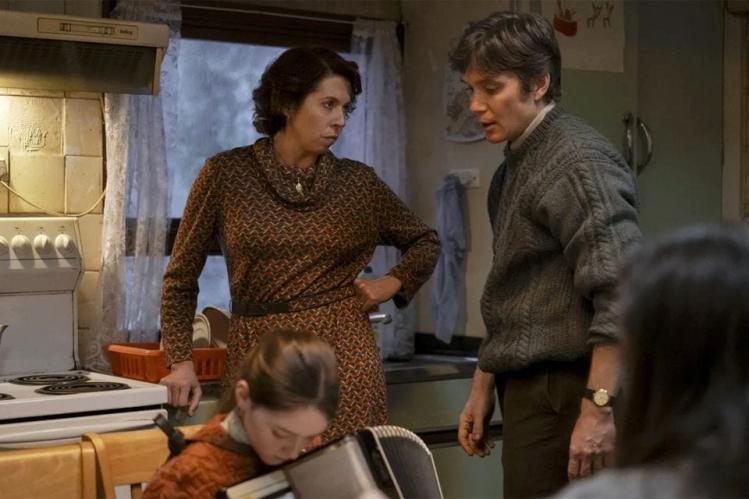
Bill Furlong rebels against caution, and in so doing enacts a genuine Christmas story. The simplicity and clarity of his movement from complicity to courage is bracing; it is no wonder that Small Things was also shortlisted for the Booker, widely lauded, and adapted as a film. It also serves as an argument for the literary vitality of the novella, a form Keegan uses masterfully, with just the right amount of dramatic compression and just the right amount of elaboration.
Like both Keegan and Wood, Kate Riley considers an individual’s faith in relief, against a community’s, but her novel Ruth (Riverhead Books, $29, 256 pp.)covers a lifetime and is utterly iconoclastic in style and tone. Ruth, who narrates the span of her life in a Christian commune, is joyful, vexed, funny, and serious about religious faith. Ruth is a slow, contemplative read that concerns itself not with dramatic momentum, but rather with the texture of Ruth’s days and nights. Each small section is a meditation, maybe even a prayer, albeit often a flabbergasted prayer. In an interview with her friend Molly Young, the critic, with whom she corresponded about the earliest versions of the book, Riley says: “I attribute whatever formal weirdness there is in Ruth to the fact that I wrote all of it on an iPod Touch, where you can only see three sentences on the screen at any one time.”
The Michigan community Ruth belongs to is loosely modeled on Christian peace churches like the Mennonites, Amish, Hutterites, and Church of the Brethren. Unlike old order versions of those faiths, though, Ruth’s community is thoroughly modern, its stores of communal property computerized and its network of brotherhood communes, or “Dorfs,” a model of slightly surreal bureaucracy. Gender roles are rigid. Ruth is expected to perform traditionally female domestic tasks, to dress modestly, and to follow her elders’ guidance about a husband. She is also an oddball, a ponderer, and an inveterate malcontent who recognizes oppression and reveres authority. Her reading list is a delight. This is the only novel I’ve read in years (or, more likely, ever) that cites both this publication (“In Commonweal a Berrigan brother wrote from jail of the hopeful solidarity among his Black cellmates”) and The Catholic Worker. Because Riley herself volunteered with the Catholic Worker and lived in an English religious commune, hers is not a disdainful outsider’s voice but one with real authority (and a healthy sense of the absurd) about attempting to live selflessly, the well-being of others always the first order of business.
Though Ruth is filled with examples of various rules and strictures that lead to a condition that might be called “either humility or insanity,” and though it is filled with wondrously funny passages that tip the absurd side of the scale, it manages to convey deep respect, not only for Ruth but for the other communards. Indeed, all three of these novels are written with reverence, not only for the written word but for people who seek to lose themselves in love for others.