Japan has an odd relationship with Christianity. First introduced in the south of the country by St. Francis Xavier in the mid-sixteenth century, the faith soon gained a foothold, notably in Nagasaki. Converts ranged from prominent feudal lords to the poor and destitute. Since the end of the previous century, Japan had been torn by civil strife. In 1597, Toyotomi Hideyoshi, a peasant foot soldier who had risen to the pinnacle of power, issued an edict banning Christianity as a threat to the land and its religious traditions. He demonstrated his determination by having twenty-seven Christians crucified. His successors were even more ruthlessly thorough in bringing Japan’s “Christian century” to an end. It was not until 1873 that the ban on Christianity was officially lifted. Today, Japanese Christians account for a mere one percent of the population, with fewer than half a million Catholics. Neighboring South Korea, with considerably less than half of Japan’s population, has nearly fifteen times that number.
These statistics make the social and cultural influence of Christianity in Japan all the more remarkable. There are hundreds of schools and dozens of universities affiliated with some form of Christianity—many of considerable prestige. One of Tokyo’s most renowned hospitals is named for St. Luke. Of Japan’s prime ministers since the end of the war, at least six have been Christians, including most recently Shigeru Ishiba (2024–25). The empress emerita is a graduate of the University of the Sacred Heart, where her aunt, born Shōda Mineko, was a teaching nun (Sr. Maria).
There is also an abundance of Japanese writers either Christian or influenced (sometimes haunted) by Christianity. Chronologically, they range from Uchimura Kanzō—author, ardent evangelist, pacifist, and founder of the Non-Church movement, baptized in 1878—to prizewinning novelist Kashimada Maki, who, born nearly a century later, was received at the age of seventeen into the Japanese Orthodox Church. A generation of authors born in the 1920s and ’30s includes such converts as Miura Ayako, Watanabe Kazuko, Suga Atsuko, Sono Ayako, and Takahashi Takako. In her work, the Protestant Miura contrasts human depravity with redemption through forgiveness. Watanabe, who joined the Sisters of Notre Dame de Namur, was—together with essayist and Dante expert Suga Atsuko and the novelist Sono Ayako—a graduate of the University of the Sacred Heart. Takahashi Takako was already a prominent writer when she was baptized in 1975. Her sponsor was Endō Shūsaku (1923–96), Japan’s best-known Christian writer.
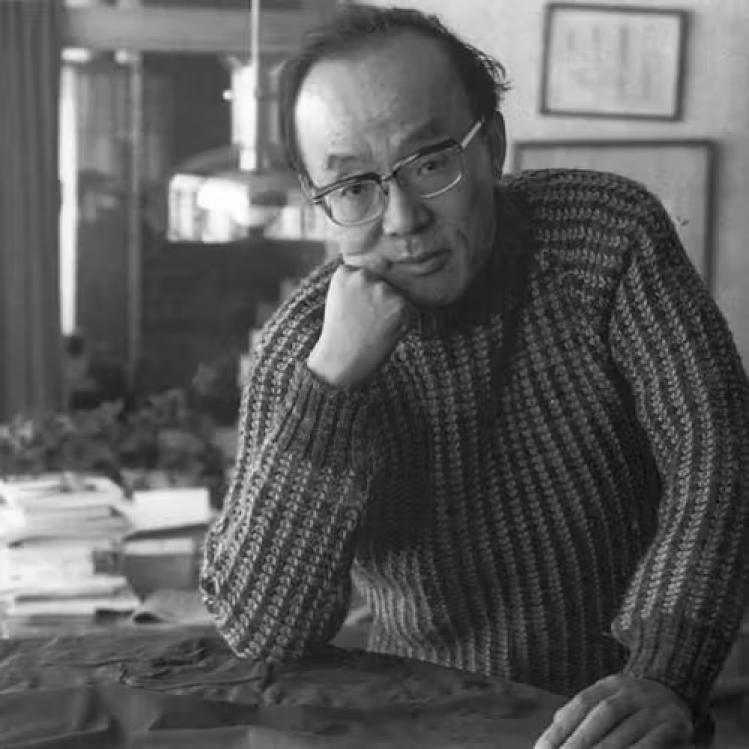
Endō, too, was a kind of a convert, baptized at age eleven or twelve after his divorced mother was received into the Church under the influence of her Catholic sister. But Endō consistently described himself as having been “borrowed” into the faith (kari-mono). He claimed to have understood almost nothing of the religion to which he had given his perfunctory assent as a boy. He came to see this religion as an ill-fitting suit, Occidental clothing to which he, being Japanese, could not fully adapt—but which he could not bring himself to discard.
Endō was already a well-known author in Japan when his now famous Chinmoku (Silence) was published in 1966. (The English translation by William Johnston, SJ, appeared three years later.) Among Catholics in Japan, both Japanese and non-Japanese, it was received with dismay and consternation. Far from portraying early seventeenth-century Catholics in Japan as heroic and saintly martyrs, Endō focused on their weakness and doubts. As in much of his other work, he skirts the edge of cultural relativism, suggesting that “Occidental” Christianity, with its stern father-God, cannot take root in the “swamp” (numachi) of animistic, mother-centered Japan.
Portraits of a Mother, a new collection of Endō’s fiction translated into English by Van C. Gessel, begins with a novelette and is followed by four short stories and a novella. All are semi-autobiographical, featuring a male character whose relationship with his mother is a constant theme, if not the focus. In all but the last, a story that went undiscovered until well after the author’s death, the character’s ambivalent ties to Christianity are never far from his mind.
The story “Mothers” is told in the first person by a traveler to an island in southern Japan who is intent on learning about the community of “hidden” Christians (kakure). These are the descendants of persecuted believers who, over the centuries, succeeded in eluding the authorities while secretly practicing their faith. When the ban on Christianity was finally lifted, they refused to rejoin the Catholic Church, preferring their own tradition and remaining in secluded villages. “What do they worship?” the narrator asks the local priest. “Well, it’s no longer true Christianity…. It’s a form of superstition?”
The narrator describes how the forebears of today’s kakure appeared to be practicing Buddhism when, for example, they worshiped before statues of Kannon, the bodhisattva of compassion. For them, however, the statue represented the Virgin Mary. Subjecting themselves to the government-imposed ritual of trampling on images of Christ to prove their nonadherence to Christianity, they then scourged themselves out of shame and sorrow.
Juxtaposing and blending religious fervor and human weakness, the narrator in this first story clearly sees himself in the kakure as he remembers his relationship to his long-deceased mother. He recalls how, on the day she collapsed from a heart attack and died, he was at the house of his friend Tamura, the son of a brothel owner, looking at obscene photography. Secrecy, shame, and sorrow.
In “A Six-Day Trip,” again told in the first person, the narrator meets a younger brother of his deceased mother and, as they dine, asks him about her and the life they shared as a family. The uncle describes his sister’s tumultuous life as an ambitious and musically gifted rebel, who, after divorcing the narrator’s father, became a fervent Catholic. On a Nagasaki-bound train, the narrator’s wife observes windblown pine trees and remarks to him: “Every branch is bent toward us…. They’re like the men who had to contend with your mother.” At the end of the story, he is driving in Tokyo when he sees a man vainly looking for a taxi in the rain. The narrator recognizes the man as his estranged father, who is now quite old. For a brief moment, the narrator feels pity, but then, “to crush that feeling out of existence,” he puts his foot to the accelerator.
In “Spring in Galilee,” the narrator, who is haunted by sinful acts he cannot bring himself to confess, describes a trip that he and his wife take to the Holy Land, weaving in memories of his devout mother and of a French missionary priest he comes to both fear and despise. He associates this priest with the Jesus who was able to look into Peter’s heart on the night that he was betrayed. The narrator’s mother admired the priest to the point of gullibility—the kind of gullibility that leads the narrator’s wife to be talked into entering the alleged grave of Lazarus.
The English title of the fourth story, “A Fairy Tale,” may be slightly misleading. The Japanese title, “Dōwa” (children’s story), is more ambiguous. A boy nicknamed Crow (Karasu) lives with his parents and a younger sister next to the house of a Russian family in Manchuria, where Endō spent his early boyhood. One day he thinks he sees the face of an old man with a long beard. He makes up a story to tell his friends of a chanting spell he hears, but they don’t believe him. As though in retaliation, he scrawls the words he imagines, writing in the katakana syllabary but spelled backwards, on the fence of the Russians’ house. The message is obscene, containing a taboo Japanese word that has no English equivalent. (Gessel translates the sentence as a string of capital letters.)
Crow continues to use his stubby piece of chalk to write the words on fences and roads. One day, while doing this, he finds himself staring at the face of an old Russian man who regularly comes by his house selling clumsily produced religious art and speaking of Christ. From a distance, Crow jeers at him: “Sōmen, Amen!” (Gessel, perhaps worried that sōmen, thin wheat noodles, will be unfamiliar to English-speaking readers, translates this as “Amen, ramen.”)
Meanwhile, Crow’s mother begins to frequent the house of an elderly shamaness, hoping for information about her husband and his doings. The couple is already contemplating divorce. When his father asks him to choose him over his mother, Crow mumbles his assent, but is haunted by the feeling of having betrayed his mother. He again repeats the words of the obscene sentence and urinates on a melting snowman that his sister has named “Jesus.”
The story “Shadows” is composed as a letter to be sent by a bitterly disillusioned believer to a once handsome and self-confident Spanish priest he first meets during the war as he lies in a hospital bed, recovering from appendicitis. “Father” (Shinpu-sama) becomes his mother’s stern counselor, advising her to discipline her son by taking away his beloved dog. No extraordinary intuition is required to foresee the story’s outcome: the priest becomes involved with a Japanese woman, leaves the Church to marry her, and fathers a child. The original title of this story, “Kage-bōshi” (literally “shadow dharma master”), suggests both “silhouette” and “éminence grise.”
The concluding story, a novella written in 1963, came to light only in 2020. In his foreword, Caryl Phillips notes: “We cannot be sure why Endō chose not to publish ‘Confronting the Shadows’ in his lifetime, but it is most likely because many of the people depicted in it were still alive and recognizable, and Endō probably decided to exercise discretion.”
Suguro, whose name in the Chinese characters of the original (ironically) suggests “Victor,” is an unpublished novelist scraping by as the translator of detective stories. He resents his divorced parents, especially his father, yet sees himself as embodying their faults. His father, ever averse to risk, declares that happiness lies in being ordi-nary. His mother—the fingertips of her left hand hardened from endless hours of violin practice—is strict, head-strong, and, for a time, ambitious.
At the end of the story, Suguro’s wife informs him that the hospital expenses for their young son are greater than anticipated. She urges him to borrow money from his father, but he refuses. In tears, she asks: “What gives you the right to look down on your father?” To this he responds: “You know nothing about this…. How dare you talk to me like that.” She in turn retorts: “I’ll talk that way if I want. You’ll never be the man your father is.” The no-vella concludes:
Suguro’s hands were shaking, and without thinking he made a move as though he would strike her, but he could not do it. He lowered his eyes and thought of his mother’s face in death. In a dark, one-room apartment, a potted rubber plant off in one corner, shadows of agony lingered on his mother’s pale forehead.
Questions of how any these six stories relate to Endō’s complex view of Christianity in Japan should perhaps be left to the individual reader. And such questions may even distract from the genuine appeal of these stories, with their stark juxtaposition of anger and guilt, bitter cynicism and a strangely resilient faith.
Finally, a note about the translation itself. Endō’s Japanese prose style may appear reassuringly accessible to the would-be translator, but a careful reading of Portraits of a Mother shows the care and craft with which Van C. Gessel has addressed various cultural and linguistic challenges. This reviewer’s quibbles are few. Gessel, who has taught at Columbia, Notre Dame, UC Berkeley, and is now professor emeritus at Brigham Young, was inducted into the Order of the Rising Sun by the Emperor of Japan in 2018.
Portraits of a Mother
Endō Shūsaku
Translated by Van C. Gessel
Yale University Press
$18 | 224 pp.