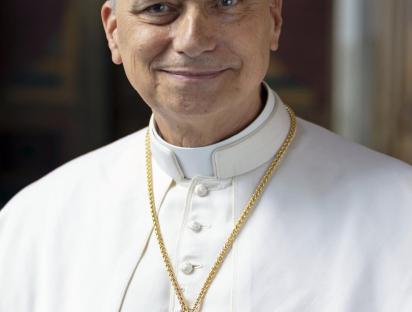
Millard Fuller is a tall, skinny, middle-aged man whose eyes squint whenever he smiles, which is often, and whose smile is so wide and full of teeth that, on any other face, it would qualify him for a beauty contest. His bones knock against your back or ribs as he pats you and hugs you in greeting not once but several times with an energy that seems reserved for you alone. “First,” he says in a Georgia accent so thick the word gets two syllables, “let me look at you. You look great, just great.” Millard’s Southern gentility is authentic; his joy effervescent; his enthusiasm constant; his energy relentless and near fatiguing. Yet his manner exudes a confidence—not so much in you as in God’s ability to do something in you beyond imagining that much of the time is empowering. He sees reality not just as what is, but as what could be: that old shack could be a pretty new home; that pauper with only one leg could be a self-sustaining head of a household; that dwindling congregation could sponsor a new house in India. An opportunity to listen to Millard’s life work and life story (Bokotola and Love in the Mortar Joints, Association Press, 1977, 1980) will leave your mouth agape, but to live and work alongside him as he builds houses for people in need around the globe may change your life.
Knowing this, I was not at all surprised to read in the New York Times this September that former President Jimmy Carter was visiting New York City to begin rehabilitating a six-story tenement on the Lower East Side as part of Habitat for Humanity, a nonprofit, international Christian organization that builds low-cost housing for the poor. Habitat was founded by Millard Fuller. Who else could enlist the voluntary carpentry skills of a former president? Carter, a man faced with thousands of projects soliciting his benevolence, chose Habitat. I can’t help thinking that the whirlwind enthusiasm for Millard, whose international headquarters is a mere nine miles from the Carters’s house in Plains, was simply too near for Carter not to have been swept up by it.
As it turned out, Carter’s support became a PR bonanza for the fledgling New York City project where press coverage was both crucial and difficult to obtain without something grand. The president’s presence garnered national coverage for Habitat in the New York Times, the Boston Globe, USA Today, Newsweek, Time, and People magazine.
I met Millard and his family in 1976 while I was living at Koinonia farm, an ecumenical Christian service community near Americus, Georgia. Millard, Linda, and their four children had just returned to the U.S. after serving as missionaries for the UCC (Disciples of Christ) in Zaire. They had lived at Koinonia for four years before leaving for Zaire, so through reputation I felt that I had always known them even before they returned to settle back into the community, telling us stories and showing us slides of their work. I knew that Millard had been among those who conceived of the Fund for Humanity, a concept of financing that provided resources for Koinonia’s partnership housing, industries, and farming. The idea was simple: their profits from farming or the pecan industry would go into the Fund for Humanity. So would any donations or non-interest loans from people who wanted to support the projects. Finally, as houses were built and sold to families who needed them but could not buy a house by other means, their monthly payments would be put back into the Fund to replenish the money supply. I was gratified to hear of Millard’s application of this concept to housing projects in Zaire. As a member of the Koinonia Partners, I saw the Fund’s concept at work daily. What struck me, however, was Millard’s own history, how he and Linda arrived at Koinonia the very first time.
It was a class story, one that never wears with telling: a millionaire gives his money away for the service of God. It is St. Francis stripping off his Calvin Kleins to begin anew.
As a college student Millard and a friend, Morris, became partners, a pair of boys working to become rich. They sold birthday cakes, desk blotters, cookbooks, and later real estate, each a lucrative effort. After law school the two men became law partners, but their business dealings outshone their law practice. Each married; each achieved the American dream. For Millard and Linda this meant: an eight-room house in Alabama, three cattle farms, a Lincoln Continental, a cabin on a lake with two speedboats, and twenty acres of land with plans for a bigger home with a swimming pool and stables. Millard achieved a net worth of $1 million at the age of 29.
He also suffered an estrangement from his own church and found himself compromising his principles. His health began to fail and so did his marriage. Linda had difficulty living with a man who was married to his business. She left Millard in 1965 to “think it over”—this was the turning point. So many marriages would have ended here. The story is refreshing as Millard tells it because his love for Linda is convincing; so is his love for God in light of the subsequent transformation of their family’s life once they decided to give away their money and embark upon a new vocation. First, they met with Clarence Jordan, who had founded Koinonia in 1942. Millard took a job as a fundraiser for Tougaloo College, a Black school in Mississippi. The family moved to Koinonia just before Clarence’s death. Then they went to Zaire. What next? I met Millard and Linda as they posed this question.
Millard wanted to use the Fund for Humanity concept to build houses throughout the U.S. and around the world. So Habitat for Humanity was born, headquartered in a rebuilt shack in Americus, Georgia. Eight years later, housing projects exist, in various stages of completion, in eleven foreign countries (Guatemala, Nicaragua, Bolivia, Peru, New Guinea, India, Haiti, and four countries in Africa) and in fifty-one locations in the U.S.
Habitat utilizes networking techniques and hundreds of volunteers. For instance, a church hears about Habitat and wants to get involved. Land is sought and money is raised to purchase it. (In Mbandaka, Zaire, the government donated the first land used,) Then volunteers are sought as well as tools and materials, including heavy equipment. All donations go into the Fund. Then as homes are begun and the project is publicized, people are selected to reside in the home. Selection is made by committee; the criteria include: need, ability to make a down payment and monthly payments, and participation in construction. Participation is often a certain number of labor-hours. Guidelines may be tailored in particular situations. For example, in Ntondo, widows who were unable to make down payments were not rejected.
As expected, housing costs vary from place to place. In Nicaragua a house costs around $1,000; whereas in New York City, the apartments will cost around $30,000 each. However, the basic principles, what Millard calls, “the economics of Jesus,” remain constant: no profit, no interest; payments replenish the Fund for Humanity. The concept of providing housing as a form of Christian ministry is stressed. For this reason, home buyers are encouraged to give money in addition to their payments, whenever, possible, to help provide housing for others. A group of three thousand Zairois raised $400 toward a new house in Guatemala.
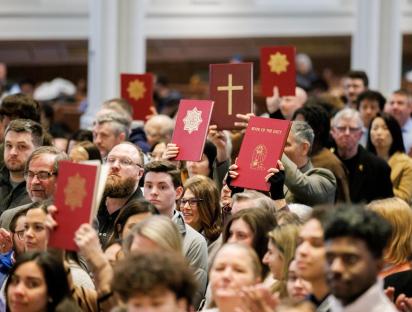
For me, it was touching to see the huge integrated crowd assemble in St. Bartholomew’s Episcopal Church, Manhattan, on a Friday night to sit through a two-hour presentation by Habitat leaders. The “economics of Jesus” were explained in reference to the Lower East Side project just a few blocks from another kind of economics epitomized by Wall Street. Here was an evangelical-style service delivered to New York sophisticates by an integrated ecumenical team (complete with a Black Gospel choir)—all within a Romanesque enclosure. I was impressed by the five-minute litany of contributors: carpenters gave labor; lumberyards gave nails and tools; a restaurant turned the dinner payment for over forty volunteers; a donor paid for the busload of volunteers from Georgia (including the former president.)
Finally, there was the irony of Jimmy Carter, accused by some of taking government’s responsibility for the poor to an extreme during his administration, now spearheading what mistakenly looks like a Reagan dream: a volunteer project that asks for no government monies. Yet the difference is that the presence of Carter exemplified Christian service as a complement to, not in lieu of government duties.
Now, after my chance reunion with Millard, after attending the Habitat rally, after writing this article, I am walking the length of Manhattan to raise funds in a Habitat walkathon. I guess my New York apartment was too open to Millard’s whirlwind spirit for me not to be swept up by it.