The biblical story of Salome is ripe for historical imagination. The gospels of Matthew and Mark provide a sharp sketch of the drama—revelry, power, illicit sex, murder—but leave a tantalizing amount of space to be darkened by the imagination. The latest production of Richard Strauss’s Salome, a mesmerizing directorial debut for Claus Guth at The Metropolitan Opera, offers viewers a violent, mind-bending staging of the biblical texts. By the opera’s final words, when Herod commands the second of two lust-driven murders, we are left contemplating the psychological origins of the characters’ sins—and our own.
The biblical outlines state that Herod Antipas, the tetrarch ruling Galilee after the death of Herod the Great, had imprisoned John the Baptist because John had criticized Herod’s marriage to his brother’s former wife, Herodias (Mark 6:14–29 and Matthew 14:1–12). Despite Herod’s political power, he feared John’s charismatic authority and large following; he also reportedly “liked to listen” to John’s prophetic teachings. But at his birthday banquet for courtiers and leaders of Galilee, the daughter of Herodias—identified as Salome by the Jewish historian Josephus—so pleased him and the guests with her dancing that he promised to grant her a wish, “even half of my kingdom.” The young Salome consulted with her mother and delivered the infamous demand: “Give me the head of John the Baptist on a platter.”
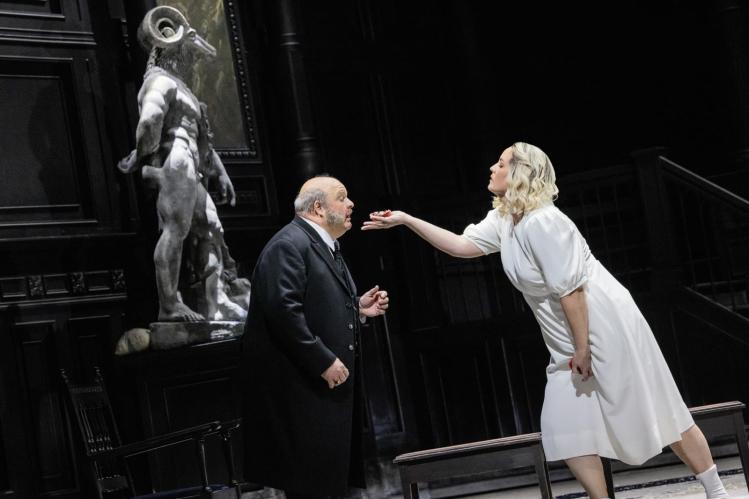
Strauss’s libretto (1905) was based on the scandalous fin-de-siècle play of Oscar Wilde (1891), and the Met’s creative team has honored the end of that Victorian era in some of the costume design. The characters in the staged world of Herod’s palace wear Victorian garb for a banquet: three-piece suits and evening gowns, and the men’s facial hair is groomed to resemble period photos. The largest company scene in the opera, a cacophonous after-dinner salon discussion of Jewish theology, is here staged by the German and Austrian creative directors like a Stammtisch at a Viennese cafe. The countenance of one of the guests resembles Freud, whose psychoanalysis was taking off at the time, and suggests the repressed psychological drama later to be unveiled.
The set design, however, shatters historical realism for either the biblical or the Victorian era. The main floor of Herod’s palace is painted entirely black, with pilasters stretching to the ceiling of the Met’s enormous stage. The colorlessness of the set, Herod’s suit, and Salome’s dress serves at first to spotlight her mother, Herodias, who wears the only color in the production: a reddish-orange gown that matches her hair. John the Baptist (Jochanaan in the opera, played by Peter Mattei) begins his singing off stage, a disembodied voice prophesying from an unseen prison cell, just as his biblical “voice crying out in the wilderness” resounds before he is physically described in the gospels. But soon the stage lifts and reveals a provocative design: down a multi-story spiral staircase descends Salome (played by Elza van den Heever) into a cavernous all-white dungeon. Jochanaan is also pale white, chained to the wall on stage left, and the bright white of the walls signifies a biblical figure primarily associated with purification of body and soul. In a dungeon at night, the clinical light must be coming from him.
Viewers expect to see Jochanaan in the dungeon. But as the stage lifts, before he is in view on the floor, we see a small girl sitting on an upper shelf, like a doll and holding a doll. The shelf is too high for her to possibly have gotten there herself, leaving no doubt that she is not real, not a new character. Rather, she is one of the six previous versions of Salome we will meet—all silent as mimes, not breaking the letter of the libretto’s law. The dungeon’s stage right is revealed as a child’s playroom from the Victorian era: rocking horse, a few toys, and later, ominously, a play sword. The dungeon for the spiritual Jochanaan is also the dungeon of Salome’s mind.
As the opera proceeds, we learn through the children’s mimetic actions how her mind had been warped by the male gaze. The libretto had established that theme immediately, with one of its first lines warning Narraboth, a young admirer of Salome played by Piotr Buszewksi, “It is dangerous to look at people in such a way. Terrible things can happen.” It is not only young men who lust for Salome, but also her stepfather Herod, played by Gerhard Siegel. An hour later, after the beheading, Salome continues to beg Jochanaan’s decapitated head, “Why won’t you look at me?”
These themes of lust and seduction—and at the climax, a necrophiliac kiss—were all core to Wilde’s vision. This production’s team is to be commended for deepening Wilde’s insights by dramatizing the biblical connection of lust and idolatry. From the Wisdom of Solomon to the letters of Paul to the Sibylline Oracles, the critique of sexual desire and idolatry share the same bed. On stage, the connection is most pronounced by the enormous statue dominating stage right: a bulging and chiseled male nude, seemingly carved from basalt and topped with the head of a ram—as if the Egyptian god Khnum, a god of fertility and creation, appeared as a sculpted Crossfit enthusiast.
After returning from the dungeon, where Jochanaan had spurned Salome’s erotic advances, the first thing she does is reverence the statue—properly at first, like a Victorian lady, but then she rubs her body on its base and strokes its legs, as if she needs to get herself off after having been rejected by her beloved. Later, during one shocking moment in a production full of them, Salome heaves the statue to the floor, smashing the idol as an enraged femme fatale. If she can’t worship him, no one will.
Other adaptations of biblical imagery are less grotesque; many stem from Wilde’s erudition, but some are brought out effectively by the Met’s creative team. In the dungeon, Salome’s seductive metaphors from the Song of Songs are channeled into a striptease to tempt the prophet. But when he rebuffs her, she mercurially switches to a prophetic invective of her own. The whiteness of his body that she desires becomes an accusation of him as a “whitewashed wall” filled with “vipers,” echoing John’s and Jesus’ own speeches against their opponents in the gospels.
Herod’s inner conflict about how to deal with the holiness of Jochanaan and the depravity of his wife and stepdaughter also strikes a biblical tone. The Holy Spirit is never mentioned as such in the libretto, but Herod keeps hearing doves, wind, and “mighty wings” hovering over the palace. No one else hears them—only those with ears to hear, in this case a morally vexed ruler who imprisons Jochanaan but considers him holy and possibly sent from God. The Spirit’s fiery dove feels for Herod like “a hot wind” and is masterfully imaged on the walls of the Met’s palace with projections that resemble a swarming murder of crows or a murmuration of Hitchcock’s Birds.
Herodias, played by Michelle DeYoung, is portrayed as a kind of biblical mashup. Sometimes associated textually with Jezebel, her staging at the Met suggests a different biblical character. Never seen without her wine glass, she gets drunker and drunker as the opera progresses; her glass is refilled by a servant, cheekily, through a kind of wine window. During one refill, she is felt up by a pair of disembodied hands, while the others on stage sing praises of the hoped-for messianic blessings. Her anti-spirituality and bloodlust for Jochanaan grows with each refilled glass, like the book of Revelation’s idolatrous “Whore of Babylon” who combines Babylon with Rome and is drunk on the blood of the saints (Revelation 17:1–18). With Herodias resembling Revelation’s “mother of whores,” the sinfulness of Salome is blamed on both heredity and the incessant violence of the male gaze.
In the end, most viewers of the Met’s newest Salome will rightly fixate on its introduction of the character’s younger selves to the story. The Bible says almost nothing about children, and even less that is sympathetic to them. By conjuring six of Salome’s younger selves from the Bible and Wilde——focalizing her past experiences—the director Guth forces us to acknowledge the youth of the biblical character and ponder her moral backstory: How does a young woman become so bloodthirsty?
Salome’s dance, Strauss’s “Dance of the Seven Veils,” brings this theme to a climax. While Herod takes a seat wearing the same ram’s head as the dominant idol, iterations of Salome’s younger self relive their past treatment by younger versions of Herod. Younger Salome was shaped, chastened, rewarded, and threatened by men’s lust. Prior to this, the younger selves haunted the stage like ghosts, but at the culminating dance, each is unveiled as a phase in the moral disfigurement of Salome’s growing up. By the end of the dance, she wants to kill him, to destroy the lust like she threw down the idol, to free herself from passion by becoming a kind of dominatrix. Like the seven revelatory seals and seven bloody vials of the Book of Revelation, Salome unveils seven versions of herself and asks for Jochanaan’s head seven times, one purgation for each step of her descent into a dungeon of lust.
Robbie Ross, the art critic and friend of Oscar Wilde, reported that Wilde thought his play Salome was “a mirror in which everyone could see himself. The artist, art; the dull, dullness; the vulgar, vulgarity.” Just so, this version of the opera dramatizes one obsession of late modern culture: in Salome, our culture sees the violent repercussions of childhood trauma.
Wilde himself was rather obsessed with the temptations and perils of self-obsession. The eponymous picture in his novel, The Picture of Dorian Gray, is a kind of fantastical mirror, a hidden portrait who ages while its man of flesh stays young and devoted to an urbane hedonism. Here in the Met’s Salome, the seven versions of her character channel Wilde’s philosophical and psychological fascination with the young self, comprising a staircase backward through the temporal self and ultimately forming in this anti-heroine an opposite yet equally macabre counterpart to Dorian Gray. This Salome shows that one’s chained spiritual voice and one’s repressed bodily memory can occupy the same inner dungeon. Kill them both? Or set them free?