An obituary for the industrialist Klaus-Michael Kühne, reputedly one of the richest men in Germany, recently appeared in The New York Times. Kühne inherited control of Kuehne+Nagel, his family’s transport company, which was “largely built from the systematic looting of the assets of European Jews during the Nazi era.” Unlike most other German corporations, Kuehne+Nagel refused to open its archives about its actions under the Nazi regime. After the war, Kühne’s father and uncle, both Nazi Party members, were excused from the German de-Nazification program by cooperating with American and European intelligence agencies as the Cold War heated up. Persistent efforts to hold Kuehne+Nagel to account for its Nazi past exasperated the heir to his family’s fortune. “I find that strange,” he said. “At some point one has to let the dust settle on things. That’s my basic attitude.”
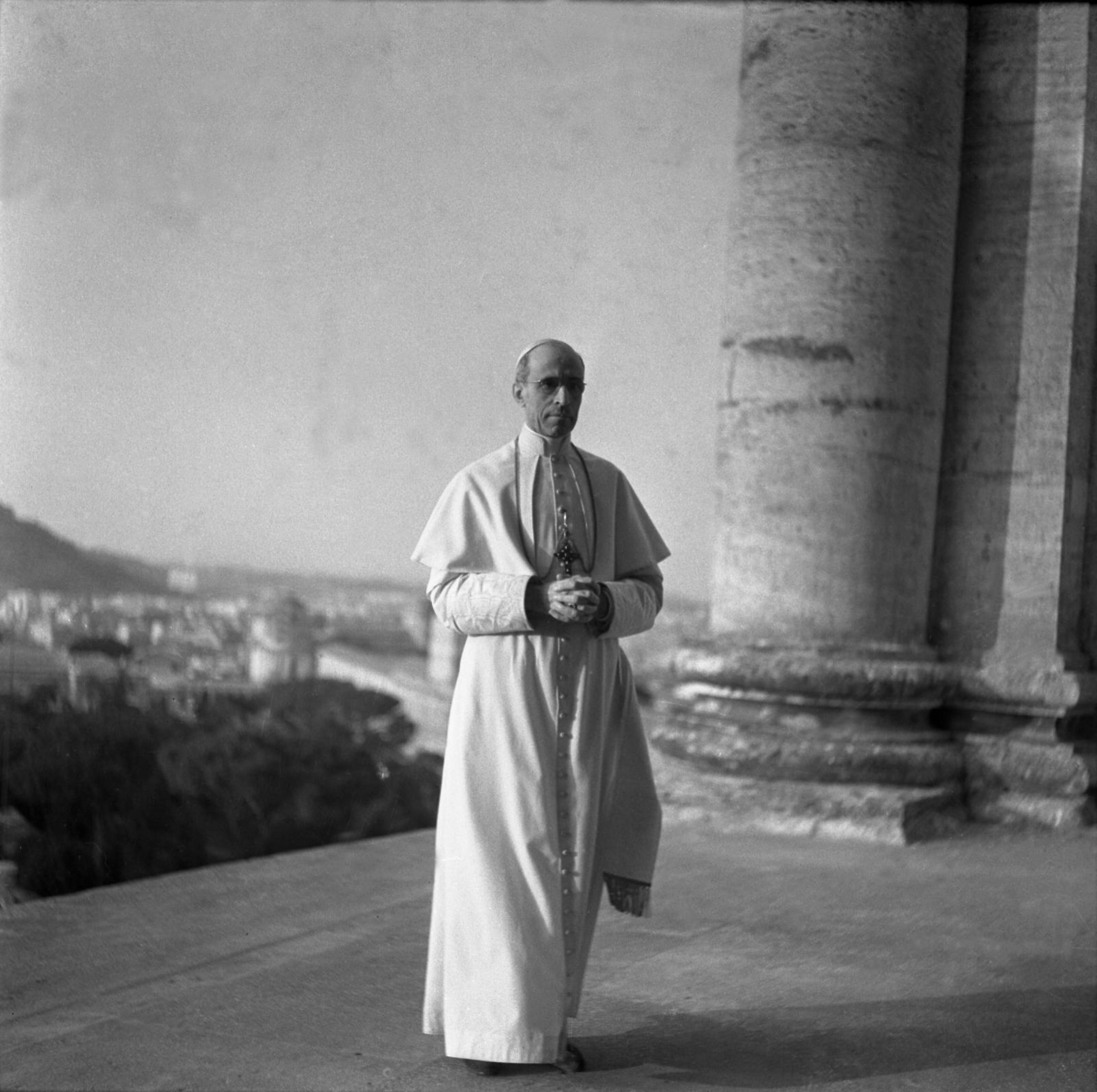
The Pope Against Nuremberg: How the Vatican Helped Nazis Escape Postwar Justice by historian Gerald J. Steinacher revisits the contentious debates over Pope Pius XII’s response to the crimes committed by the Nazis. Steinacher, author of Nazis on the Run and other books, has taken full advantage of recently opened Vatican archives to construct a nuanced but still disturbing portrait of Pius XII’s efforts to meet the moral challenges posed by the most destructive war, and the most heinous regime, in history.
Pius spent many years as a Vatican diplomat in Germany, personally experiencing the calamitous domestic aftermath of Germany’s World War I defeat and observing the destabilizing consequences of the onerous terms imposed on Germany by the Versailles Treaty. He had a deep appreciation of German culture and a love for the German people. He believed they had been seduced and led astray by Hitler. He was strongly opposed to holding the German people responsible for the war or Nazi crimes and strenuously objected to the idea that Germans should be held collectively accountable. In the aftermath of the war, he believed that a revitalized and reconstructed Germany was essential to deterring the spread of the Soviet Union’s “godless communism.” In that regard, he pressed the case to “forgive and forget.” He wanted to rehabilitate and convert Nazi criminals rather than punish them. The pope’s focus, according to Steinacher, was on mercy and saving “as many souls as possible.” In large part, Pius believed the war to have been the result of Europe’s abandonment of the Catholic faith. To secure the future peace, the continent needed to be “re-Christianized,” not to wallow in the retribution represented by military trials. While supposedly keeping the Church neutral with respect to the Allies’ efforts to bring Nazi leaders to justice at Nuremberg and in subsequent trials, Pius nevertheless worked to “undermine” those proceedings, according to Steinacher. Like many Germans, Pius understood the trials to be the illegitimate imposition of “victors’ justice” on survivors. The basic attitude of most Germans, including Germany’s Catholic and Protestant leaders, was essentially to “let the dust settle on things.”
In considerable detail, Steinacher discusses how the Vatican and various Catholic prelates urged the Allies to grant amnesty to Nazi leaders. Pardons for Catholics and those who had converted to Catholicism in the aftermath of the war, sometimes after being charged with war crimes, were a priority. He also discusses the extraordinary role the Church played in helping refugees displaced by the war, but this included many Nazis and their collaborators, who often found refuge in South America. Austrian bishop Alois Hudal, a fascist sympathizer and Hitler admirer, was a notorious facilitator of what was called “the rat line.” In a 1949 letter to Msgr. Giovanni Montini, who was a close adviser to Pius and who would become the future Pope Paul VI, Hudal expressed the fervently anticommunist views of many churchmen. He urged the Vatican to call for a “wide amnesty,” arguing that former Nazis could not be justly described as war criminals. Their only “crime” was that “in politics they defended ideas or beliefs that are today denied, while a few years ago, until the tragedy of the lost war, they were confessed by millions.”
As Steinacher acknowledges, in holding individual Nazis responsible, the Nuremberg trials established what were then “novel legal concepts” concerning what came to be called crimes against humanity. Given the restrictive legal parameters of the trials, it was the crime of aggressive war, not the Holocaust, that was prosecuted. There were really no legal precedents for such an international tribunal. Indicting government leaders who waged wars, no matter how pernicious and destructive, was thought to undermine national sovereignty. (Even today, the United States refuses to recognize the International Criminal Court.) Historically, trials for those who violated the rules of war were conducted, often fruitlessly, in their own country. Consequently, strenuous objections were raised about the ex post facto nature of the Nuremberg charges. Initially, in fact, Churchill and Stalin objected to the idea of trials. The traditional way to proceed in the aftermath of war, they assumed, would be with summary executions of thousands of Nazi leaders and German officers. It was the United States that insisted on conducting a judicial proceeding in the hopes of restoring a sense of the rule of law to the German nation, which had abandoned it under the Nazis. Yet most Germans vehemently objected to the idea that the Soviet Union, which had committed similar war crimes, and the United States, which had carpet bombed German cities and used atomic bombs on civilian populations, should sit in judgment on German leaders.
Those objections dovetailed nicely with the Vatican’s reservations. Given the enormity of Nazi criminality, U.S. Supreme Court justice Robert Jackson, who presided at the trial, rejected both the idea of summary executions and the Church’s call for wholesale leniency. Jackson “emphasized the pursuit of justice, not revenge, as an imperative,” Steinacher writes. “That the four great nations, flushed with victory and stung with injury, stay the hand of vengeance and voluntarily submit their captive enemies to the judgment of the law is one of the most significant tributes that power has ever paid to reason,” Jackson announced at the opening of the trial. It is unfortunate, to say the least, that Pius failed to grasp the nobility and righteousness of that aspiration, even if we can understand his distrust of the Soviet Union. “Awakening the Germans to their past as a means of influencing their future political conduct was what then mattered most,” according to the political philosopher Judith Shklar. “The trial fulfilled an immediate function which is both the most ancient and the most compelling purpose of all criminal justice. It replaced private, uncontrolled vengeance with a measured process of fixing guilt in each case, and taking the power to punish out of the hands of those directly injured.” Twelve defendants were sentenced to death, seven were given prison sentences, and three were acquitted.
The Vatican, of course, was not uniquely guilty of turning a blind eye to former Nazis. For a confluence of reasons, opposition to the trials soon prevailed, with many former Nazis assuming influential positions in the new West German government and the growing postwar economy. “The Cold War pushed the war crimes trials to the sidelines,” Steinacher concedes. “Sweeping the Nazi past into the dustbin of history was the price German elites were extracting for their cooperation in the anti-Soviet crusade,” wrote the historian Peter Novick, whom Steinacher quotes. To be sure, there was plenty of credulity, delusion, and antisemitism among Catholic prelates who were obsessed with the communist threat and who thought that future peace could be secured only by “forgiving and forgetting.” But the derailing of efforts to bring Nazis to justice was principally driven, Steinacher acknowledges, by how the Cold War came to dominate both international and domestic U.S. politics.
Steinacher does not question the sincerity of Pius’s religious reasons for opposing the trials, and he is at pains to emphasize that “simple answers remain elusive” when assessing efforts to bring war criminals to justice. “Christian teaching tends to focus more on the sinner than the victim for theological reasons. The sinner’s soul is believed to be in danger and in need of salvation, while the victim’s soul is seen as intact and not at risk,” he writes. I think I understand what Steinacher means, but he could be clearer. The Church teaches that we will all be judged by God, including people who have been victims; and the thirst for revenge, however understandable, can certainly put a soul at risk. Steinacher also argues that the Church was “willing to forgive Nazi perpetrators without even requiring” them to admit personal guilt, repent, and ask for forgiveness. To be sure, opposing the trials and calling for blanket amnesties were dubious policies, but such a public stance is not the same as granting forgiveness to penitents in the confessional, where presumably those seeking absolution are still required to admit guilt, repent, and ask for forgiveness. In calling for an end to the war in Ukraine, Pope Leo is not offering absolution to Vladimir Putin.
That many Church prelates were especially obtuse regarding the suffering of Jews under the Nazis is no secret. Catholicism’s status as both a religion and a state actor has long complicated its spiritual authority, often putting its diplomatic efforts to end wars and secure the peace at odds with pressing demands for justice. The Pope Against Nuremberg raises all the right questions about that tangled history without resorting to easy answers. To his credit, Steinacher doesn’t let the dust settle.
The Pope Against Nuremberg
How the Vatican Helped Nazis Escape Postwar Justice
Gerald J. Steinacher
NYU Press
$35 | 349 pp.
We welcome your comments about this article. Please send your response to [email protected].


