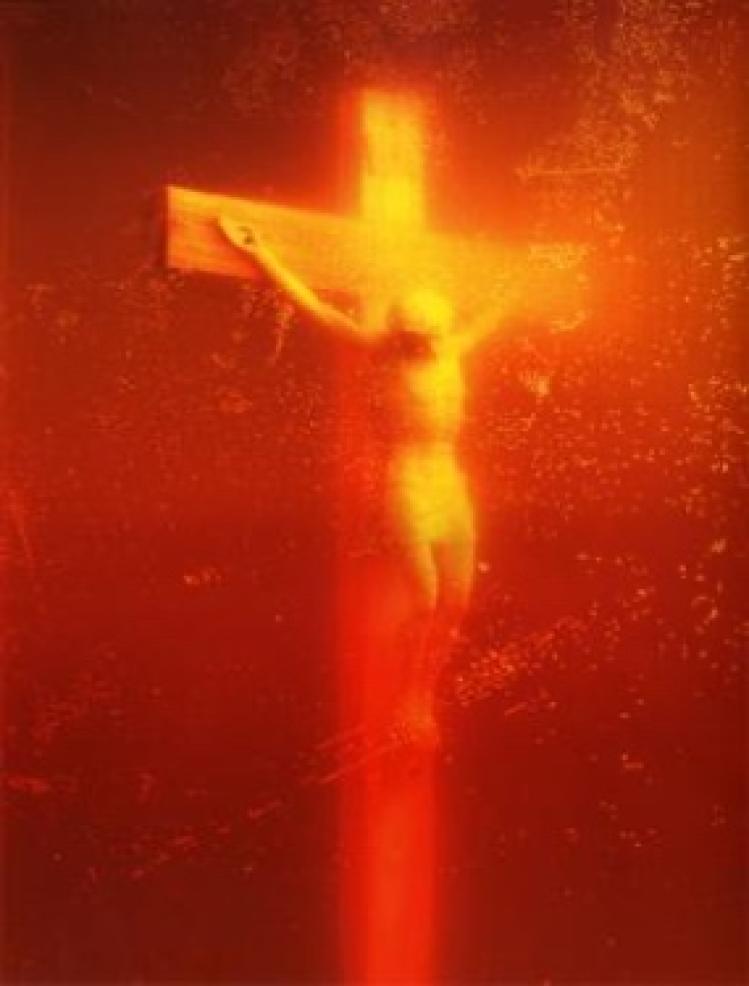
A retrospective exhibit is usually a milestone in an artist’s career: a gathering together of years of work, and a message sent to the art world and the culture at large that the artist has claimed a place altogether his or her own. But Andres Serrano: Works 1983-93, which closed in April at the New Museum of Contemporary Art in New York City, had the feel of a postscript to the 1989 controversy over the National Endowment of the Arts. That year, of course, Serrano’s photograph “Piss Christ,” which depicts a crucifix immersed in urine, became an exhibit in the congressional debate about whether the agency should support artists (such as Serrano, a grant recipient) whose work scorns the standards of common decency thought to be shared by the taxpayers who support the agency. The controversy prompted the NEA’s directors to insert an anti-obscenity clause in the grant guidelines, and led legislators to raise hard questions-now being raised again-about whether the agency should be scrapped altogether.
So while the Serrano retrospective was a summing-up so far, it was also a justification of sorts, an attempt to ground the artist’s reputation in something deeper than notoriety, even as that notoriety was a justification for the exhibit. The bright light of controversy shone all through the show, lending it an aura of danger and subversion which the artist and the museum invited and made the most of; at the same time, it gave the exhibit an accessible, even populist, character of the kind that conservative critics often lament is missing from contemporary art.
In the museum lobby, a documentary about the artist was played continuously on an overhead television set (“His work is not in any way didactic,” the voice-over pronounced as I walked in), drawing a crowd at least as large as that in the galleries. The work on display inside depicted subjects (guns, homeless people, Klansmen, corpses in morgues, as well as religious figures and bodily fluids) that have long since been deemed controversial, and did so in a medium (Cibachrome color photographs) familiar to the viewer’s eye from advertising.
Controversy is in no way a distraction from Serrano’s work. Rather—and this is what most riled his critics in Congress—it is the work’s fulfillment. Serrano describes himself not as a photographer but “a conceptual artist with a camera,” and, as with much conceptual art, his photographs depend to an unusual degree on extravisual information to make them intelligible and interesting. On one wall hung abstractions suggesting, in turn, a smoldering volcano, the Japanese flag, a Georgia O’ Keeffe flower, a Barnett Newman color field; from the tags one learned that they were compositions of blood, milk, and urine. A gauzy white splatter arcing across the photographic field was revealed as ejaculate. A series of photographs that might have been drawn from the ad campaign for a Gap line of grunge clothing turned out to be portraits of homeless people.
In these photographs, Serrano’s basic strategy is to reverse the conventions usually applied to the subject. Bodily fluids—what could be more realistic?—are made abstract; homeless people—the subjects of countless documentary photographs—are granted the sort of stylized sittings usually reserved for actresses and presidents. The “Morgue” series, for example, depicts freshly dead bodies in close-ups of high color and relentless clarity in which all the medical apparatus has been carefully screened out. And a series of portraits of Klan members, while powerfully iconic, gains its greatest effects from Serrano’s attention to the coarse weave of the Klan robes and the crow’s-feet of a Klanswoman’s eye peering out from her hood. Even as they provoke the viewer’s curiosity through their treatment of controversial subjects, these photographs assume a certain familiarity with the photographic tradition whose terms they alter and refer to—with the work of Walker Evans, Paul Strand, Tina Barney, and the like. But Serrano’s religious photographs also negotiate with a tradition that is longer and broader, yet more remote. Just as Serrano is a photographer who is not a photographer, he describes himself as “a former Catholic…who even today is not opposed to being called a Christian.”
This paradoxical information complicates the religious images and the commentary that swirls around them. Sure enough, the critic who reviewed the exhibit for the New York Times suggested that “it may be as a religious artist, and specifically as a Roman Catholic artist, that Mr. Serrano makes the most sense.” Where once an artist like James Joyce generated artistic tension through frank acknowledgments of apostasy, today an artist like Serrano does so through an unexpected assertion of his Catholic identity—by claiming, like Martin Luther, in effect, that he has not left the church and its artistic tradition so much as the church has left him.
In the most powerful of the religious photographs, the tension between tradition and propaganda is sharp and evocative. One of them is “Piss Christ.” I remember the first time I saw the photograph, at the Saatchi Collection in London in 1991. I had read about it in accounts of the controversy, of course—and doubtless had seen it reproduced in black-and-white—but I had the impression that Serrano was a prolific photographer, the creator of hundreds of images on religious subjects. Here in a corner of the gallery was a crucifixion, and it was one of the most powerful contemporary religious images I had ever seen. The golden hue that suffuses the photograph had just the right touch of apocalypse, the crucifix just the right tilt to suggest windswept, earthshaking drama; for a moment—contrary to what Serrano intended—the nature of that golden hue was hardly relevant. A related photograph, the crucifix smaller against a horizontal golden ground, was even more powerful; it suggested Giacometti, yes, but more than that it suggested Golgotha at the moment the heavens were rent. Only as I leaned forward to look at the tags did I realize that these were the notorious photographs. And of course the extravisual information made it necessary to try to see them all over again. For if it would be unfair to condemn an image without knowing essential information such as its title and materials, so it would be unfair to judge it beautiful based on its visual qualities alone. Well, blasphemous or no? I decided the latter, if only to avoid being manipulated by the photograph and its detractors alike.
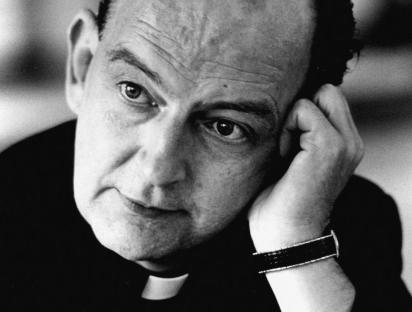
Most of Serrano’s other religious images are considerably less effective. “Heaven and Hell” (1984), which depicts a bishop figure indifferently looking away from a nude, mutilated woman, is sheer agitprop; “Pieta” (1985), in which a Mary holds a giant fish, and “Blood Cross” (1985), a plexiglas cross filled with blood, are ineffectual visual puns. And the “Church” series of 1991 seems overwhelmed by the sense of mission the NEA controversy must have inspired in Serrano. It is a series of portraits of French religious figures. A nun wearing an over-starched wimple—and bright red lipstick—gazes at the camera, fresh-faced and clear-eyed as Jodie Foster; a priest bites his lip, wearing a super-orthodox, all-the-way-round-the-neck white collar. The figures cannot bear the weight of the iconic status that Serrano has thrust upon them.
The priest who sat for Serrano, it happened, was wearing glasses with whorled plastic rims, the sort of traditional but up-to-date glasses that one might buy at Sterling Optical. To me they were the most striking detail in the whole exhibit. They reminded me that this figure was not an icon, after all, but a man who is a priest. I had to ask myself: Had I ever seen an art photograph of a priest before? If so, I couldn’t recall it. And this suggested to me just how deep the controversy over Serrano’s work really is. It is not only a conflict of values and standards, a conflict between religious tradition and the avant-garde; it is an argument in which the crucial middle term-that is, contemporary visual art that does in one way or another frankly embody religious standards and expectations-is all but absent. (Quick, try to think of a noted religious artist. See?)
Is Andres Serrano a genuine religious artist, or a sham one? How might we judge? Not only is there no authoritative definition of just what a Christian artist might be; there is very little contemporary religious art of any prominence with which Serrano’s might be compared. Lucky for him—and not so lucky for us—the religious is territory that he, for the time being, has claimed as his own.