In the fall of 1965, I worked in the final session of the Second Vatican Council. A young priest and doctoral candidate, I was tasked with distributing documents and collecting votes and amendments from my assigned section of bishops. Almost half a century later, a bound set of those documents holds a prized place in my library—and the events and personalities of those days hold a prized place in my memory. I recall the buses filled with bishops leaving St. Peter’s piazza after each day’s session, the sun reflecting their colorful robes through the windows. Many were bishops from poorer parts of the world, returning to modest residences at various religious houses in Rome. Some American bishops also lived in such residences, but more were in hotels. The council was the first to bring together so large a gathering from all continents, and one sensed that it marked a new chapter in the life of the church: a truly global church, its unity expressed in a diversity of cultures and rites.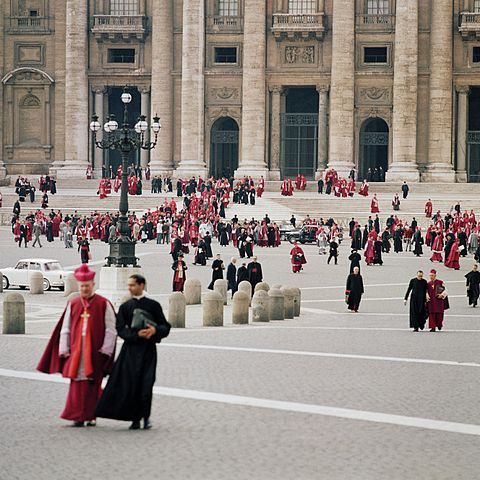
Though glad to be involved in the council, I had no idea I would witness proceedings that would bring enormous change to so many aspects of Catholic life and practice. I had come to Rome as a seminarian in 1959, and after being ordained as a priest for the diocese of Paterson, New Jersey, had returned in 1964 to study for a doctorate in canon law at the Lateran University. During my first years in Rome, in the time immediately before the council opened in October 1962, I’d seen little outward evidence of what lay ahead. Pope John XXIII, who announced the council in 1959—much to the consternation of the Roman Curia—had been crowned with the Triple Tiara and still wore it on ceremonial occasions. Indeed, I photographed him coming into St. Peter’s on the sedia gestatoria, carried on the shoulders of attendants and ushered in by large ceremonial fans of ostrich feathers.
Yet despite such trappings of tradition, change was in the air. In 1943, Pope Pius XII’s encyclical Divino afflante spiritu had cautiously opened the door to new methods of scriptural interpretation long pioneered by Protestant scholars—a development that threatened the antimodernist, ahistorical ethos of the Curia. In the ecclesiastical universities, new currents in scholarship were creating obvious tensions. I studied theology from 1959 to 1963 at the Gregorian University. At the Pontifical Biblical Institute just across the piazza, the Jesuits Stanislas Lyonnet and Maximilian Zerwick, who embraced the historical-critical method, were suspended from their posts.
As it turned out, such events were a prelude to the council’s debates over revelation and liturgy. The run-up to Vatican II saw a final campaign by Cardinal Alfredo Ottaviani, the prefect of the Holy Office (now the Congregation for the Doctrine of the Faith), and other Curia theologians to reject any move toward a historical-critical approach to scriptural interpretation. As the Scripture scholar John Donohue has noted, the draft document prepared for discussion at the first session of the council “crystallized the reactionary tendencies of post-Tridentine and antimodernist theology.” The draft rarely referred to Divino afflante spiritu—and never cited those passages that explicitly authorized modern methods of interpretation. As far as Ottaviani and most of the Curia were concerned, the church was Semper Idem, always the same: what is, has always been, and therefore must always be. The notion of historical development was anathema.
Pope John, however, did not share the Curia’s fear of change, and one of his goals for the council was aggiornamento, or the updating of the church. This emphasis engendered a sense of hopeful openness to change. I was present for the pope’s opening speech on October 11, 1962, in which he noted that in the daily exercise of his pastoral office, he sometimes had to listen to “prophets of gloom” who insisted “that our era, in comparison with past eras, is getting worse.” Such doomsayers, he lamented, “are always forecasting disaster, as though the end of the world were at hand”—while he himself, by contrast, saw Divine Providence “leading us to a new order of things.” John acknowledged the need to translate the message of Christianity anew for the current culture. “The substance of the ancient doctrine of the deposit of faith is one thing,” he famously asserted, “and the way in which it is presented is another.”
The first session of the council saw bishops strongly criticizing the draft documents prepared by the Curia; I vividly remember the evening discussions with fellow students on the day when 60 percent of the bishops voted to reject the draft of the Constitution on Divine Revelation. The same day, the public defense of the first historical-critical dissertation at the Biblical Institute attracted an extraordinarily large audience, including curial cardinals in the great foyer of the Gregorian. We all wondered how the conflict between the Curia and the bishops would be resolved. Pope John rose to the occasion by appointing a mixed commission that included persons open to modern biblical studies, such as Cardinal Bea, Karl Rahner, and others. In the end, after much further debate and revision, the seventh draft of the Constitution on Revelation would be approved and accepted in the final session on November 18, 1965.
For me, the council brought a new sense of openness and hope, grounded in a genuine dialogue among Catholic scholars, bishops, and eventually the laity. As Joseph Ratzinger wrote at the time, the bishops at Vatican II “had taken a giant step beyond being a mere sounding board for propaganda,” to become, as an “independent body of bishops,” a force that the papal Curia had to reckon with. And perhaps nowhere was this giant step more evident than in the vexed issue of liturgical reform. Within the church as it was experienced “from below” by Catholics of the so-called Latin Rite, the liturgical reforms of the Second Vatican Council would be particularly unexpected.
Most Catholics today don’t know what liturgical life was like before the council. On weekday mornings the priest, frequently dressed in black vestments, silently “said” a “Low Mass” for the dead, in Latin, with his back to the people. He read the Epistle—again, in Latin—on the right side of the altar. The altar server then moved the book to the left side of the altar for the reading of the Gospel, also in Latin. Only on Sundays was the Gospel read a second time, in English, from the pulpit. On weekdays, the faithful fended for themselves. They could follow along by reading their missals—a grudging concession to the laity, one so forcefully resisted that those who had produced the first translations of the liturgy, decades earlier, had been penalized for doing so.
In 1947, Pius’s encyclical Mediator Dei had offered a guarded nod to the movement for liturgical reform, acknowledging that the liturgy “grows, matures, develops, adapts, and accommodates to temporal needs and circumstances.” Yet Mediator Dei was hardly a reformist document. Decrying “the temerity and daring” of novel innovations such as making use of the vernacular, it declared Latin a manifest sign of unity and an effective antidote to corruptions of doctrinal truth. It warned against any attempt to restore the altar to its primitive table form, or to exclude black as a color for liturgical vestments. It criticized those who disapproved of Masses offered privately and without any congregation, and those who disapproved of simultaneous Masses, in which different priests offered Mass at different altars in one church at the same time. The encyclical asserted that Communion was obligatory for “the priest who says the Mass,” but only “earnestly recommended to the faithful,” and further declared that the “dialogue” Mass could not replace the High Mass, which, “though it be offered with only the sacred ministers present, possesses its own special dignity due to the impressive character of its ritual and the magnificence of its ceremonies.”
By contrast, Vatican II’s Constitution on the Sacred Liturgy (Sacrosanctum concilium) returned to the church’s earliest sources to retrieve a vision of church as a particular or local community assembled for the Eucharist. The constitution emphasized that “it is through the liturgy, especially, that the faithful are enabled to express in their lives and manifest to others the mystery of Christ and the real nature of the true church.” This was an enormous shift in the church’s self-understanding, a dramatic move away from identifying the essence of the church with its juridical organization as a “perfect society.” Referring to the Epistles of Ignatius of Antioch, the constitution emphasized that “the principal manifestation of the church consists in the full active participation of all God’s holy people in the same liturgical celebrations, especially in the same Eucharist, in one prayer, at one altar, at which the bishop presides, surrounded by his college of priests and by his ministers.”
My own thinking in this regard had been shaped by Ludwig Hertling, a Jesuit historian at the Gregorian. Hertling offered an alternative to a way of thinking, prevalent since the Middle Ages, that conceived the church as a pyramidal hierarchy, with the pope at the top and the bishops as his subordinates. He emphasized the central role of the concept of communio in the early church, depicting the church not as a pyramidal structure, but rather as a large circle containing many smaller circles, the local churches presided over by bishops. The Church of Rome was at the center of a web of communion, a sacramental relationship uniting all the churches. Hertling’s lectures drew me into reading the Didache, the letters of Ignatius, Irenaeus, and many other patristic sources that revealed how differently the organizational structures of the early church had functioned from those of the second millennium. This attempt to reclaim a long-neglected patristic inheritance found expression both in the council’s Constitution on the Sacred Liturgy and in the Dogmatic Constitution on the Church, both of which reflect Vatican II’s revival of the ancient understanding that the Catholic or universal church is actualized in and through the community of a particular locale, especially when assembled in prayer.
Looking back at Vatican II, I see a remarkable time, full of spirited discussion and ad hoc innovations of significant import. Orthodox and Protestant observers engaged in lively dialogue with cardinals and bishops in the aisles on either side of St. Peter’s and in the two crowded coffee bars nearby. Twenty-nine lay auditors—all male—had been invited to sit in on the proceedings. After heated debate over whether laywomen should be allowed to attend, twenty-three women were invited to be observers during the third conciliar session of 1964. They were Australian, European, Middle Eastern, Latin and North American; nineteen were either members of religious communities or single; three were widows; and one was married, a Mexican mother of twelve whose husband had received a separate invitation. To keep men and women separated, a third coffee bar was opened, just for the women. At one point, the married woman’s husband and other male friends of the women were refused entry—a policy that was changed after a protest to the conciliar president, Archbishop Felici. Sr. Mary Luke Tobin, president of the Conference of Major Religious Superiors of Women in the United States (the group recently investigated by the Vatican), noted three kinds of treatment accorded the women by the bishops: a minority supported their presence; the majority was indifferent and even uneasy meeting them; some openly disapproved of their presence and completely avoided them. For the most part, no real importance was attached to the women’s participation—although, at the urging of the Redemptorist moral theologian Bernard Haring, they acted as full voting members of the commission for the Pastoral Constitution on the Church in the Modern World (Gaudium et spes).
Right and left, things were happening that overturned the received presuppositions of centuries. Reading the modi or amendments regarding Jews and the death of Jesus during the discussion of the Declaration on the Relationship of the Church to Non-Christian Religions (Nostra aetate) was an especially eye-opening moment for me. An equally compelling moment came on December 7, 1965, the day before the close of the council, as I watched Paul VI and the delegate of Patriarch Athenagoras ceremoniously lift the reciprocal excommunications that had been issued nine hundred years earlier, to repeated, thunderous applause from the bishops. Such actions gained worldwide attention. Time, Newsweek, and the International Herald Tribune ran stories about the council. Irving R. Levine’s reports for the TV evening news were beamed to the states via satellite.
In its reaffirmation of “the priesthood of all believers” and its references to the church as the People of God, Vatican II inaugurated a remarkable change in how lay Catholics thought about their place in the church. The term church no longer meant a “they,” composed of the ordained and the hierarchy; rather it was a “we,” including all the baptized, non-ordained and ordained. Such changes recaptured the original meaning of the biblical term ekklesia, or assembly. The council closed amid a tremendous sense of engagement and anticipation. Sadly, at least from my perspective decades later, much of that sense of possibility has faded, as previous patterns of authority and demands for obedience have increasingly been reasserted. Looking back, I admire the initiative of the bishops who voted to reject documents prepared by the Curia. I am still amazed at their candor and outspokenness, and their criticism of the church’s triumphalism. And I wish they were still around.
My experience of the council had a profound personal effect on me; it is fair to say that it changed the course of my life. The more I read ancient sources, bolstering my understanding of changes in the history of the church, the more I began to regret a celibacy that cut me off from many of life’s meaningful relationships and experiences. Back in New Jersey, now a vice-chancellor living in the bishop’s residence, I gave numerous talks about the council in parishes and to groups of sisters. At one of the talks, I met a young Benedictine sister. We became close friends; eventually, we decided that we wanted to live our lives together. I applied for and received a dispensation, and my wife Helen and I were married for forty-one years until her death early this year. Fortunately, the formal letter or “rescript” of dispensation did not include the stipulation that the recipient not hold a teaching position in a Catholic college or university. I had applied for a teaching position in theology, and was offered one by Villanova University—where I have been teaching since 1969.
Fifty years after the council, I still believe the church has to face up to new possibilities. It won’t be easy. Not long ago the biography of John XXIII on the official Vatican website reminded us of the following: “When on October 28, 1958, the cardinals, assembled in conclave, elected Angelo Roncalli as pope many regarded him, because of his age and ambiguous reputation, as a transitional pope, little realizing that the pontificate of this man of seventy-six years would mark a turning point in history and initiate a new age for the church.” That turning point came on January 25, 1959, less than three months after John XXIII’s election, when he announced his intention to convene the Second Vatican Council.
Tellingly, the biography that currently appears on the Vatican website has been revised, and no longer describes John’s pontificate as one that “would mark a turning point in history and initiate a new age for the church.” Those words have been struck, and their absence reflects a new era in which the prospect of a pope calling for aggiornamento in the church is extremely unlikely. Yet John XXIII’s foresight lives on. His openness to the future must be kept in mind in the sometimes revisionist discussions about whether he really envisioned where Vatican II would take the church. He may have been somewhat surprised, but in my view John would not have been surprised to be surprised.
The words of the council spoke movingly to so many of us—about joy and hope amid grief and anguish, about solidarity with other believers and with the entire human race and its history, and about the church keeping the freshness of youth. These words and ideas still ring true. As the Australian priest and theologian Ormond Rush has observed, our task involves new questions “that the past cannot answer for us, and the past may need us to help it answer them in fidelity to the past.”
Please email comments to [email protected] and join the conversation on our Facebook page.
Previous Story
Faithful Ferryman
Next Story
‘Pray Only to Allah!’