 Lola Montez, mistress of King Ludwig I, trained her bulldog to attack Jesuits. When the pooch bit a hunk out of a theology professor, the enraged Bavarian intellectual community saw to it that Lola was imprisoned and, for the sake of exorcism, put on a diet consisting solely of raspberry juice. The right team of theatrical geniuses could probably whip up a successful musical comedy out of these ingredients; but dogs on stage are a huge headache, and nowadays there are scarcely any Jesuits left worth biting.
I understand Lola’s attitude, however, because in my youth Jesuits loomed large. I still recall the afternoon when, walking down a corridor at Marquette High School, I was jolted by a sudden loud whack and a slash of fire across my backside. I halted, gasping. Pain had caused me involuntarily to squeeze my eyes shut, and I opened them to see Fr. Jerry Boyle, SJ, saunter past me, chuckling. We didn’t exchange a syllable. Conversation wasn’t one of his strengths. He ambled on down the hallway, swinging his golf club.
It wasn’t a whole club. He’d removed the head and used the shaft as a flogging cane. Boyle’s official title, assistant principal, politely obscured his chief function—discipline. Students in need of correction would, from time to time, be summoned to his office to receive a series of blows like the single one that so startled me. I never suffered one of these official punishment canings. However painful, they presumably lacked the grotesque element of surprise that dominates my memory. During the hour or two that my rump continued to hurt I brooded on three aspects of Jerry Boyle’s assault: he attacked by surprise from behind; he didn’t say a word; he was laughing. Presumably my pain was his whim. That was fifty-six years ago. Although he’s long dead, the desire to kill him is still with me.
Don’t misunderstand. I rather liked him. Those of us who aren’t cut out for slavery can’t be humiliated by a sadistic bully without feeling enduring retaliatory hatred. But none of us, including Boyle, should be judged by our worst moments. There was sadism in his character, but it didn’t always prevail. His bullying was, at most, intermittent. He was a very large man with a high quavering voice like the old-time cowboy actor Andy Devine. He presided at “jug,” Jesuit prep schools’ uniform name for after-school detention, where malefactors sat at the desks of a large study hall, each struggling to earn his liberty by memorizing his particular assigned text. Assigned by Boyle. So mysteriously precise was his assessment of each boy’s retentive powers, to which he matched a selected literary passage, that after about an hour the entire group of detainees would invariably rise almost simultaneously and approach his desk on the dais at the front of the classroom to recite and be released. Just about the time Terry Dooley had mastered the ten short lines of Countee Cullen’s “Incident” (“Once riding in old Baltimore...”), Andy Clark would have digested his huge tract of Tennyson, and everyone caught the same bus home.
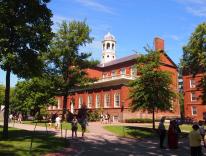
Marquette University High School, in Milwaukee, on Wisconsin Avenue at 35th Street, in the 1950s seems pretty remote now. If it strikes me as strange, it must be profoundly alien to you. And for good reason: nothing like my high-school education could possibly happen today. My life, full, lucky, and already reasonably long, has been lived mostly in New England. But everyone comes from somewhere. I come from Marquette High School, class of 1956. More than five decades, not at all uneventful, lie between here, now and there, then, but no other four years stay with me so insistently as my days among some nine hundred boys in that one not-very-big building on Wisconsin Avenue. Nine hundred boys, and the Jesuits. Anarchic and authoritarian, democratic and elitist, lax and rigorous, the culture of Marquette High looks now like a prodigious anachronism. We inhabited a world of Latin, Greek, football, frequent breaks for religious observances, cigarettes, a card game called sheepshead, corporal punishment, and no girls. No girls at school, that is. Despite the convivial camaraderie I clearly recall, it was often difficult and stressful. And, ever since, I’ve been unable really to understand why I was so happy there.
Learning had something to do with it. Many of the Jesuits, having consecrated their lives to teaching, brought to their educational duties as much enthusiasm as Fr. Boyle to his disciplinary functions. Classroom morale was very good. Much was accomplished.
I have had in my life two incomparable teachers, both Jesuits: William Connell and Alfred Desautels. Fr. Connell taught me Freshman English at Marquette High School and Fr. Desautels introductory French at the College of the Holy Cross. Both were short, compact men with notably precise manners of speaking. Neither ever entered the classroom unprepared. Indeed, to my young judgment, both seemed to be perpetually prepared by grace of nature. Each brought to everything he taught a persuasive sense of natural interest. Neither ever appeared bored by his job. Yet they were two quite different sorts of men. Connell’s classroom technique, for instance, included minimal histrionics; Desautels relied on them. No teacher can dispense altogether with the fundamental elements of stagecraft, and Fr. Connell was not handicapped in this department. His voice and presence were adequately animated; he made eye contact, had clear diction, etc. But his stock in trade was to engage our intellects with his. I was a fourteen-year-old kid when I walked into his classroom, and before the end of September he had enabled me to glimpse the richness and power of the English language. Since his students arrived already speaking English, his task differed completely from that of Desautels, who couldn’t engage our intellects without first bombarding our senses—at least our sight and our hearing. Each of these two men was equipped by temperament, even physical endowment, to teach as he taught, and each found his way to a classroom setting congruent with his gifts.
A fellow who long ago had his Medicare card laminated wouldn’t necessarily be expected to find that his most vivid recollections from his teenage years are of a classroom. But they are. And that encourages me to try to describe to you what happened there. First the classroom of William Connell, SJ.
There were about thirty of us in Freshman Section A, the one-seventh of the entering class reckoned by Marquette High to be least obtuse. Such stratifying of students on the basis of their presumed aptitudes is still done, I believe, in mathematics, but is judged politically incorrect in the humanities. Perhaps that’s why almost no one now can conjugate lie and lay, much less explain how a gerund differs from a participle. We were already in our seats—squirming, chattering, and throwing small objects around—when he entered. A little, bald, bespectacled, elderly, discernibly frail man in his generic Roman collar and black cassock, he walked to the front of the room and faced us. At once we were still. That’s how it was, there, then. (Subsequently I learned that Connell, on account of poor health, had been advised to retire; but he continued to teach on the proviso that he be required to take only sections A and B. His weak heart could probably no longer endure the blank stares of the irremediably uncomprehending.)
He told us his name, and wrote it on the blackboard. We were seated in alphabetical order, and he had a list. Unhurriedly, one by one, Andrulaitis through Warnemuende, he exchanged greetings with us and learned to pronounce our names. Stan Chojnacki was an ebullient, extroverted, notably good-looking lad with an excellent singing voice and considerable athletic ability. He would twice be elected class president. Fr. Connell examined the name carefully.
“Ha-NUFFS-ska?”
“Ha-NUFFS-ska probably would be correct, sir. We say Wai-NOTSZ-skee. But everyone calls me Stan, sir.”
Connell’s smile was warm and his voice gentle. “Everyone calls me Father. Please sit down, Wai-NOTSZ-skee.”
I believe that during several hundred years of endeavoring to prepare young men for leadership, the Jesuits probably learned some things about how to do it. Like that first day of unrushed, rather painstaking mutual introduction. Looking one another in the eye. Saying the name correctly. It established a sense that we were embarked upon something important—or at any rate something worth doing. Worth our doing. Worth his doing. Effort and expertise go a long way toward establishing such an atmosphere, but tradition, ceremony, and civility help considerably. So does the knowledge that you and he are in this together. This old man had been acquainting fourteen-year-old boys with the structure and music of the English sentence for over forty years, and had never been paid a nickel to do so. He had trained as a Jesuit, taken his vows, been ordained, and marched off to his classes. In exchange he didn’t have to worry about the necessities of life. We freshmen may not have given all this much thought, but we knew it. The guy was here to teach us English. He had nothing else to do!
Those opening-day introductions, though deliberate, didn’t consume the full hour. There was time to get some work done. Fr. Connell circulated blank sheets of lined notepaper, instructing us to print the date and our names at the top—but, at the very top, above name and date, “AMDG” (Ad Majorem Dei Gloriam). His was a consecrated life, and, if he had anything to say about it, so would be ours.
“Write these words. Take your time: restaurant, occurrence, parallel, divine....” It was a spelling test. Twenty-five words. We corrected one another’s work, which he then collected, advising us that we must bring to the next class a paper upon which we’d written twenty times each word we got wrong. It turned out that this exercise was repeated every week. In a lifetime of teaching he’d developed a list of about a thousand frequently misspelled words. He would teach us not to misspell any of them; but not as a sterile exercise of memory. He taught principles of spelling, exceptions to those principles, and, above all, etymology: the provenance of words, their component parts, their ancient meanings, and hence their connotations and the subtle shadings of difference between near synonyms. He engaged our young intellects with his, and as he did so, the resources of the English language opened before us.
Yes, our language is rich, intoxicatingly so. No one knew this better than Fr. Connell, who was equally aware that, like any intoxicant, it could make a young fellow drunk and disorderly. Order and clarity were the stars he would have us steer by. In every class, all year, he elaborated upon one splendid topic: the English sentence. Every Monday we gave him a composition of several hundred words. He corrected these most painstakingly, and woe betide us if he found a “sentence fault,” for example something punctuated as a sentence that was, in fact, more or less than one. Run-ons, half-sentences: he would have no truck with them. But his greatest scorn was reserved for the dangler—the orphan phrase or, perish the thought, clause. “Turning the corner an accident happened.” I can still hear his fierce interrogation, “Who turning the corner; what turning the corner?”
In a world where language just doesn’t matter, this all becomes so much nitpicking pedantry. But in the world of Connell’s classroom language counted very much. What happens in a great teacher’s classroom is important because he makes it important. He wanted us to be honest word carpenters: our syntactic floors dead level and our verbal walls true plumb. The unit of construction was the English sentence: simple, compound, complex, compound complex, but in any event correct and clear, the whole thing nailed together at the corners so as not to fall apart. In September we knew from nothing; in May we could do it.
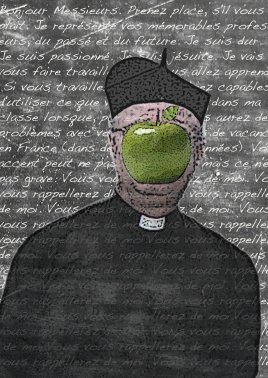
Four years later came my second experience of a born teacher. When I entered the College of the Holy Cross in September 1956, Fr. Alfred Desautels, SJ, had just been made chairman of the Modern Languages Department. In the world of the Jesuits that was no great shakes; presumably that word “modern” was the kiss of death. At Marquette High the abler students hadn’t been allowed near a foreign language that was actually spoken. It was nothing but Latin and Greek for us. So I arrived in Fr. Desautels’s classroom never having heard a word of French. It was exactly the level of preparation he anticipated; in that classroom, from day one, he never uttered a syllable of anything but French. I mentioned histrionics. From his eyebrows to his toenails Fr. Desautels enlisted every conceivable resource of gesture, mime, intonation, grimace; he made use of every prop, device, sound effect, every faint ripple of our audience response to accomplish one unwavering purpose: that the sounds of French should convey meaning to us; not through translation, directly. “Stylo” does not mean “pen” (an English word); it means the thing Fr. Alfred Desautels is, at this moment, waving about in his right hand, “Messieurs, prenez vos stylos. Prenez. Prenez et préparez à écrire. Et maintenant nous avons pris nos stylos...” Etc. Day after day; unwearying; undismayed by the lame struggles of the most backward student, he kept up the performance. Never a word of English. French with gesticulation, French with charade, French with hilarious acrobatics, but French, damn it, French! Fifty-four years later I remember vividly the energy and fervor he brought to that classroom. As Fr. Connell had been cerebral, soft-spoken, and didactic, Fr. Desautels was animated, volatile, and demonstrative. Connell had opened to us the structural and lexical depths of our familiar language. Desautels was striving to give immediate sensual meaning to sounds entirely strange to us. Their different styles perfectly suited their different tasks.
Desautels was also my dormitory prefect that first year at Holy Cross. Perhaps because of his slight French accent and natural formality of manner, he had the knack of fraternizing quite pleasantly with us without compromising his standing as professor and priest. One memorable evening the conversation turned to the ominous topic of mortal sin. Desautels suggested that, in his opinion, mortal sin was almost impossible to commit, involving as it did a deliberate intent to violate the law of God. “For goodness sake, who is thinking about violating God’s law—or anything like that—when he is, for instance, with a beautiful woman? It’s ridiculous!” This, I realized, was an authentic French professor.
In my tiny pantheon of great teachers, Desautels occupies a place alongside Connell, but I would not have you think my memories of Holy Cross are comparable to those of Marquette High. When the disciples of Ignatius Loyola evolved through the generations their design to educate young men for leadership, they would, I think, have done well to concentrate on boys from age twelve to eighteen. Establishing universities, they bit off more than they could chew, and mediocrity drove out excellence.
To have assembled nine hundred teenage boys in close quarters, kept discipline, and maintained high academic standards were commendable, but not unexampled, achievements. Other prep schools did as much. Noteworthy about Marquette High was the price at which these services were delivered. Tuition was less than $300 per year. That’s because the Jesuits handled most of the teaching themselves and drew no wages. As a result Marquette High, although private, was accessible to boys from poor families. Admission was based on academic ability and achievement. There were a few salaried lay teachers, but Jesuits taught me English, Latin, Greek, history, algebra, geometry, and physics. By and large they did so quite well. Many of us felt lucky to be there and took our work pretty seriously.
After Marquette High, Holy Cross College was a big disappointment. Worcester was a dreary little city. The absence of young women, tolerable at a nonboarding high school, was grim indeed at a residential college. And in the classroom many Jesuits performed abysmally. It’s curious that the Jesuits, who had seemed such satisfactory, even inspirational, teachers in high school, should so generally have disappointed us a few years farther along in the educational process. Perhaps during those years we had become a little more discerning and demanding. Living cheek-by-jowl with Jesuits on campus probably tended to reveal personal foibles, like churlishness and alcoholism. University teachers often have to be genuine experts, that is, to know a lot about a little. Exiguous learning is apt to be conspicuous.
Moreover, I think that the functions of the two institutions—high school and university—are not really comparable. High-school kids must be trained, equipped with basic information, and coached in the development of certain intellectual skills. Without such preparation they’ll get little out of the university, where questions lead not to answers but only to more questions. In the hurly-burly of university life kids embark on the transition to adulthood. This is a journey on which many Jesuit priests were imperfectly equipped to guide them.
On completion of their training Jesuits take vows: poverty, chastity, and obedience. And what are the challenges of adolescence? With what must we come to terms as we struggle to adapt to a place in the adult world? Wealth, sex, and power. Are these not the three great forces, the perplexing and dominant mysteries with which the untroubled child must at last unhappily contend? These men had vowed to avoid these issues. Poverty, chastity, obedience. However admirable in the purity of their moral rigor, might not these principles forfend some of the most difficult challenges of full adulthood? About the schoolmaster there is an ancient saying, Inter pueros senex; inter senes puer. A man among boys; a boy among men.
As for men and boys, more particularly priests and boys, the past decade has cast a lurid glare on that previously obscure topic. The Catholic Church in America is said to have spent a billion dollars on pederasty, or pedophilia, or ephebophilia. Whatever it’s called, it’s certainly not what the faithful thought they were paying for when they tossed their envelopes into the basket. I grew up in the Catholic Church. I was an altar boy. I went to Catholic grammar school, high school, and college. I married a Catholic girl in St. John’s Cathedral in Milwaukee. As a young psychiatrist in Boston in the 1970s, I saw quite a few priests as patients. And until I read about it in the Boston Globe a couple of years ago I had never heard of this. Priests molesting kids! How could so huge and horrible a secret have been kept so well for so long? I have friends from St. Robert School in the 1940s and from Marquette High and Holy Cross in the ’50s. They were all as astounded as I was. None of us has any recollection of any weird overture from a priest. None of us, growing up Catholic, ever heard of such a thing.
But I’m remembering the 1950s. The sexual revolution hadn’t happened. During the second half of the nineteen sixties the divorce rate in the United States and Western Europe abruptly doubled. Perhaps the sexual disinhibition of that era affected the clergy as it did the laity. Whenever it began, abuse of kids by priests was alarmingly widespread and was met with dismal administrative laxity.
Any executive who discovers a scandalous problem within his organization will inevitably find that he has two objectives: to solve the problem and to conceal it. Unfortunately the pursuit of either one of these objectives jeopardizes the other. Any decisive action calls attention to the mess it addresses; on the other hand, the demands of secrecy encumber all remedial efforts. The Catholic Church in America, faced with a pervasive problem of child molestation by its priests, prioritized concealment over resolution to a startling degree.
Anyone who is abruptly made aware of so great a breach of trust, who learns that an ancient institution claiming supreme moral and spiritual authority has been at the same time cynically concealing its own pervasive evil—anyone so deceived and betrayed must feel he has been made a fool of. This conduces to rage. Like the whimsical sadism of Jerry Boyle, SJ, the criminal perversion of thousands of child-abusing priests stirs in an ordinary fellow a powerful reaction of fury and revulsion. Yet my memories of Marquette High are numerous and vivid. I look back now on those years fondly, wistfully. Fury and revulsion are not the dominant emotions. Fr. Connell taught us English; Fr. Ostertag, physics; Fr. Kelly, algebra; Fr. Windle, Latin; Fr. Sanderson, history. They harmed no one. Their lives were consecrated—to our education.
To reconcile so mixed a picture may be a fool’s errand. That the church and some of its priests can have been so good and some so bad boggles the mind. But I recall your attention to the issue of incomplete adulthood. Celibacy may facilitate the consecrated life, but not full and ordinary life. Obedience may make one a good soldier, but not necessarily a good decision maker. The unworldliness of a pious man, like that of an intellectual, ill equips him for administrative emergencies. The absent-minded impracticality of professors is legendary. Everyone forgives them their somewhat childlike single-mindedness and understands that ivory towers are necessary for the protection of their endangered species. Perhaps both the spiritual and the academic life conduce to one’s retaining some traits of the innocent child. Poverty, chastity, obedience. Perhaps these abnegations are accomplished at some cost, dulling the shrewd discernment and restraining the decisive reaction that crisis management requires.
St. Paul, in his letter to Timothy, offered this advice: “A bishop, therefore, must be above reproach, husband of one wife.... He must be one who manages his own household well and controls his children.... For if a man does not know how to manage his own family, how can he take care of a congregation?” There’s a commonsense plausibility to Paul’s argument, and he seems to be making a case against a celibate clergy. A man can stop being a child without becoming a husband and father, but it isn’t easy.
I don’t mean to argue that the incomplete psychosexual development of some celibate clergy is enough to explain this sad failure of governance. Secretiveness, dread of scandal, the historically weak role of the laity, the oligarchic concentration of power, and the political clout of “the church” in America were all factors in the catastrophe. Not dozens, or scores, but thousands of priests molested kids. Could it be that the requirement of celibacy resulted in a disproportionate number of sexually immature men among Catholic clergy? And just what did Jerry Boyle, SJ, think he was doing with that golf club? Would a normal adult do something like that?
Would a sexually enlightened hierarchy seriously attempt to prevent married couples from using artificial birth control? I remember listening at Holy Cross to a priest’s explanation that contraception was sinful because it was unnatural. I knew this fellow to be a heavy cigarette smoker. Even then it occurred to me that his belief must be based on something other than logic, and was unlikely to be espoused by a noncelibate ethicist. Surely one could argue that personal celibacy is something of a handicap when it comes to providing guidance to sexually mature adults.
Before you conclude it’s time to pass me the raspberry juice, let me protest that I’m not trying to set my dogs on anybody. It’s just that I’m left staring in perplexed discomfort at a painful paradox in my own personal history. The same church that committed this institutional crime against children illuminated my boyhood with an education my mother and I could never have afforded. So here I am, squinting at a tragic protagonist, the Catholic Church; and I’m wondering whether, as in classic tragedy, heroic virtue and fatal flaw may both derive—at least in part—from one source: the Catholic clergy’s incomplete personal entanglement in the perplexing challenges of full adulthood.
It was from women, several of them, that I first heard the observation that priests are like children. My informants didn’t actually explain this idea in a way I could fully grasp. It reminds me of the parallel observation, heard from more than a few women, that men are like children. But priests, perhaps, even more so.
Maybe that’s it. Maybe they were boys themselves, boys who loved school, and teaching school, and being with boys at school. They consecrated their lives to it; and they created Marquette High School, where I was so happy, although I still don’t quite understand why. Not really.
Art by Sarah Baumann
Related: Letters to the editor responding to this article, along with Gault's reply
Please email comments to [email protected] and join the conversation on our Facebook page.
Previous Story
Prophetic Stringency
Next Story
Kashima & the Catfish