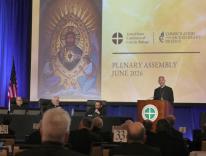
With regret and some trepidation, Commonweal and many other prolife Catholic commentators and organizations, including the Catholic Health Association, disagreed with the U.S. Conference of Catholic Bishops about the health-care-reform bill that Congress passed in March (see “Crying Wolf,” March 26).
Feelings on all sides remain raw, and in May the three chairmen of the USCCB’s committees on Pro-Life Activities, Immigration, and Domestic Justice, Peace, and Human Development issued a statement, “Setting the Record Straight,” charging those who disputed the USCCB’s reading of the health-care bill with causing “confusion and a wound to Catholic unity.” It is not clear whether this statement represents the settled opinion of the conference as a whole; but insofar as it does, it has the potential to cause a good deal of confusion itself.
The statement is remarkably defensive in tone, complaining that the USCCB’s position “has been misrepresented, misunderstood, and misused for political and other purposes.” Those are serious accusations, yet no groups or individuals, aside from the Catholic Health Association, are named. Worse, much of the letter questions the motives of those who disagreed with the bishops about the legislation’s restriction on funding for abortion. The letter implicitly dismisses the arguments of prolife advocates, such as Senator Robert Casey Jr. (D-Pa.), and Representative Bart Stupak (D-Mich.), who concluded that the bill did not in any way extend public funding of elective abortions.
The health-care law is an exceedingly complicated piece of legislation, one that some experts on insurance law who share the bishops’ opposition to abortion nevertheless think will advance the prolife cause (see Timothy Stoltzfus Jost’s “Episcopal Oversight,” May 25). In “Setting the Record Straight,” however, the three bishops assert that “whether from within or without the Catholic community, very often these critics lacked an understanding of these particular issues or of the moral framework that motivated our positions. Others did grasp the seriousness of the issue we were attempting to address. Yet other priorities, in our judgment, led them to accept an inaccurate reading of the proposed legislation.”
What makes the USCCB and its legal and legislative staffs so confident that they alone are competent to understand the new law? Is there a possibility that the USCCB might be wrong? Evidently not. “Making such moral judgments, and providing guidance to Catholics on whether an action by government is moral or immoral, is first of all the task of bishops, not of any other group or individual,” the committee chairmen write. If you disagree with the bishops on highly technical legislative and legal questions, the statement suggests, you are guilty of causing confusion and wounding Catholic unity.
It has long been the position of the USCCB that, while bishops must provide moral guidance, lay Catholics are fully competent to make decisions in the public sphere, whether in the workplace or in politics. Is it now the USCCB’s view that the laity has lost that competence? If that is the case, real confusion will surely ensue. And if only the hierarchy is permitted to assess the merits of something like health-care policy, how are American Catholics to make sense of the approval expressed for the new health-care law in La Civiltà Cattolica, the Rome-based Jesuit magazine whose contents are approved by the Vatican secretary of state?
In the USCCB’s 2007 statement Forming Consciences for Faithful Citizenship, the conference insisted that “we bishops do not intend to tell Catholics for whom or against whom to vote,” and that “the responsibility to make choices in political life rests with each individual in light of a properly formed conscience.” In other words, the competence and authority of bishops is no greater than that of well-informed lay people when it comes to evaluating a specific candidate or piece of legislation. “Setting the Record Straight” appears to contradict this principle.
Catholics seeking full and equal participation in American democracy have long battled the canard that they cannot think for themselves, and instead take political orders from their prelates and from the Vatican. Historically, however, American Catholics have shown a great degree of political independence from the hierarchy—and from political parties themselves—and there is little reason to think that will change. If the authors of “Setting the Record Straight” wish to seize a “new opportunity for the Catholic community to come together in defense of human life,” they can start by not questioning the motives of those Catholics who disagree with them about how best to interpret the provisions of the new health-insurance law. On questions such as this, disagreement should not be understood as a threat to unity, but as a sign of the church’s intellectual vitality.
Related: A Pattern of Missteps, by the Editors
From the blog: Who Has the Right to Be Right?