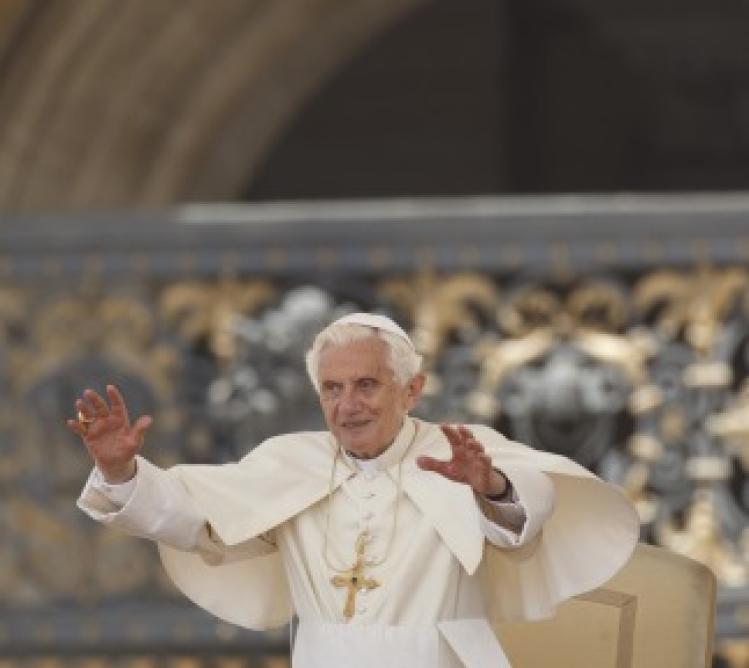
"The church is not the pope, and the pope is not the church,” theologian Joseph Komonchak reminds us (see “Benedict’s Act of Humility”). Amen to that. Komonchak also cautions about the “hullabaloo over the upcoming conclave,” urging Catholics of every theological and ideological disposition to place Benedict XVI’s surprise resignation in the broader and deeper context of the responsibilities every Catholic has for building up the church and spreading the gospel. Expectations for the papacy need to change.
Amen to that as well.
Even Benedict’s most ardent supporters concede that his papacy has been marred by too many scandals and too many gaffes. The few glimpses the public has gotten into the opaque operations of the Holy See—from the Vatican bank controversy to the inept machinations of the pope’s own butler—reveal an institution in crisis. These intrigues are especially disconcerting as the church still struggles to come to terms with the legacy of the sexual-abuse crisis. Unfortunately, the courtly secrecy surrounding the deliberations to elect the next pope provides an all-too-obvious reminder of the lack of transparency and accountability in the operations of the entire hierarchy.
Advertisement
In the modern era, but especially over the past half-century, there has been an unprecedented concentration of authority in the papacy and the Roman curia. Under the tireless and charismatic John Paul II, this focus on the pope seemed providential to many. Yet John Paul’s commanding personality left little room for younger episcopal talent to flourish or alternative institutional structures of leadership and authority to develop. Only the most obdurate ultramontanists think the governance of a global church of more than 1 billion should rest principally on the shoulders of one man. In resigning for reasons of ill health and physical frailty, Benedict himself strongly suggested that the demands of the papacy have become a crippling burden, especially for a man of his age. Many think that the papacy is now a crippling burden for a man of any age—and that this is one of the many signs that ecclesial authority has become too centralized.
Benedict will surely be remembered for his personal humility and profound piety. He will also be remembered as a theologian and teacher of rare gifts. His three encyclicals are remarkably rich documents—especially Caritas in veritate, which remains one of the most thoughtful responses to the recent financial crisis, a reminder of the inescapable moral dimensions of a globalized economy.
What this shy scholar evidently could not do was manage or reform a sclerotic church bureaucracy riven by factions and left to function on its own for far too long. Real reform can return the governance of the church to the bishops in true partnership with the pope, and reduce the curia to the status of a modest administrative apparatus. Perhaps, as some have speculated, this is what Benedict hoped to set in motion in taking the exceptional step of resigning. Let’s hope so.
Many Catholics first heard of Joseph Ratzinger in 1985 when, a few years into his tenure as head of the Congregation for the Doctrine of the Faith, a series of his conversations with the journalist Vittorio Messori was published as The Ratzinger Report. Readers were stunned by Ratzinger’s dour appraisal of the implementation of Vatican II’s reforms and his stinging criticism of liberal democratic societies. In the Report, the future pope comes across as deeply pessimistic about the trajectory of the church and even about the competence of local bishops. Western culture as a whole, he insisted, had also lost its moorings. Only Rome could be trusted on questions of faith and morals.
Writing in Commonweal in November, 1985, Lutheran theologian George Lindbeck, an official observer at Vatican II, suggested that Ratzinger’s emphasis on Roman authority was “more a product of despair than of authoritarianism.” Lindbeck, although sympathetic to Ratzinger’s theological and cultural agenda, lamented his “uncritical and one-sided emphasis on the official magisterium.” He feared that Ratzinger despaired “of the struggle pursued at Vatican II” to find a way to make the church’s teachings accessible and compelling to the scientifically sophisticated and increasingly secular world.
It is possible to see Benedict’s resignation as another gesture of discouragement. Certainly in his final remarks to the priests of Rome only days after announcing his resignation, Benedict struck a note of anguish over what he characterized as the “calamities” and “miseries” that followed the council. He blamed the media and secular politics for that disarray. But much of the responsibility lies with the Vatican, for guarding its own power and privileges too jealously. If we are not to despair of the worthy project pursued by the bishops at Vatican II, the whole church, and not just Peter’s successor, must now be allowed to take responsibility for it.


"But much of the responsibility lies with the Vatican, for guarding its own power and privileges too jealously."
Sounds like rethorical a sleigh of hand. The massive disarray of cathechesis and evangelization produced by theological liberalism after the council had nothing to do with organizational disarray in the Roman curia.
And one could easily argue that without a strong Papacy the effect of 1960-style neo-modernism would have been even worse.
Carlo L ... Tell us ... what in the hell does 'worse ' look like?
To state the obvious: The Catholic Church’s cardinal princes have “no clothes.”
Despite how intriguing their colorful medieval costuming may be to us, Catholic hierarchs are hopelessly irrelevant to and dangerously alienated from, even hostile to, the lived experience of growing millions of Catholic, indeed Christian, women and men around the world.
The upcoming papal conclave does indeed place the hierarchs at the fork of a fateful historic crossroads: Do they continue to lead the church down this same treacherous road over the almost certain extinction cliff?
Or, with no preordained fore-promise of their survival or endurance, do the cardinals embrace the slow evolution toward a Peoples Church?
On “the road not taken,” the Holy Spirit has left a clear road “sign of the times” for any pilgrim to see where to find the required anecdote: LET THE PEOPLE DECIDE!
eg gleason:
oh you know: the brilliant "Hans Kung" plan of turning the RCC in another dying liberal Protestant denomination.
Carlos L.. one blessed hope of the post-BXVI is that nobody will give the SSPX the new phone #
O.K. my comments on Brother Komonchak's article didn't make it into your current editorial comments. But I'll repeat them here. It is a fact that the organized, well-funded conservative sector of our church, led by Brother Ratzinger and before him by Brother Wojtala, is exactly where they want it--scandals and all. In fact their premise is that the likes of us liberals and modernists are the cause of all the scandals.
And so this "retirement" of Brother Ratzinger is not an act of humility as much as a wise step to do all he can do to consolidate his years of extreme conservatism. By not continuing on to death and/or senilty and putting off a papal election, he and the legion of conservative followers--not just a few curial workers--will bask in the admiration of this "scholarly", "humble" " servant and support a worthy replacement. An African cardinal dedicated to the conservative's unique "evil" target--LGBT-- would very admirably fulfill a lot of their goals.
We in the liberal/radical wing--proven all too often to be powerless-- can opine and do these critiques that will only be noticed by ourselves. Without beginning now to effect a real dynamic, loving, unified, moral force within the church, there will be no change. Waiting for things to change--short of populating seminaries with our liberal children--just is not a respectable approach.
All the radical change groups have been easily shut out and even though we call ourselves "catholic", we simply aren't. We have to gather our fellow-sister pew mates and do an impressive "sit-in" or "stand-in" and get attention for a real pastoral aim. I've suggested we use the moral persuasion of "loving dissent" with the voice/body of all those who say they are for change but who are silenced to almost everyone. Why be afraid of being threatened with excommunication? I suggest what I call "The Least Harm--Loving Dissent" where we call our opposition to sit down and agree to lay aside the medieval approach of the past and agree to begin by doing the least harm while we sift out the real issues before us to arrive at change without the litter of the likes of the ashes of Giordano Brunos ashes and Galileo's house arrest. I would call for "Galileo Reconcilation Commission" to carry this out. Brother Wojtala's "pardon" hundreds of years later is just not the Christian way.
Thanks. Tom Luce http://leastharm.weebly.com tomfluce@gmail.com
@ Thomas Luce:
I think you're on to something: The Catholic Church hierarchy has never really accepted the Copernican revolution which dislodged them as the sole gatekeepers to the Divine. The hierarchs have been fighting a rear-guard action against all things modern ever since.
The hierarchs have been living on borrowed time since the time of Galileo and the rise of the scientific era. Sadly, the hierarchs about to receive a very nasty lesson from the laws of evolution: The hierarchs are very shortly going to become vestigle organs on the Body of Christ - the process has been going on for decades with the evidence all around us.
Either we celebrate their time with us with a proper Catholic funeral and burial - something that Catholics should be really good at given our central defining mythologies about death and resurrection - so that new life can emerge, and the Gospel can continue to be spread.
Or, the hierarchs' remains will pile up like petrified dionsaurs in a boneyard at the bottom of history's extinction cliff.
This editorial is rubbish. Read Benedict's books. Then you will know what it means to be Catholic.
Subject: On Religion Sent to PBS Wide Angle
"Professsor Gillis and Reverend McBrien,
I sincerely hope that I did not misunderstand the points you were making but I came away with the following impressions.
Both of you were interviewed on TV programs this past week-end and introduced as theologians from 'Catholic' Universities, Georgetown and Notre Dame, respectively. The subject was John Paul II who passed away on Saturday. While the world wept, President Bush, world leaders, both political and religious, journalists and common folk remembered him, praised him and spoke of his influence on the world. But not our 'Catholic' theologians from 'Catholic' Universities who spoke of his divisiveness, his being out of step with American Catholics on abortion, birth control, gay issues, celibacy and women in the priesthood. Apparently American Catholics, not the Pope, have the The Truth on all matters of morality which Professor Gillis confirmed by pointing out that Georgetown students ignore the Pope and selected polls show that a majority of American Catholics elect a Chinese menu approach to their catholic faith based on their own subjective conscience which provides self-justification for a hedonistic, immoral life style absent any religious underpinnings. An ex-President, while not a Catholic but a graduate of Georgetown, was well schooled in moral relativism and represents a classic example of a Professor Gillis's student, there is no right or wrong, no intrinsic good or evil, there is only one's subjective conscience to look to for approval. The subjective conscience combined with moral relativism enables one to lie, to cheat, to commit perjury and any other nefarious act, all the while proclaiming one's innocence and, if 'catholic', firmly believe that he/she is a catholic in good standing while holding that the Pope and the Vatican are just not with it, too conservative, not Protestant enough.
To argue that one is free to follow his own conscience on matters of religion and morals, even to supporting abortion, birth control, gay marriage, celibacy and other issues presumes that one's own subjective conscience is infallible and superior to all others which leads to the absurd conclusion that there is no truth in moral and religious matters as there would be an infinite number of right answers.
Since Vatican II the liberal wing of the Catholic Church has promulgated the superiority of the subjective conscience and in February 1991 Cardinal Ratzinger delivered the Church's response in his presentation 'Conscience and Truth" delivered at the '10th Workshop for Bishops; in Dallas Texas.
Cardinal Ratzinger touched on the correct understanding of conscience," "Conscience is understood by many to be sort of deification of subjectivity, a rock on which even the magisterium can founder. It claimed that in the light of conscience no other reason applies. Finally, conscience appears as the supreme level of subjectivity; but conscience is an organ, not an oracle; it requires growth, exercise and development."
For those who hold that one's own subjective conscience is infallible, superior to all others and that the Church Authority cannot impose restrictions on those whose conscience brings them to decisions contrary to the Church's teachings, Cardinal Ratzinger points out the obvious error in this rationalization by the following "It is of course undisputed that one must follow a certain conscience or at least not act against it. But whether the judgment of conscience or what one takes to be such, is always right, indeed whether it is infallible, is another question. For if this were the case, it would mean that there is no truth - at least not in moral and religious matters, which is to say, in the areas which constitute the very pillars of our existence. For judgments of conscience can contradict each other. Thus there could be at best the subject's own truth, which would be reduced to the subject's sincerity."
Cardinal Ratzinger describes the concept of the erroneous conscience as follows:
"The erroneous conscience, by sheltering the person from the exacting demands of truth, saves him ... - thus went the argument. Conscience appeared here not as a window through which one can see outward to that common truth which founds and sustains us all, and so makes possible through the common recognition of truth, the community of needs and responsibilities. Conscience here does not mean man's openness to the ground of his being, the power of perception for what is highest and most essential. Rather, it appears as subjectivity's protective shell into which man can escape and there hide from reality. Liberalism's idea of conscience was in fact presupposed here. Conscience does not open the way to the redemptive road to truth which either does not exist or, if it does, is too demanding. It is the faculty which dispenses from truth. It thereby becomes the justification for subjectivity, which should not like to have itself called into question. Similarly, it becomes the justification for social conformity. As mediating value between the different subjectivities, social conformity is intended to make living together possible. The obligation to seek the truth ceases, as do any doubts about the general inclination of society and what it has become accustomed to. Being convinced of oneself, as well as conforming to others, are sufficient. Man is reduced to his superficial conviction and the less depth he has, the better for him."
The erroneous conscience also would allow the false and utterly despicable conclusion, "Nazi SS would be justified and we should seek them in heaven since they carried out all their atrocities with fanatic conviction and complete certainty of conscience. There is no doubting the fact that Hitler and his accomplices who were deeply convinced of their cause, could not have acted otherwise. Therefore, the objective terribleness of their deeds notwithstanding, they acted morally, subjectively speaking. Since they followed their albeit mistaken consciences, one would have to recognize their conduct as moral and, as a result, should not doubt their eternal salvation." Cardinal Ratzinger concludes this section by writing "Since that conversation, I knew with complete certainty that something was wrong with the theory of justifying power of the subjective conscience, that, in other words, a concept of conscience which leads to such conclusions must be false. For, subjective conviction and the lack of doubts and scruples which follow therefrom do not justify man.
Furthermore, "No one may act against his convictions, as Saint Paul had already said (Rom 14:23). But the fact that the conviction a person has come to certainly binds in the moment of acting, does not signify a canonization of subjectivity. It is never wrong to follow the convictions one has arrived at - in fact, one must do so. But it can very well be wrong to have come to such askew convictions in the first place, by having stifled the protest of the anamnesis(an inner repugnance to evil and an attraction to the good) of being."
It seems that the American Catholic Church has lost is way, lost its humility and rejected guidance of the Holy Spirit by denying the Pope as Good Shepherd and Christ's representative on earth. Is this the fault of the Catholic laity or the leaders and teachers who are striving to remake the American Catholic Church in the Episcopalian model by questioning the Pope's authority?
It is time that all Catholics, especially students at Catholic Universities, read the collected works of Dom Columba Marmion to understand the relationship between God, His Church, the individual and humanity. "Christ the Life of the Soul" is an excellent starting point. "
@Luce & Jenkins et al
It is high time that the Catholic Church became both democratic and scientific. It is an organization that plays an immense role in public physical and mental health and it if full of contradictions becasue it is inconsistent with reality. There is no evidence (except documents written within the Church) that God is a myterious other, owned totally by the Church.
There is no reason to think that God and the Universe are in any way distinct. If this is the case, theology can become an empirical science like all the others. All human experience becomes expereince of God. The scientific method has a general tendency to lead us to the truth, as can be seen in all the disciplines that have grown up since Galileo's day. One by one questions are raised and settled on the evidence.
The Church can become truly catholic (small c, Greek meaning) and the ecumenical project proceed globally ) if all the theolgians of all persuasions started to look at the reality around them instead of cooking up ever more convoluted exegeses of ancient and (to the modern ear) irrelevant texts.
Given this approach to theology, there is no need for central dogmatic authorities. Our authority is the divine world that we all share. Of course a lot of vested interests will have to be shot down before this agenda has a snowball's chance in Hell.